- Introduction
- Why Drilling and Blasting Efficiency Matters in Metal Mining
- Common Problems Affecting Drilling and Blasting Performance in Metal Mines
- Inefficient Cut Hole Design Reduces Blast Advance
- Poor Drilling Accuracy and Borehole Deviation Problems
- Insufficient Operator Skills and Lack of Standardized Operations
- Improper Explosive Charging and Incomplete Charging Problems
- Difficult Geological Conditions Affecting Blasting Performance
- Poor Coordination Between Drilling and Blasting Processes
- Effective Ways to Improve Drilling and Blasting Efficiency in Metal Mines
- Optimize Cut Blasting Methods to Increase Blast Advance
- Improve Drilling Accuracy and Optimize Drilling Parameters
- Select Suitable Rock Drilling Tools
- Strengthen Operator Training and Technical Management
- Ensure Complete Explosive Charging and Solve Borehole Blockage Problems
- Adopt Digital Technologies for Drilling and Blasting Optimization
- Establish an Integrated Drilling and Blasting Management System
- How Advanced Rock Drilling Tools Improve Mining Efficiency
- Conclusion
Introduction #
In metal mining operations, drilling and blasting are fundamental processes that directly influence mining productivity, operational costs, and overall project efficiency. Whether in open-pit mines or underground metal mines, the quality of blast hole drilling and blasting performance determines rock fragmentation, loading efficiency, equipment utilization, and downstream processing costs.
However, achieving consistent and efficient drilling and blasting results remains a major challenge for many mining companies. Complex geological conditions, hard and abrasive rock formations, borehole deviation, low drilling penetration rates, premature drill tool wear, and inefficient blast designs can significantly reduce productivity and increase operating expenses. Poor drilling accuracy or improper blasting parameters may also lead to oversized fragments, the need for secondary breaking, excessive explosive consumption, and longer mining cycles.
To overcome these challenges, mining operators need to adopt a systematic approach that combines optimized drilling parameters, suitable drilling equipment selection, advanced drilling tools, accurate blast design, and effective equipment maintenance strategies. High-performance rock-drilling tools can improve hole quality, increase drilling efficiency, and maximize energy utilization in blasting operations.
This article explores the key problems affecting drilling and blasting efficiency in metal mines and discusses practical solutions to improve drilling performance, blasting results, and mining productivity. By understanding the relationship between geological conditions, drilling technology, and blasting optimization, mining companies can achieve safer, more cost-effective, and more sustainable operations.
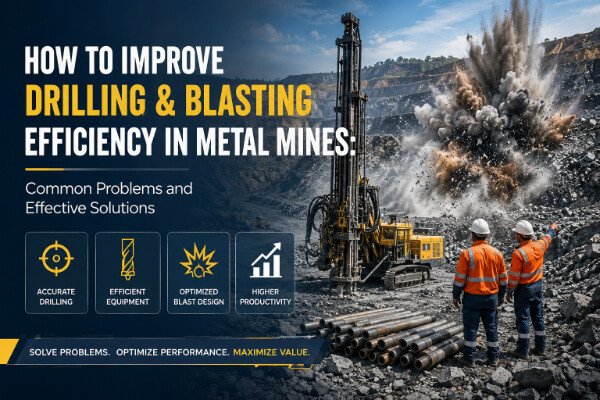
Why Drilling and Blasting Efficiency Matters in Metal Mining #
Drilling and blasting are the first and one of the most critical stages in metal mining operations. The efficiency of these processes directly affects rock fragmentation quality, mining productivity, operating costs, and the performance of subsequent activities such as loading, hauling, crushing, and mineral processing. A well-optimized drilling and blasting operation can create better fragmentation, reduce energy consumption, and improve the overall economic performance of a mine.
In modern metal mining, operators are facing increasing pressure to improve production efficiency while controlling costs and maintaining safe operations. As ore bodies become deeper and geological conditions become more complex, traditional drilling and blasting methods may no longer meet the requirements of high-efficiency mining. Optimizing drilling accuracy, equipment performance, and blast design has become essential for achieving stable and predictable mining results.
Improve Rock Fragmentation Quality #
The primary objective of blasting is to break rock into fragments with suitable sizes for efficient excavation and processing. Poor drilling accuracy or improper blasting parameters can result in uneven fragmentation, including excessively large blocks (oversized) or excessively fine materials.
Efficient drilling and blasting help achieve:
- More uniform rock fragmentation
- Reduced secondary breaking requirements
- Improved loading and transportation efficiency
- Lower energy consumption during crushing and grinding
For metal mines, especially those extracting hard rock materials such as iron ore, copper ore, and gold ore, optimized blast hole quality is essential to maintain continuous production.

Increase Mining Productivity #
Drilling and blasting efficiency directly influences the mining cycle. Faster drilling speed, accurate hole positioning, and effective blasting results allow mining operations to complete more excavation cycles within the same period.
Key factors affecting productivity include:
- Drilling penetration rate
- Borehole depth accuracy
- Hole deviation control
- Rock drilling tool reliability
- Blast performance consistency
For example, excessive downtime caused by drill bit failure, rod damage, or unstable drilling performance can significantly reduce daily production capacity. Selecting suitable rock drilling tools, such as high-performance DTH hammers, drill bits, and top hammer drilling tools, can improve operational efficiency and reduce production interruptions.
Reduce Operating Costs #
Drilling and blasting account for a significant portion of mining operation costs. Inefficient drilling practices can increase expenses through higher fuel consumption, excessive explosive usage, frequent tool replacement, and additional labor requirements.
Improved drilling and blasting efficiency can help mining companies reduce costs by:
- Extending drill bit and drill rod service life
- Reducing drilling time per meter
- Minimizing explosive waste
- Lowering equipment maintenance requirements
- Reducing downtime
A properly matched drilling system ensures that impact energy is effectively transferred from the drilling equipment to the rock, improving penetration efficiency and reducing unnecessary energy losses.
Enhance Equipment Utilization #
Mining equipment represents a major investment, and maximizing equipment utilization is essential for profitability. Inefficient drilling and blasting operations can create bottlenecks that affect the performance of excavators, haul trucks, crushers, and processing facilities.
Optimized drilling and blasting contribute to:
- Higher drilling equipment availability
- More predictable production schedules
- Reduced idle time for downstream equipment
- Improved mine planning accuracy
By selecting drilling equipment and tools according to rock conditions, hole diameter requirements, and project objectives, mining companies can achieve better compatibility between drilling operations and overall mining systems.
Improve Safety and Environmental Performance #
Efficient drilling and blasting are also important for improving mine safety and reducing environmental impacts. Poor blast design or inaccurate drilling may cause problems such as flyrock, excessive vibration, unstable slopes, and unnecessary damage to surrounding rock structures.
Advanced drilling and blasting practices help:
- Improve blast control
- Reduce vibration and noise
- Minimize overbreak and rock damage
- Create safer working conditions
In complex geological environments, accurate borehole placement and controlled blasting are especially important for maintaining slope stability and protecting mining infrastructure.
Support Sustainable and Intelligent Mining Development #
With the development of smart mining technologies, drilling and blasting operations are becoming increasingly data-driven. Modern mines are adopting digital drilling systems, automated equipment monitoring, and real-time performance analysis to optimize production processes.
Future-oriented drilling and blasting management focuses on:
- Data-based drilling parameter optimization
- Automated drilling control
- Real-time equipment condition monitoring
- Intelligent blast design
These technologies enable mining companies to improve efficiency, reduce resource consumption, and achieve more sustainable operations.
Drilling and blasting efficiency is a key factor determining the productivity, cost control, safety, and sustainability of metal mining operations. By improving drilling accuracy, selecting appropriate drilling tools, optimizing blasting parameters, and adopting advanced technologies, mining companies can achieve better fragmentation results, higher production efficiency, and lower operating costs.
For mines working in challenging rock conditions, the combination of reliable drilling equipment and optimized operational practices is essential to maximize the value of every blast cycle and maintain long-term competitiveness.
Common Problems Affecting Drilling and Blasting Performance in Metal Mines #
In metal mining operations, drilling and blasting performance directly determines excavation efficiency, production capacity, and operating costs. Among various evaluation indicators, blast advance is one of the most important measurements used to assess the quality and efficiency of underground excavation and development operations. It refers to the excavation length achieved through a complete production cycle involving drilling, blasting, mucking, and material removal.
Generally, higher blast advance indicates better drilling and blasting efficiency. However, achieving consistent blast advance is challenging because it is affected by multiple factors, including blasting design, drilling accuracy, rock conditions, charging quality, equipment performance, and operator skills.
The following are the most common problems that reduce drilling and blasting performance in metal mines.
Inefficient Cut Hole Design Reduces Blast Advance #
The cut hole (also called cut blasting or tunneling cut) is one of the most critical factors affecting blast advance, especially in underground metal mining where drifting and shallow-hole blasting methods are widely used.
In a typical underground blasting pattern, blast holes are generally divided into:
- Cut holes
- Auxiliary holes
- Perimeter holes
Each type has a specific function:
- Cut holes: Create the initial free surface and provide expansion space for subsequent blasting.
- Auxiliary holes: Enlarge the opening created by the cut holes and improve rock breaking efficiency.
- Perimeter holes: Control excavation shape, profile, and overbreak.
Among them, cut holes play a decisive role because they must overcome the confinement of surrounding rock and create sufficient cavity space for the following blasting stages.
When the cut hole layout is inappropriate, several problems may occur:
- Insufficient cut cavity volume
- Incomplete rock breaking
- Poor stress release during blasting
- Reduced blast advance per round
- Increased need for secondary blasting
The efficiency of cut blasting is mainly evaluated by:
- Cut cavity area
- Cut depth
- Breakage effectiveness
Low cut blasting efficiency is often caused by improper hole arrangement, inaccurate drilling parameters, or failure to consider actual geological conditions.
Improvement Approach: #
To improve cut blasting performance, mining operations should:
- Analyze rock properties, including rock hardness and rock mass classification
- Determine suitable drilling and blasting parameters
- Optimize cut hole patterns according to geological conditions
- Control hole spacing, burden, and drilling angle
- Improve drilling accuracy to ensure designed hole placement
A properly designed cut blasting system can significantly increase blast advance and improve overall excavation efficiency.

Poor Drilling Accuracy and Borehole Deviation Problems #
Borehole accuracy is a key factor affecting blasting results. Even if the blasting design is theoretically optimized, inaccurate drilling can reduce the effectiveness of explosive energy.
Common causes of borehole deviation include:
- Improper drilling machine positioning
- Excessive drill rod deflection
- Unstable rock formations
- Incorrect drilling parameters
- Worn rock drilling tools
Borehole deviation may lead to:
- Incorrect burden and spacing
- Uneven explosive distribution
- Poor fragmentation
- Overbreak or underbreak
- Reduced blast advance
In deep-hole and large-scale mining operations, borehole deviation becomes more serious as hole depth increases.
Improvement Approach: #
Mining companies can reduce borehole deviation by:
- Selecting suitable rock drilling tools
- Maintaining proper drilling pressure and rotation speed
- Using high-quality drill bits with appropriate button design
- Regularly inspecting drilling tools wear
- Applying automated drilling guidance systems where possible
Accurate drilling ensures that explosive energy is distributed according to the blast design, improving fragmentation and excavation efficiency.
Insufficient Operator Skills and Lack of Standardized Operations #
The skills and experience of drilling and blasting operators have a significant impact on production efficiency.
Drilling and blasting involve several technical operations, including:
- Hole positioning
- Drilling parameter adjustment
- Cut hole arrangement
- Explosive charging
- Blast preparation and safety inspection
However, differences in operator experience and technical knowledge may result in inconsistent blasting performance.
Common problems caused by insufficient operator skills include:
- Incorrect drilling angles
- Poor hole arrangement
- Improper charging procedures
- Failure to adjust parameters according to rock conditions
- Ineffective troubleshooting during abnormal conditions
These issues can directly reduce blast advance and increase drilling and blasting costs.
Improvement Approach: #
To improve operational performance, mining companies should:
- Provide regular technical training
- Establish standardized drilling and blasting procedures
- Improve communication between engineers and operators
- Use digital monitoring systems to record drilling parameters
- Conduct performance analysis after each blast cycle
Professional operators are essential for maintaining stable and predictable blasting results.

Improper Explosive Charging and Incomplete Charging Problems #
Explosive charging quality directly affects the utilization of blasting energy. Improper charging is a common issue that reduces blasting effectiveness in metal mines.
In underground metal mines, high geological stress often causes:
- Rock fractures
- Loose surrounding rock
- Borehole collapse
- Broken rock accumulation inside holes
During charging operations, collapsed rock fragments may block the borehole, preventing explosive cartridges or charging tools from reaching the designed position.
Common consequences include:
- Incomplete explosive placement
- Reduced explosive energy transmission
- Poor rock fragmentation
- Reduced blast advance
- Increased explosive consumption
This problem is especially common in:
- Highly fractured rock formations
- Water-bearing conditions
- Downward inclined blast holes
- Deep blast holes
Improvement Approach: #
To improve charging reliability, operators should:
- Inspect boreholes before charging
- Remove loose rock and debris using appropriate cleaning tools
- Ensure proper hole flushing after drilling
- Select suitable charging methods according to hole conditions
- Manage groundwater conditions effectively
For severely collapsed holes, additional measures such as re-drilling or alternative charging techniques may be required.
Difficult Geological Conditions Affecting Blasting Performance #
Metal mines often encounter complex geological environments, including:
- Fault zones
- Fractured rock masses
- Variable rock hardness
- Water-bearing formations
- High-stress underground conditions
These conditions make drilling and blasting more unpredictable.
Typical impacts include:
- Reduced drilling penetration rate
- Increased rock drilling tool wear
- Poor blast fragmentation
- Excessive vibration
- Unstable excavation profiles
For example, hard and abrasive rocks may require higher-performance rock drilling tools, while fractured formations require different drilling strategies to prevent deviation and hole collapse.
Improvement Approach: #
Mining operations should:
- Conduct geological analysis before blasting design
- Adjust drilling parameters according to rock conditions
- Select suitable drilling methods and tools
- Optimize explosive parameters based on rock characteristics
- Continuously monitor blasting results
A geology-based drilling and blasting strategy is essential for maintaining efficiency in complex mines.
Poor Coordination Between Drilling and Blasting Processes #
Drilling and blasting are closely connected processes. Any mismatch between drilling quality and blasting design can reduce overall efficiency.
Common coordination issues include:
- Drilling parameters not matching blast design
- Incorrect hole depth
- Delayed charging operations
- Poor communication between drilling and blasting teams
These problems may result in:
- Lower production efficiency
- Longer blasting cycles
- Increased operational downtime
Improvement Approach: #
Mining companies should establish an integrated drilling and blasting management system by:
- Sharing drilling data with blasting engineers
- Monitoring drilling quality before charging
- Reviewing blast results after each cycle
- Continuously optimizing parameters
The efficiency of drilling and blasting in metal mines is influenced by multiple interconnected factors, including cut hole design, drilling accuracy, operator capability, charging quality, geological conditions, and process coordination. Problems in any single stage can reduce blast advance, increase operating costs, and limit mining productivity.
To achieve higher drilling and blasting efficiency, mining companies need to combine optimized blast design, accurate drilling practices, suitable drilling tools, and professional operational management. By addressing these common challenges systematically, mines can improve blast performance, increase excavation speed, and achieve safer and more economical production.
Effective Ways to Improve Drilling and Blasting Efficiency in Metal Mines #
Improving drilling and blasting efficiency is a systematic process that requires optimization across the entire mining cycle, from blast design and drilling accuracy to charging operations and workforce capability. Since blast advance, fragmentation quality, and excavation efficiency are closely related, mining companies need to adopt practical improvement measures based on geological conditions, operational challenges, and equipment performance.
By optimizing cut blasting methods, improving operator skills, ensuring proper explosive charging, and applying advanced drilling technologies, metal mines can increase blast advance, reduce operational delays, and achieve higher productivity with lower costs.
The following approaches can effectively improve drilling and blasting performance in metal mining operations.
Optimize Cut Blasting Methods to Increase Blast Advance #
The cut blasting method is one of the most important factors affecting blast advance, especially in underground metal mining where development headings and shallow-hole blasting are commonly applied.
The primary function of cut holes is to create an initial free surface and expansion space for subsequent blasting holes. If the cut design is ineffective, the blasting energy cannot be fully utilized, resulting in incomplete rock breaking and reduced excavation depth per cycle.
Optimizing the cut blasting method can significantly improve drilling and blasting efficiency. Under the condition that the existing blasting cycle time remains unchanged, a properly designed cut pattern can increase blast advance to approximately 2.6–2.7 meters per round, improving overall blasting efficiency to around 85%–90%.
Key optimization measures include:
Select the Appropriate Cut Hole Pattern #
Cut hole arrangements are generally divided into two major categories:
- Inclined cut
- Parallel or vertical cut
The selection should be based on:
- Rock hardness and geological structure
- Tunnel or roadway cross-section
- Available drilling equipment
- Required blast depth
- Rock fragmentation requirements
For example, in hard and compact rock formations, an optimized inclined cut may provide better rock-breaking conditions by creating a larger initial cavity. In other conditions, parallel cuts may provide better drilling accuracy and easier operation.
Optimize Cut Hole Parameters #
A successful cut blasting design requires accurate control of:
- Hole spacing
- Burden distance
- Hole depth
- Hole inclination angle
- Charging concentration
Improper cut hole parameters may cause:
- Insufficient cavity formation
- Incomplete rock displacement
- Low utilization of explosive energy
- Reduced blast advance
Therefore, mining engineers should adjust cut blasting parameters according to actual rock properties rather than relying on fixed designs.
Combine Geological Conditions with Blast Design #
Rock properties have a significant influence on blasting performance. Before modifying the cut pattern, mines should evaluate:
- Rock strength
- Rock mass integrity
- Joint and fracture distribution
- In-situ stress conditions
A geological-based blasting design allows the explosive energy to work more effectively and improves excavation consistency.
Improve Drilling Accuracy and Optimize Drilling Parameters #
Accurate drilling is the foundation of successful blasting. Even with an optimized blast design, poor drilling quality can result in uneven fragmentation and reduced excavation efficiency.
Common drilling issues include:
- Borehole deviation
- Incorrect hole depth
- Inconsistent hole spacing
- Improper drilling angle
- Excessive tool wear
These problems affect the relationship between actual hole position and designed blast parameters.
Effective improvement methods:
Select Suitable Rock Drilling Tools #
Choosing the correct rock drilling tools according to rock conditions is essential.
For example:
- Hard and abrasive rock formations require durable drill bits and high-performance DTH hammers.
- Medium-hard formations may benefit from efficient top hammer drilling tools.
- Fractured formations require stable drilling tools to reduce deviation.
Proper matching between drilling equipment and geological conditions can improve penetration rate and extend tool service life.
Control Drilling Parameters #
Operators should optimize:
- Rotation speed
- Feed pressure
- Impact pressure
- Flushing performance
Incorrect parameters may cause:
- Reduced drilling speed
- Increased bit wear
- Poor hole quality
Maintaining stable drilling parameters helps ensure that each blast hole meets design requirements.
Strengthen Operator Training and Technical Management #
Human factors play an important role in drilling and blasting performance. The skills and experience of operators directly affect drilling quality, cut blasting results, and explosive charging accuracy.
In many mining operations, differences in operator experience may lead to inconsistent blasting performance.
Key improvement strategies include:
Develop Professional Training Programs #
Mining companies should provide continuous training covering:
- Drilling principles
- Blast design fundamentals
- Equipment operation
- Charging procedures
- Safety management
- Troubleshooting methods
Operators with strong theoretical knowledge can better understand the relationship between drilling parameters and blasting results.
Combine Theory with Practical Experience #
Professional training should not only focus on classroom knowledge but also include:
- On-site technical guidance
- Skill competitions
- Experience-sharing meetings
- Case analysis of blasting failures
Operators should be able to adjust practical operations according to actual conditions, such as:
- Charging speed
- Explosive quantity
- Borehole depth
- Rock conditions
The combination of theory and field experience helps achieve more stable blasting performance.
Ensure Complete Explosive Charging and Solve Borehole Blockage Problems #
Proper explosive charging is essential for maximizing blast energy utilization. However, borehole blockage and collapse are common problems in metal mines, especially under complex geological conditions.
High ground stress, fractured rock masses, and groundwater conditions may cause:
- Borehole wall collapse
- Loose rock accumulation
- Blocked blast holes
- Difficulty inserting explosive cartridges
These issues can prevent explosives from reaching the designed position, reducing blasting effectiveness and lowering blast advance.
Improve Borehole Cleaning Before Charging #
Before charging, operators should:
- Inspect borehole conditions
- Remove loose debris
- Ensure the hole is unobstructed
- Confirm hole depth
Traditional manual cleaning methods may become inefficient when blockages occur deep inside the hole.
Use Borehole Cleaning Tools to Improve Charging Efficiency #
For blocked blast holes, especially downward inclined holes with water accumulation, specialized borehole cleaning tools can provide an effective solution.
Compared with manual cleaning, borehole clearing equipment can:
- Reach deeper blocked areas
- Remove crushed rock and debris efficiently
- Reduce labor intensity
- Shorten preparation time
- Improve charging reliability
Field applications show that cleaning multiple blocked holes can often be completed within several minutes, significantly improving blasting preparation efficiency.
By ensuring explosives are placed according to the designed position, mines can achieve better fragmentation and higher blast advance.
Adopt Digital Technologies for Drilling and Blasting Optimization #
Modern mining operations are increasingly adopting intelligent technologies to improve drilling and blasting control.
Digital solutions include:
- Automated drilling systems
- Real-time drilling parameter monitoring
- 3D blast design software
- Data-based blasting analysis
These technologies help mining companies:
- Reduce drilling errors
- Improve blast prediction accuracy
- Optimize explosive consumption
- Track equipment performance
Data-driven drilling and blasting management enables continuous improvement and more stable production results.
Establish an Integrated Drilling and Blasting Management System #
Drilling and blasting should not be managed as separate activities. Effective coordination between drilling teams, blasting engineers, and production managers is essential.
An integrated approach includes:
- Reviewing drilling quality before blasting
- Adjusting blast parameters based on actual results
- Recording drilling and blasting performance
- Continuously improving operating procedures
By creating a closed-loop optimization process, mining companies can gradually improve blast efficiency and reduce operational losses.
Improving drilling and blasting efficiency in metal mines requires optimization throughout the entire operation process. Optimizing cut blasting methods, improving drilling accuracy, strengthening operator training, solving borehole blockage problems, and adopting intelligent technologies are effective ways to increase blast advance and improve mining productivity.
For modern metal mining operations, higher drilling and blasting efficiency not only means faster excavation but also lower operating costs, improved safety, and more sustainable production. By combining advanced drilling tools with scientific blasting management, mining companies can achieve more reliable and economical mining performance.
How Advanced Rock Drilling Tools Improve Mining Efficiency #
In modern metal mining operations, drilling efficiency plays a critical role in determining overall productivity, operating costs, and project profitability. As mines become deeper and geological conditions become more complex, traditional drilling methods and standard tools may struggle to maintain consistent performance. Advanced rock drilling tools have become essential for improving drilling speed, enhancing borehole accuracy, extending service life, and optimizing the entire drilling and blasting process.
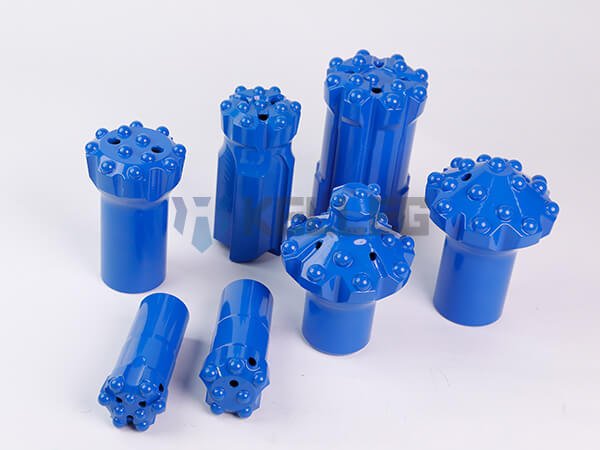
Rock drilling tools, including DTH hammers, DTH drill bits, top hammer drill bits, drill rods, shank adapters, and coupling sleeves, are not only consumable components but also key factors affecting energy transfer, penetration performance, and blast hole quality. Selecting the right drilling tools according to rock conditions and application requirements can significantly improve mining efficiency and reduce total operating costs.
Increase Drilling Penetration Rate and Productivity #
One of the most direct ways advanced drilling tools improve mining efficiency is by increasing the drilling penetration rate.
In metal mining, especially open-pit mining and underground hard rock excavation, slow drilling speed can become a major production bottleneck. Advanced drilling tools are designed to maximize impact energy transfer from the drilling machine to the rock, allowing faster rock breaking and reduced drilling time.
Key factors affecting penetration performance include:
- Drill bit design
- Carbide button quality
- Impact energy efficiency
- Rock-tool matching
- Flushing hole performance
For example, high-performance DTH hammers provide powerful and consistent impact energy directly behind the drill bit, making them suitable for deep-hole and hard rock drilling applications. Efficient impact transmission helps maintain stable penetration rates even in challenging formations such as granite, basalt, and other abrasive rocks.
Benefits: #
- More meters drilled per shift
- Shorter drilling cycles
- Higher production capacity
- Improved utilization of drilling equipment
Improve Borehole Accuracy and Blasting Performance #
The quality of blast holes directly affects blasting results. Even a well-designed blast plan may fail if holes deviate from their intended position.
Advanced drilling tools help improve borehole accuracy through:
- Optimized drill rod design
- High-strength thread connections
- Improved tool rigidity
- Better drilling stability
Reduced borehole deviation helps maintain accurate:
- Hole spacing
- Burden distance
- Hole depth
- Drilling angle
This leads to better explosive distribution and more predictable rock fragmentation.
For metal mines, improved borehole accuracy can reduce:
- Overbreak
- Underbreak
- Secondary blasting requirements
- Explosive waste
As a result, advanced drilling tools contribute not only to drilling efficiency but also to overall blasting optimization.
Extend Tool Service Life and Reduce Operating Costs #
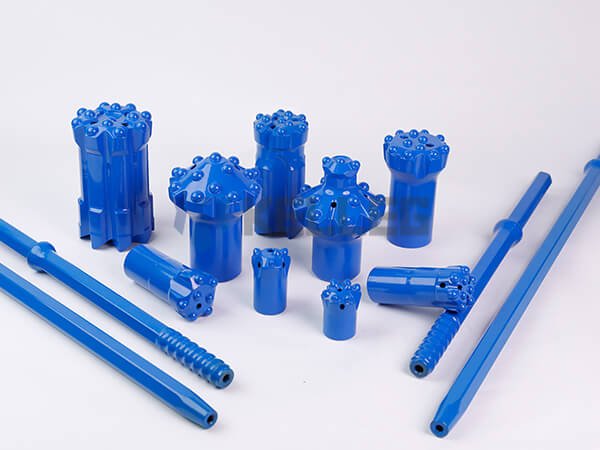
Drilling tools operate under extreme conditions, including high impact loads, abrasion, heat, and vibration. Premature tool failure can increase downtime and raise mining costs.
Advanced rock drilling tools improve service life through:
High-quality raw materials #
Premium alloy steel provides:
- Higher fatigue resistance
- Better wear resistance
- Improved impact toughness
Optimized heat treatment #
Proper heat treatment balances:
- Surface hardness
- Core toughness
- Crack resistance
This helps drilling tools withstand repeated impact loading without premature failure.
Advanced thread design #
High-performance thread types improve:
- Connection strength
- Energy transmission efficiency
- Resistance to thread wear
Longer tool life means:
- Fewer tool replacements
- Reduced maintenance downtime
- Lower cost per drilled meter
Improve Energy Transfer Efficiency #
The efficiency of a rock drilling system depends heavily on how effectively impact energy reaches the rock.
A complete drilling system includes:
- Rock drill
- Shank adapter
- Drill rod
- Coupling sleeve
- Drill bit
If any component performs poorly, energy losses may occur through:
- Thread damage
- Poor connection fit
- Excessive vibration
- Component deformation
Advanced rock drilling tools ensure efficient energy transmission.
For example:
- High-strength shank adapters improve connection stability.
- Precision-manufactured drill rods reduce energy loss.
- Optimized drill bits convert impact energy into effective rock fragmentation.
Better energy utilization results in:
- Higher penetration rates
- Lower fuel consumption
- Reduced mechanical stress
Adapt Better to Different Rock Conditions #
One of the biggest challenges in mining drilling is the variation of geological conditions. Different rock formations require different drilling solutions.
Advanced drilling tools allow mining companies to select optimized configurations based on:
Hard and abrasive rocks #
Recommended solutions:
- Wear-resistant DTH drill bits
- Strong carbide buttons
- High-impact DTH hammers
Applications:
- Iron ore mining
- Copper mining
- Quarrying
Medium-hard rock formations #
Recommended solutions:
- Top hammer drilling tools
- Optimized button bit designs
- Efficient flushing holes
Applications:
- Underground development
- Tunneling
- Production drilling
Fractured and unstable formations #
Recommended solutions:
- Stable rock drilling tools
- Proper drilling parameters
- Specialized bit face designs
These customized solutions help maintain drilling efficiency under complex geological conditions.
Reduce Downtime Through Better Reliability #
Mining productivity is strongly affected by equipment availability. Unexpected failures of drilling tools can interrupt production schedules and increase operating costs.
Advanced drilling tools improve operational reliability by:
- Reducing premature breakage
- Improving wear resistance
- Maintaining stable drilling performance
- Supporting longer continuous operation
A reliable drilling system allows mining companies to achieve:
- More predictable production planning
- Reduced maintenance requirements
- Higher equipment utilization
Support Intelligent and Sustainable Mining Operations #
With the development of smart mining technologies, advanced drilling tools are increasingly integrated with digital monitoring systems.
Modern drilling operations can collect data such as:
- Drilling speed
- Impact pressure
- Tool wear condition
- Energy consumption
- Drilling performance
This information helps operators:
- Optimize drilling parameters
- Predict tool replacement needs
- Improve maintenance planning
- Reduce resource waste
Intelligent drilling management enables mines to achieve higher efficiency while improving safety and sustainability.
Advanced rock drilling tools are essential for improving mining efficiency in modern metal mining operations. By increasing penetration rates, improving borehole accuracy, extending tool service life, optimizing energy transfer, and adapting to different rock conditions, high-performance drilling tools help mining companies achieve better productivity and lower operating costs.
From DTH hammers and drill bits for large-scale open-pit mining to top hammer drilling tools for underground development, selecting the right drilling system is a key factor in maximizing drilling and blasting performance.
For mining companies seeking higher efficiency, the combination of advanced drilling technology, proper tool selection, and optimized operating practices provides a reliable pathway toward safer, more productive, and more economical mining operations.
Conclusion #
Improving drilling and blasting efficiency is essential for metal mines to increase productivity, reduce operating costs, and achieve safer and more sustainable mining operations. Since drilling and blasting performance is influenced by multiple factors, including blast design, rock conditions, drilling accuracy, charging quality, equipment performance, and operator skills, a systematic optimization approach is required rather than focusing on a single factor.
As discussed in this article, common challenges such as low blast advance, inefficient cut blasting, borehole deviation, improper explosive charging, borehole blockage, and inconsistent operator performance can significantly limit mining efficiency. Addressing these issues requires practical solutions, including optimizing cut hole patterns, improving drilling accuracy, strengthening technical training, ensuring proper charging procedures, and adopting advanced drilling technologies.
Advanced rock drilling tools also play a critical role in improving drilling and blasting results. High-performance DTH hammers, drill bits, drill rods, and related tools help mining companies achieve faster penetration rates, better borehole quality, longer tool service life, and more stable drilling performance. When rock drilling tools are properly matched with geological conditions and operating requirements, mines can maximize energy utilization and improve the effectiveness of blasting operations.
For modern metal mining enterprises, the future of drilling and blasting optimization lies in the combination of scientific blast design, reliable drilling equipment, skilled operators, and intelligent mining technologies. By continuously analyzing drilling performance, optimizing operational parameters, and selecting suitable drilling solutions, mining companies can increase blast advance, reduce unnecessary costs, and improve overall production efficiency.
Ultimately, efficient drilling and blasting is not only about achieving faster excavation—it is about creating a more predictable, economical, and sustainable mining process. Through continuous improvement and the application of advanced drilling solutions, metal mines can maintain higher productivity and stronger competitiveness in increasingly challenging mining environments.