- Introduction
- What Is a Tapered Button Bit?
- What Is a Thread Button Bit?
- Main Differences Between Tapered and Thread Button Bits
- Advantages of Tapered Button Bits
- Advantages of Thread Button Bits
- Disadvantages and Limitations
- How to Choose Between Tapered and Thread Button Bits
- Application Comparison by Industry
- Common Problems and Troubleshooting
- Conclusion
Introduction #
Tapered Button Bits and Thread Button Bits are the two most widely used drill bit types in top hammer rock drilling. Tapered button bits are commonly used for small-diameter, shallow-hole drilling with handheld rock drills, offering quick installation and lower equipment cost. In contrast, thread button bits are designed for medium- to large-diameter drilling, deeper holes, and high-power hydraulic drilling systems that require greater drilling efficiency and stability.
However, many drilling contractors, distributors, and project managers still struggle to understand the real differences between tapered and threaded drilling tools. Questions such as:
- What is the actual difference between taper and thread connections?
- Which type is more suitable for specific rock conditions and drilling methods?
- How do drilling efficiency, tool life, and operating costs compare?
- Which option delivers better long-term value for mining, quarrying, or tunneling projects?
Choosing the wrong drill bit system can lead to lower penetration rates, unstable drilling performance, higher tool consumption, and unnecessary operating costs.
In this guide, we will provide a practical comparison between tapered button bits and thread button bits, including their structure, working principles, compatible drilling equipment, drilling depth capability, performance differences, application scenarios, and cost considerations. Whether you are involved in quarry drilling, underground mining, tunneling, or construction blasting, this article will help you select the most suitable rock drilling tool solution for your project.
What Is a Tapered Button Bit? #
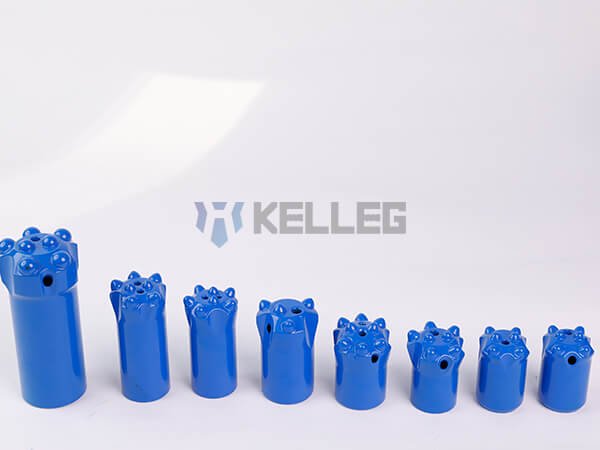
The tapered bit works by matching the tapered skirt of the drill bit with the tapered end of the drill rod, creating a tight friction-based connection during drilling operations.
Unlike threaded button bits that use a screw-in connection, tapered button bits feature a conical taper design that allows the bit to be hammered or pressed directly onto the rod. This simple connection structure makes tapered drilling tools easy to assemble, remove, and maintain in field operations.
Tapered button bits are widely used with lightweight pneumatic rock drills and are especially suitable for shallow-hole drilling, small quarry operations, and portable drilling applications.
Common Taper Angles #
The most widely used taper angles include:
- 7°
- 11°
- 12°
Selecting the correct taper angle is essential to ensure stable energy transfer and reduce bit loosening during operation.
Main Components of a Tapered Button Bit #
- Carbide buttons — Tungsten carbide inserts used for rock crushing and wear resistance.
- Bit skirt — The outer body structure that supports the buttons and connects to the rod.
- Taper socket — The internal tapered connection area that fits the tapered drill rod.
The design of these components directly affects drilling speed, flushing performance, and service life.
Compatible Drilling Tools #
Tapered button bits are commonly used together with:
- Tapered drill rods
- Pneumatic rock drills
- Handheld rock drilling equipment
- Jack hammers and air-leg rock drills
These systems are widely favored in projects that require mobility, simple operation, and lower equipment investment.
Common Sizes of Tapered Button Bits #
Typical bit diameters include:
- 28 mm
- 32 mm
- 34 mm
- 36 mm
- 38 mm
- 41 mm
Typical Applications #
Tapered button bits are mainly used in:
- Mining operations
- Tunnel excavation
- Roadway boring
- Stone quarrying
- Construction blasting
- Small-scale quarry drilling
- Underground development drilling
Because of their simple structure and cost-effective performance, tapered button bits remain widely used in many manual and semi-mechanized drilling environments.
What Is a Thread Button Bit? #
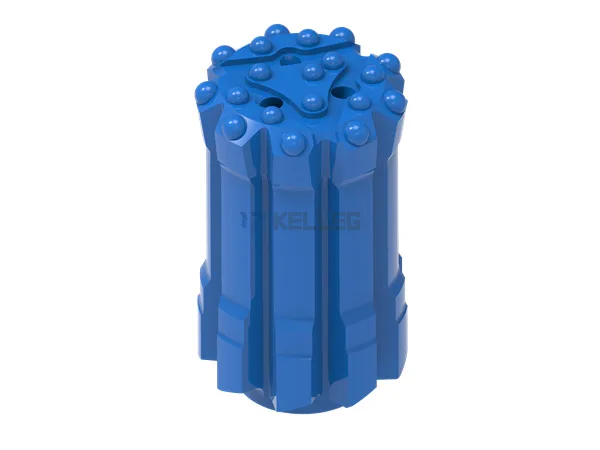
A thread button bit is a rock drilling tool designed with a threaded connection type that securely connects the drill bit to the drill rod or threaded adapter. Compared with tapered button bits, threaded drill bits provide a stronger and more stable connection, making them suitable for high-power and high-productivity drilling operations.
The threaded connection allows the drill bit to reliably transmit higher impact energy and torque during drilling. It also makes drill rod extension more convenient, which is essential for medium-depth and deep-hole drilling applications.
Because of their superior stability and drilling performance, thread button bits are widely used on hydraulic drilling rigs and mechanized top hammer drilling systems for larger-diameter and deeper-hole rock drilling.
Common Thread Types #
The most commonly used thread types include:
- R25
- R28
- R32
- R38
- T38
- T45
- T51
- GT60
Different thread systems are designed for different drilling equipment, hole diameters, and rock conditions. Choosing the correct thread type is critical for ensuring connection stability, efficient energy transfer, and optimal drilling performance.
Main Features of Thread Button Bits #
Compared with tapered drilling systems, thread button bits offer several important advantages:
- Strong and secure connection
- Better impact energy transmission
- Higher torque resistance
- Improved hole straightness
- Easier drill rod extension
- Better suitability for mechanized drilling
These advantages make threaded systems the preferred choice for modern mining and tunneling operations.
Compatible Drilling Systems #
Thread button bits are commonly used together with:
- Hydraulic drifter drilling rigs
- Top hammer drilling rigs
- Extension rods
- MF rods
- Bench drilling rigs
- Underground jumbo drills
These drilling tools are designed to achieve higher penetration rates and improved productivity in demanding rock drilling environments.
Common Thread Button Bit Sizes #
Typical thread button bit diameters include:
- 45 mm
- 51 mm
- 64 mm
- 76 mm
- 89 mm
Smaller diameters are commonly used in underground development drilling, while larger diameters are suitable for bench drilling, production drilling, and large-scale quarry operations.
Typical Applications #
Thread button bits are widely used in:
- Underground mining
- Tunnel construction
- Bench drilling
- Production drilling
- Quarry blasting
- Long-hole drilling
- Infrastructure and hydropower projects
Due to their high drilling efficiency, durability, and compatibility with modern hydraulic drilling equipment, thread button bits have become the standard solution for medium- and large-scale rock drilling operations.
Main Differences Between Tapered and Thread Button Bits #
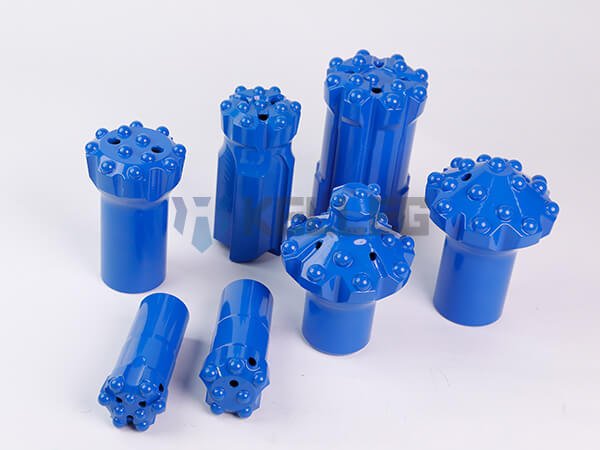
Although both tapered button bits and thread button bits are used in top hammer rock drilling, they are designed for different drilling systems, working conditions, and productivity requirements. The biggest difference lies in the connection method, which directly affects drilling depth, efficiency, stability, and overall operating cost.
Tapered button bits are mainly used for light-duty and shallow-hole drilling with handheld pneumatic rock drills, while thread button bits are designed for mechanized drilling systems that require higher power, deeper drilling capability, and better hole accuracy.
The following comparison highlights the key differences between the two drilling tools:
| Feature | Tapered Button Bit | Thread Button Bit |
|---|---|---|
| Connection Type | Taper connection | Thread connection |
| Drilling Depth | Shallow holes | Medium to deep holes |
| Drilling Speed | Moderate | Higher |
| Hole Accuracy | Lower | Higher |
| Stability | Basic | Better |
| Automation Compatibility | Low | High |
| Rod System | Tapered rods | Extension rods / MF rods |
| Typical Equipment | Handheld pneumatic drills | Hydraulic drilling rigs |
| Maintenance | Simple | More technical |
| Initial Cost | Lower | Higher |
| Productivity | Lower | Higher |
| Best Use | Light-duty drilling | Heavy-duty drilling |
Connection Structure #
Tapered button bits rely on a friction-based taper fit between the bit and the drill rod. This design is simple and easy to operate, but may become loose under prolonged high-impact drilling conditions.
Thread button bits use a threaded connection that provides stronger engagement, better energy transfer, and improved drilling stability, especially in deep-hole drilling applications.
Drilling Capability #
Tapered drilling tools are generally suitable for shallow-hole drilling and smaller hole diameters. They are commonly used in lightweight drilling operations where mobility and low investment cost are important.
Thread button bits are more suitable for medium-depth and deep-hole drilling. Their stable threaded connection allows the drilling tool to handle higher impact energy and larger drilling diameters.
Drilling Efficiency and Accuracy #
Because threaded tools can transfer impact energy more efficiently, thread button bits usually achieve:
- Higher penetration rates
- Better hole straightness
- Reduced energy loss
- More stable drilling performance
Tapered button bits, while effective for smaller projects, typically offer lower drilling efficiency and less precise hole alignment.
Equipment Compatibility #
Tapered button bits are mainly paired with:
- Handheld rock drills
- Air-leg rock drills
- Pneumatic drilling equipment
Thread button bits are designed for:
- Hydraulic top hammer drilling rigs
- Underground jumbo drills
- Bench drilling rigs
Cost and Productivity #
Tapered drilling tools generally require lower initial investment and simpler maintenance, making them suitable for small contractors and light-duty drilling work.
Threaded drilling tools involve higher equipment and tooling costs, but they often deliver:
- Higher productivity
- Lower cost per drilled meter
- Longer service life
- Better long-term operating efficiency
For modern mining, tunneling, and large-scale quarry drilling, thread button bits are typically the preferred solution due to their superior performance and automation compatibility.
Advantages of Tapered Button Bits #
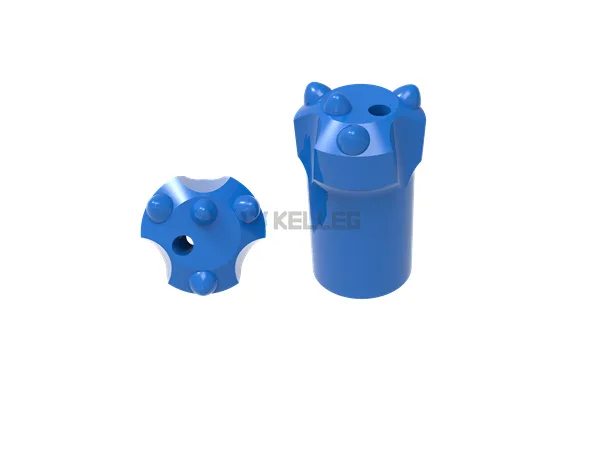
Tapered button bits remain widely used in many drilling applications because of their simplicity, flexibility, and cost-effectiveness. Although they are not designed for high-power mechanized drilling, they still offer important advantages for light-duty and shallow-hole operations.
Lower Investment Cost #
One of the biggest advantages of tapered drilling tools is the relatively low equipment and tooling cost. Tapered drill rods, pneumatic rock drills, and tapered bits are generally more affordable than hydraulic threaded drilling tools, making them suitable for budget-sensitive projects.
Easy Handling and Simple Operation #
Tapered button bits are easy to install and remove. Operators can quickly replace worn bits in the field without complicated tools or procedures. This simplicity is especially valuable in remote or small-scale drilling environments.
Suitable for Portable Drilling #
Because tapered tools are commonly used with lightweight pneumatic rock drills, they are highly portable and adaptable to confined or difficult-to-access working areas.
Efficient for Shallow-Hole Drilling #
For shallow-hole applications, tapered button bits can provide reliable drilling performance with relatively low operating costs. They are widely used in development drilling, small blasting jobs, and dimensional stone quarrying.
Ideal for Small Contractors #
Smaller construction and quarry companies often prefer tapered tools because they are easier to maintain and require lower upfront investment.
When Tapered Bits Are the Better Choice #
Tapered button bits are often the preferred solution for:
- Small mining operations
- Rural blasting projects
- Small construction teams
- Lightweight pneumatic drilling applications
- Portable rock drilling work
- Shallow-hole drilling environments
In these conditions, the simplicity and affordability of tapered bits can outweigh the performance advantages of threaded bits.
Advantages of Thread Button Bits #
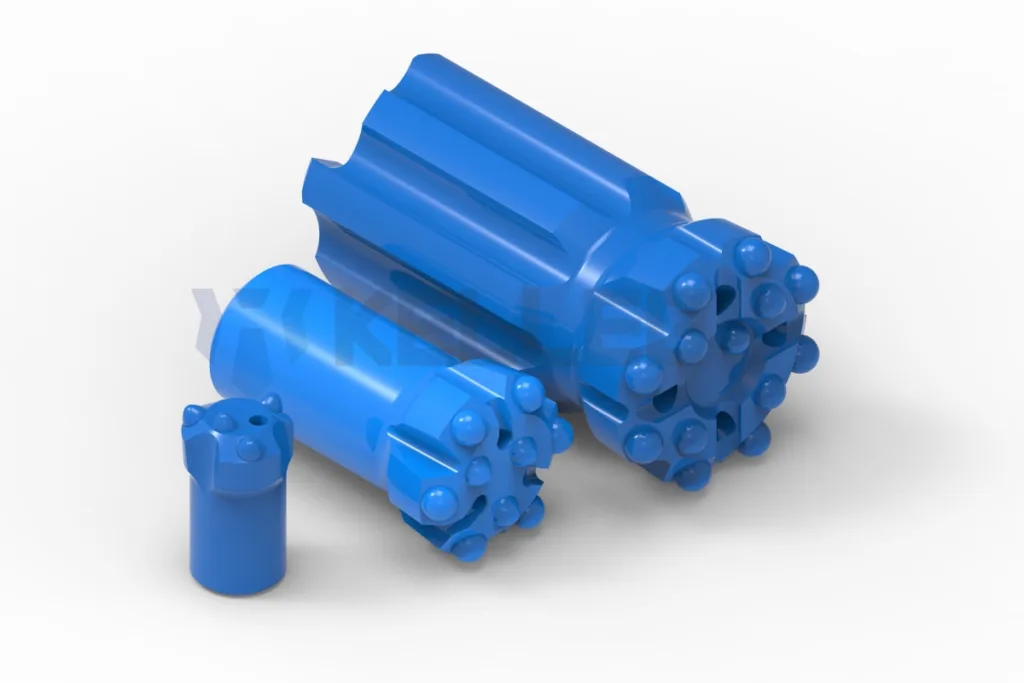
Thread button bits are designed for high-performance rock drilling and are widely used in modern mining, tunneling, and large-scale quarry operations. Their threaded connection type provides superior drilling efficiency, stability, and durability.
Better Energy Transfer #
The threaded connection creates a stronger and more secure link between the bit and the drill rod, allowing impact energy to transfer more efficiently into the rock. This helps improve overall drilling performance and reduce energy loss.
Higher Penetration Rate #
Because of their improved energy transmission and drilling stability, thread button bits usually achieve faster penetration rates compared with tapered bits, especially in hard rock formations.
Better Hole Straightness #
Threaded drilling tools provide improved drilling alignment and reduced bit movement during operation. This results in straighter holes and more accurate drilling, which is particularly important in tunneling and production drilling.
Suitable for Long-Hole and Deep-Hole Drilling #
Thread button bits are specifically designed for medium-depth and deep-hole drilling. Their secure, threaded connection makes them suitable for heavy-duty drilling operations with longer drill strings.
Stronger Connection Stability #
Compared with taper drilling tools, threaded connections are more resistant to loosening under high-impact drilling conditions. This improves operational reliability and reduces unexpected downtime.
Higher Automation Compatibility #
Thread button bits are fully compatible with modern hydraulic drilling rigs and automated drilling systems, making them essential for mechanized mining and infrastructure projects.
Why Modern Mining Prefers Thread Button Bits #
Modern mining and tunneling operations increasingly favor threaded drilling tools because they support:
- Mechanized drilling
- Higher productivity
- Faster drilling cycles
- Lower cost per drilled meter
- Reduced downtime
- Better drilling consistency
- Improved operational efficiency
Although the initial investment is higher, thread button bits often provide better long-term economic performance in large-scale drilling operations.
Disadvantages and Limitations #
Both tapered and thread button bits have advantages and limitations. Selecting the right system depends on drilling depth, rock conditions, equipment type, productivity goals, and project budget.
Limitations of Tapered Button Bits #
Connection Loosening #
Because tapered bits rely on friction-based connections, the bit may loosen during prolonged high-impact drilling operations, especially in hard rock conditions.
Limited Drilling Depth #
Tapered bits are mainly designed for shallow-hole drilling. As drilling depth increases, connection stability and energy transfer efficiency become less reliable.
Lower Efficiency in Hard Rock #
Compared with threaded bits, tapered button bits generally provide lower penetration rates and reduced drilling efficiency in very hard or abrasive rock formations.
Less Suitable for Modern Hydraulic Rigs #
Tapered drilling tools are not ideal for high-power hydraulic drilling rigs or automated drilling environments, where stronger and more stable threaded connections are required.
Limitations of Thread Button Bits #
Higher Initial Investment #
Threaded drilling tools typically require more expensive equipment, including hydraulic rigs, threaded rods, couplings, and drill bits.
More Technical Maintenance #
Thread button bits require proper thread maintenance and handling procedures. Damaged or worn threads can negatively affect drilling performance and increase tool replacement costs.
Requires Compatible Drilling Systems #
Thread button bits are designed for specific thread standards and drilling equipment. Incorrect thread matching may lead to poor connection stability or equipment damage.
Despite these limitations, threaded drilling tools are generally considered the preferred solution for medium- and large-scale rock drilling projects where productivity and drilling performance are the primary priorities.
How to Choose Between Tapered and Thread Button Bits #
Choosing between tapered button bits and thread button bits depends largely on your drilling conditions, equipment type, productivity requirements, and project budget. There is no universally “better” option — the right choice is the one that matches your drilling system and operational goals.
In general, tapered button bits are better suited for light-duty and shallow-hole drilling, while thread button bits are designed for high-productivity, mechanized, and deep-hole drilling applications.
The following recommendations can help you determine which drilling tool is more suitable for your project.
Choose Tapered Button Bits If You: #
Use Handheld Rock Drills #
Tapered button bits are specifically designed for pneumatic rock drills, jack hammers, and other handheld drilling equipment. Their simple taper connection type allows quick bit installation and easy field operation.
Drill Shallow Holes #
For shallow-hole drilling applications, tapered bits can provide reliable performance without the need for more expensive threaded drilling equipment.
Have a Limited Budget #
Tapered drilling tools usually require lower initial investment in drill rods, rock drills, and consumables. This makes them a cost-effective solution for smaller projects and budget-sensitive operations.
Work on Small Quarry or Construction Projects #
Small quarry sites, dimensional stone operations, and rural blasting projects often prioritize portability and operational simplicity over high drilling speed. In these situations, tapered button bits remain a practical and economical choice.
Need Simple Maintenance and Easy Operation #
Tapered tools are easier to maintain and require less technical expertise than threaded drilling tools. Bit replacement and rod handling are relatively straightforward, which can reduce operational complexity.
Choose Thread Button Bits If You: #
Use Hydraulic Drilling Rigs #
Thread button bits are designed for hydraulic top hammer drilling rigs, underground drill jumbos, and mechanized drilling equipment that require stronger and more stable threaded connections.
Require High Drilling Productivity #
If your project demands fast penetration rates, high drilling efficiency, and continuous operation, thread button bits are generally the better solution.
Drill Medium-Depth or Deep Holes #
Threaded drilling tools provide better connection stability and energy transfer for long-hole and deep-hole drilling applications.
Need Precise Hole Alignment #
For tunneling, bench drilling, and production drilling, hole straightness and drilling accuracy are critical. Thread button bits help maintain better drilling alignment and reduce hole deviation.
Operate in Mining or Tunneling Projects #
Modern underground mining, tunnel excavation, and large-scale quarry operations typically rely on threaded drilling tools because they support mechanized drilling and higher overall productivity.
Practical Selection Recommendation #
In simple terms:
- Choose tapered button bits for portable, shallow-hole, and low-cost drilling operations.
- Choose thread button bits for high-power, deep-hole, and high-efficiency drilling projects.
When selecting a drilling system, contractors should evaluate several important factors together, including:
- Rock hardness
- Hole depth
- Hole diameter
- Drilling equipment
- Productivity target
- Maintenance capability
- Total operating cost
A properly matched drilling system can significantly improve drilling efficiency, reduce tool consumption, and lower the overall cost per drilled meter.
Application Comparison by Industry #
Different drilling industries have different requirements for drilling depth, hole accuracy, equipment power, and operational efficiency. As a result, the choice between tapered button bits and thread button bits often depends on the specific working environment and drilling objectives.
In general, tapered button bits are more suitable for lightweight and shallow-hole drilling applications, while thread button bits are preferred in mechanized, high-productivity, and deep-hole drilling operations.
The following table shows the typical industry applications for each drilling system:
| Industry | Recommended Bit Type |
|---|---|
| Small Quarry | Tapered Button Bit |
| Underground Mining | Thread Button Bit |
| Tunnel Construction | Thread Button Bit |
| Dimensional Stone Quarry | Tapered Button Bit |
| Bench Drilling | Thread Button Bit |
| Road Construction | Both |
| Small Blasting Jobs | Tapered Button Bit |
Small Quarry Operations #
Small quarry projects usually prioritize low equipment investment, portability, and easy operation. Tapered button bits are commonly used because they work efficiently with handheld pneumatic rock drills and shallow-hole drilling systems.
Underground Mining #
Modern underground mining operations require high drilling efficiency, deeper holes, and reliable drilling stability. Thread button bits are the preferred choice because they provide stronger connections, better energy transfer, and compatibility with hydraulic jumbo drilling rigs.
Tunnel Construction #
Tunnel drilling demands accurate hole alignment and high drilling productivity. Thread button bits are widely used in tunnel excavation projects due to their superior hole straightness and stable drilling performance.
Dimensional Stone Quarrying #
In dimensional stone applications, drilling is often performed with portable equipment and relatively shallow holes. Tapered button bits remain popular because of their simplicity, flexibility, and lower operating cost.
Bench Drilling #
Bench drilling operations in mining and quarrying typically involve larger hole diameters and higher drilling intensity. Thread button bits are better suited for these demanding applications because they can withstand higher impact energy and longer drilling cycles.
Road Construction #
Road construction projects may use either tapered or threaded drilling tools depending on the project scale, rock conditions, and drilling equipment. Smaller projects often use tapered tools, while large infrastructure projects increasingly rely on hydraulic threaded drilling rigs.
Small Blasting Projects #
For rural blasting, secondary breaking, and light construction drilling, tapered button bits are often the most economical and practical solution due to their simple handling and lower investment requirements.
Common Problems and Troubleshooting #
Both tapered button bits and thread button bits are widely used in rock drilling operations, but each bit has its own typical failure modes. Understanding these common problems can help operators improve drilling efficiency, reduce downtime, and extend tool service life through proper usage and maintenance.
Tapered Button Bit Problems #
Although tapered button bits are simple and easy to use, they can experience performance issues under improper operation or demanding rock conditions.
Button Dropping #
One of the most common issues is carbide button loss. This usually happens due to excessive impact force, worn bit bodies, or drilling in highly fractured or abrasive rock. Once buttons drop, drilling efficiency decreases significantly.
Taper Wear #
The tapered connection between the bit and rod may gradually wear out after repeated use. This reduces the friction fit strength and can lead to bit loosening during operation, especially in hard rock drilling.
Poor Flushing #
Insufficient air or water flushing can cause cuttings to accumulate at the bottom of the hole. This leads to slower penetration rates, overheating of the bit, and increased wear on carbide buttons.
Thread Button Bit Problems #
Thread button bits are designed for high-performance drilling systems, but they require proper handling and maintenance to ensure stable operation.
Thread Damage #
Damaged threads are often caused by incorrect handling during rod connection or disassembly. Cross-threading or impact during assembly can permanently affect connection strength and drilling safety.
Improper Torque #
If the threaded connection is not tightened to the correct torque level, it can lead to instability during drilling. Under-tightening may cause loosening, while over-tightening may damage the threads.
Thread Wear #
Over time, repeated use leads to gradual wear of the thread profile. Worn threads reduce connection reliability, decrease energy transfer efficiency, and may eventually require replacement of the drill bit or rod.
Maintenance Tips for Better Performance #
To reduce these common problems, operators should follow several best practices:
- Ensure proper flushing during drilling operations
- Use correct drilling pressure and impact energy settings
- Regularly inspect taper and thread connections for wear
- Avoid excessive force during assembly and disassembly
- Replace worn bits and rods in time to prevent system damage
Proper maintenance not only improves drilling efficiency but also significantly extends the service life of both tapered and thread button bits.
Conclusion #
Tapered button bits and thread button bits each play an important role in modern rock drilling operations, and there is no absolute “better” choice between them. The right selection always depends on matching the drilling tool with the actual working conditions rather than simply comparing performance in isolation.
The key factors that determine the most suitable option include:
- Drilling method (handheld pneumatic drilling vs. hydraulic mechanized drilling)
- Equipment type (portable rock drills vs. hydraulic drilling rigs)
- Rock conditions (soft, medium, or hard and abrasive formations)
- Hole depth requirements (shallow-hole vs. medium to deep-hole drilling)
From a practical industry perspective, modern large-scale mining, tunneling, and bench drilling operations increasingly prefer thread button bits due to their higher drilling efficiency, better energy transfer, stronger connection stability, and compatibility with mechanized hydraulic drilling systems.
At the same time, tapered button bits continue to be widely used in small-scale construction, light-duty drilling, dimensional stone quarrying, and shallow-hole blasting projects, where simplicity, portability, and lower equipment cost are more important than maximum productivity.
In summary, selecting between tapered and thread button bits should always be based on a comprehensive evaluation of application requirements and drilling conditions. A well-matched system will significantly improve drilling performance, reduce operating costs, and enhance overall project efficiency.