- Introduction
- Drill Rod Types Overview
- Common Drill Rod Failures (Integral, Tapered & Shank Rods)
- Failure Differences by Rod Type
- Root Cause Analysis
- Practical Troubleshooting Guide
- How to Extend Drill Rod Service Life
- Selection Tips to Avoid Failures
- Conclusion
Introduction #
In rock drilling operations, drill rods play a critical role as the primary channel for transmitting impact energy and rotation from the rock drill to the bit. Whether in top hammer drilling or other percussive drilling, the efficiency of energy transfer directly determines drilling speed, hole quality, and overall productivity.
However, drill rods are also among the most heavily stressed and frequently consumed components in the entire drilling system. Subjected to continuous impact, torsion, bending, and abrasive conditions, they operate under extreme environments that make them inherently high-wear and high-risk parts.
When drill rods fail, the consequences are immediate and costly:
- Reduced drilling efficiency and slower penetration rates
- Unexpected downtime that disrupts project schedules
- Potential damage to related equipment, such as rock drills, shank adapters, and couplings
Understanding why these failures occur is essential for maintaining stable operations and controlling costs.
In this guide, you will learn how to identify common drill rod failures, analyze their root causes, implement effective troubleshooting solutions, and prevent recurring issues—helping you maximize service life and drilling performance.
Drill Rod Types Overview #
Understanding different drill rod types is essential before analyzing failures, as each design has unique structural characteristics and failure patterns. While many issues are shared across all rods, their connection methods and applications create distinct weak points.
Integral Drill Rod #
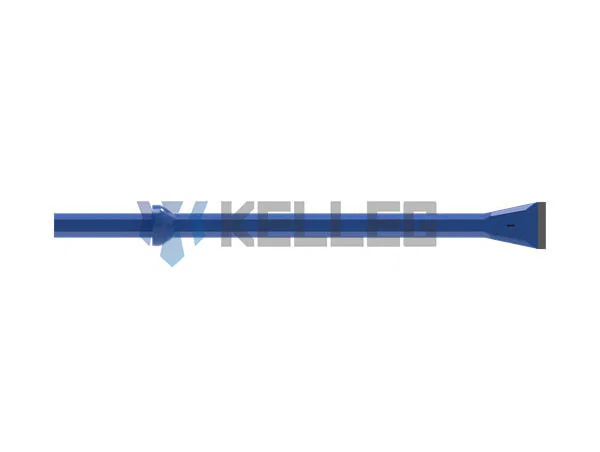
An integral drill rod is a one-piece rock drilling tool that combines the shank, rod body, and drill bit into a single unit.
It is typically used for small-diameter, shallow-hole drilling, especially in conditions such as:
- Broken rock
- Weathered formations
- Soft rock environments
Key characteristics:
- No threaded or detachable connections
- Simple structure with lower initial cost
- Limited flexibility (once the bit is worn, the entire rod is replaced)
Tapered Drill Rod #
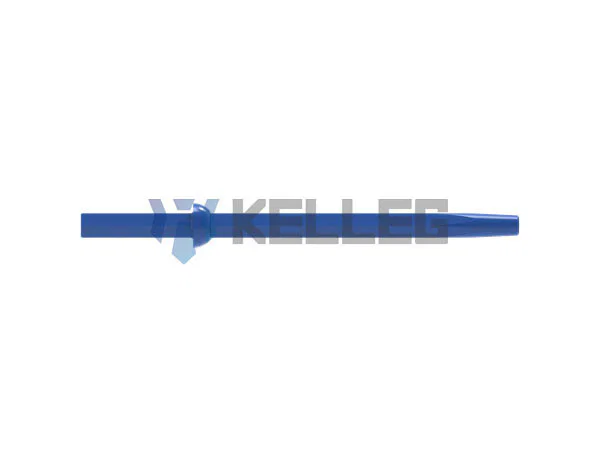
A tapered drill rod features a tapered connection (commonly 7°, 11°, or 12°) between the rod and the bit.
It is usually a hexagonal hollow rod with a shank at one end, which connects to the rock drill, while the other end has a tapered socket for mounting a tapered drill bit.
Key characteristics:
- Quick bit replacement
- Widely used in hand-held and light drilling applications
- Suitable for small to medium hole diameters
Shank Rod #
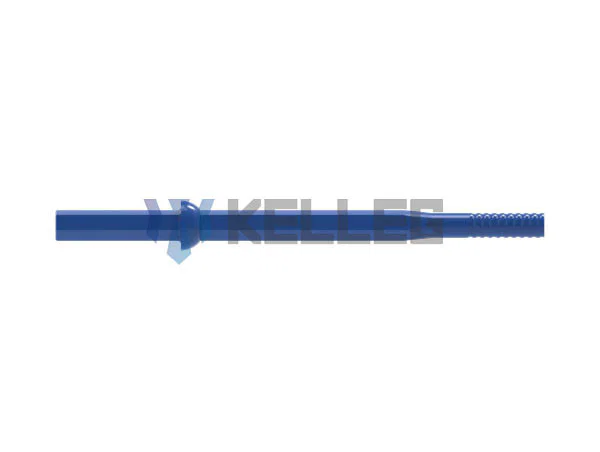
A shank rod is a hexagonal hollow rod with an integrated shank, designed to directly connect with the rock drilling machine.
Unlike tapered rods, the front end is threaded, allowing connection with threaded drill bits.
Key characteristics:
- Acts as the first energy transfer component in the drill string
- Subjected to maximum impact stress
- Commonly used in top hammer drilling
MF Rod (Male-Female Rod) #
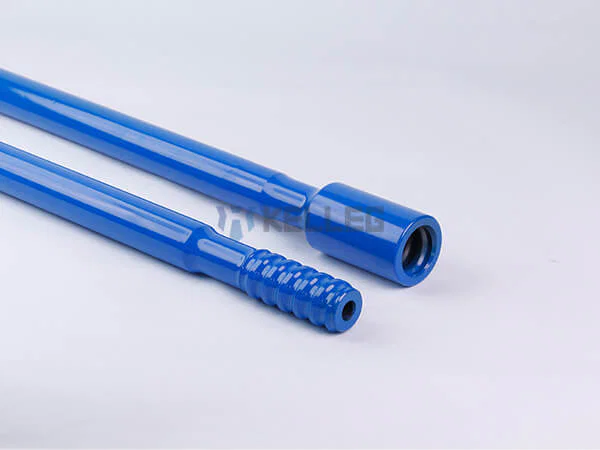
An MF rod (male-female rod) has:
- External thread (male) at one end
- Internal thread (female) at the other end
This design allows rods to be connected directly without couplings, reducing the number of joints in the drilling tools.
Key characteristics:
- Faster rod handling and connection
- Reduced energy loss at joints
- Lower risk of connection loosening compared to coupled rods
Extension Rod #
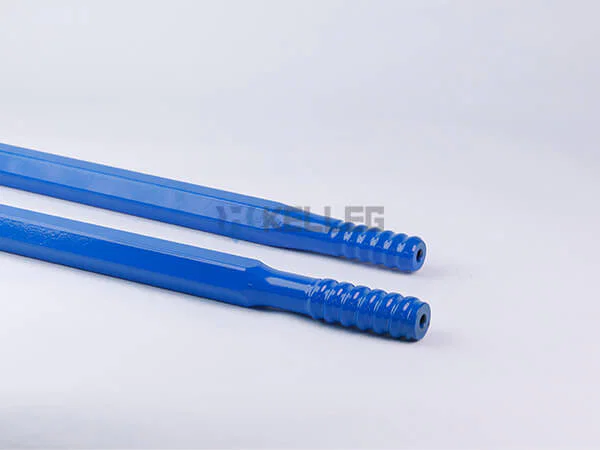
An extension rod is a drill rod with external threads at both ends, typically used together with couplings to extend drilling depth.
Key characteristics:
- Flexible length combinations
- Suitable for deep hole drilling operations
- More connection points, which may increase potential wear areas
By understanding these different rod types, operators can better identify where failures are most likely to occur and apply more targeted maintenance and troubleshooting strategies in real-world drilling conditions.
Common Drill Rod Failures (Integral, Tapered & Shank Rods) #
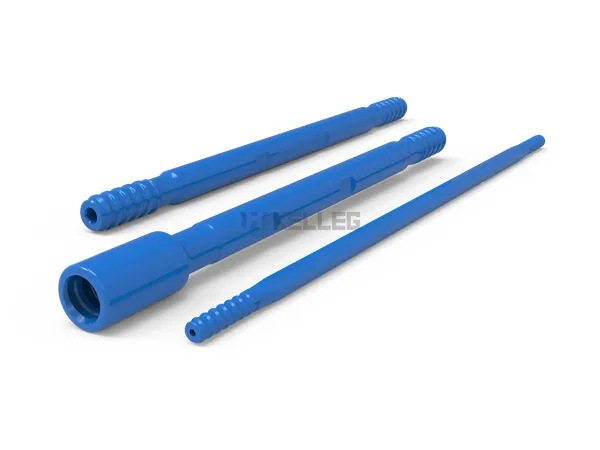
In percussive drilling, integral rods, tapered rods, and shank rods share similar working principles—direct energy transfer with fewer. As a result, their failures are often concentrated in high-impact zones such as the striking end, shank, and collar area.
Below is a structured breakdown of the most common failure modes, along with causes and corrective actions.
Striking End Mushrooming #
Typical Symptoms:
- The striking end becomes enlarged (“mushroomed”)
- Irregular deformation affecting energy transfer
Root Causes:
- Worn drill chuck bushing
- A deformed or damaged piston inside the rock drill
- Excessive operating pressure beyond design limits
- Improper heat treatment of the rod
Recommended Actions:
- Replace worn drill chuck bushings
- Inspect and replace the drill piston if necessary
- Adjust operating pressure to match drilling conditions
- Return the rod to the manufacturer for metallurgical analysis if needed
Failure at Shank End #
Typical Symptoms:
- Cracks or breakage near the shank connection
- Accelerated wear at the contact interface
Root Cause:
- Worn drill chuck bushing is causing poor alignment and uneven stress distribution
Recommended Action:
- Replace worn drill chuck bushings promptly to restore proper alignment
Failure in the Middle of Shank #
Typical Symptoms:
- Cracking or breakage along the shank body
- Signs of fatigue or bending stress
Root Causes:
- Worn drill chuck bushing leading to vibration and misalignment
- Insufficient lubrication at the shank
- Excessive feed pressure beyond optimal range
Recommended Actions:
- Replace worn drill chuck bushings
- Ensure adequate lubrication reaches the shank area
- Adjust feed pressure according to rock conditions and drilling parameters
Failure at the Beginning of Collar Radius #
Typical Symptoms:
- Cracks initiating near the transition (radius) between shank and rod body
- Localized deformation or overheating marks
Root Causes:
- Overheating due to insufficient lubrication
- Inadequate drill chuck bushing radius, causing collar deformation
- Misalignment from excessive clearance in worn drill bushings
Recommended Actions:
- Use the correct type and sufficient quantity of lubrication; inspect regularly
- Check the condition and geometry of the drill chuck bushing; replace if necessary
- Ensure proper alignment of the drilling
Failure at the Collar #
Typical Symptoms:
- Cracks or structural failure in the collar area
- Irregular internal geometry affecting flushing
Root Cause:
- A distorted flush hole caused during the forging process
Recommended Action:
- Return the product to the manufacturer for detailed inspection and root cause analysis
For integral, tapered, and shank rods, most failures are not random—they are typically linked to:
- Worn drill machine components (especially bushings)
- Improper lubrication
- Incorrect operating parameters
Addressing these factors early can significantly reduce failure rates, extend service life, and maintain drilling efficiency.
Failure Differences by Rod Type #
While many drill rod failures share common causes, each rod type has distinct structural weak points. Understanding these differences helps operators diagnose issues faster and apply targeted solutions, rather than using a one-size-fits-all approach.
Integral Drill Rod Failures #
Integral rods combine the bit and rod into one unit, so failures are often concentrated at the carbide and cutting structure.
Failure 1: Carbide Failure #
Symptoms:
- Broken, chipped, or rapidly worn carbide buttons
Root Causes:
- Improper grinding practices
- Overheating during sharpening
- Reverse taper formation
- “Snake skin” wear pattern (irregular surface wear)
Recommended Actions:
- Sharpen carbides following proper procedures
- Avoid overheating during grinding
- Inspect carbide condition more frequently
- Discard and replace severely worn rods
Failure 2: “Propeller” Carbide Wear #
Symptoms:
- Spiral or propeller-like wear pattern on carbide
Root Causes:
- Insufficient flushing pressure
- Low rotation speed
Recommended Actions:
- Increase flushing pressure to improve cutting removal
- Increase rotation speed to ensure even wear
Tapered Rod Failures #
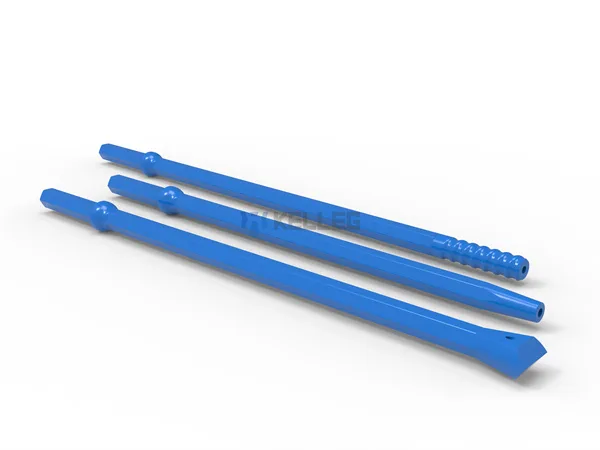
Tapered rods rely on friction-based taper connections, making the taper interface the most critical failure zone.
Failure 1: Cracking at End of Taper Radius #
Root Causes:
- Using bits with worn, damaged, or mismatched taper angles
- Worn carbides in the gauge row are causing instability
Recommended Actions:
- Use a taper gauge to verify compatibility
- Replace worn or damaged bits
- Maintain sharp carbides
Failure 2: Cracking at Beginning of Taper Radius #
Root Causes:
- Mismatched or worn taper connections
- Bit spinning the socket (loss of proper seating)
Recommended Actions:
- Check taper angles using proper tools
- Replace worn bits
- Adjust feed force
- Use bits with symmetrical carbide design
MF Rod (Female Thread End Failures) #
The female thread end is more sensitive to internal damage and alignment issues, often showing hidden failures.
Failure 1: Cracks Across Female Threads #
Root Causes:
- Drill string misalignment
- Hole deviation
- Inadequate feed pressure
- Excessive torque (often from dull bits)
- Thread mismatch between components
- Mechanical damage (impact on steel surfaces)
Recommended Actions:
- Ensure threads are clean, tight, and in good condition
- Improve hole alignment using proper drilling practices
- Adjust feed pressure to match rock conditions
- Sharpen dull bits
- Avoid mixing components from different manufacturers
- Use proper tools for handling connections
Failure 2: Deformation of Female End #
Root Causes:
- Loose thread joints during drilling
- Misalignment during rod connection
Recommended Actions:
- Ensure all thread joints are tight before percussion
- Align rods properly during assembly
Failure 3: Vertical Cracks on Female End #
Root Causes:
- Hole deviation
- Worn threads
- Misalignment during threading
- Loose joints during operation
Recommended Actions:
- Improve hole straightness with alignment tools
- Replace worn components
- Ensure proper alignment before threading
- Tighten all joints before drilling
MF Rods, Extension Rods, and Shank Rods (Male Thread End Failures) #
The male thread end is directly exposed to impact, torque, and environmental conditions, making it highly vulnerable to wear and fatigue.
Failure 1: Excessive Thread Wear (Pitting / Galling) #
Root Causes:
- Overheating due to loose joints or poor lubrication
- Reflected impact energy
- Free hammering (dry firing)
- Worn mating components
Recommended Actions:
- Ensure all connections are tight before drilling
- Apply proper thread lubrication regularly
- Adjust drilling parameters
- Avoid percussion when not engaged with rock
- Replace worn components in time
Failure 2: Breakage Behind Threads #
Root Causes:
- Hole deviation
- Worn threads
- Bending due to excessive feed pressure or misalignment
- High rotational load from dull bits
- Poor ground conditions
- Applying percussion while the rod is stuck
Recommended Actions:
- Improve hole alignment
- Avoid mixing worn and new threads
- Adjust feed pressure
- Maintain sharp bits
- Never apply percussion when stuck
Failure 3: Male End Broken at Face #
Root Causes:
- Drilling with dull bits
- Inadequate feed pressure
- Worn thread connections
- Misalignment during assembly
- Corrosion-induced fatigue
Recommended Actions:
- Maintain sharp bits
- Adjust feed pressure
- Replace worn components
- Ensure proper alignment
- Implement corrosion protection measures
Extension Rods, and Shank Rods (Shaft Failures) #
Failure 1: Breakage in Rod Shaft #
Root Causes:
- Poor alignment
- Surface damage
- Improper heat treatment
Recommended Actions:
- Improve drilling alignment
- Avoid mechanical damage during handling
- Return to manufacturer if material issues are suspected
Failure 2: Inner Surface Damage #
Root Causes:
- Corrosion caused by flushing agents
- Lack of rust protection
Recommended Actions:
- Maintain or replace flushing agents
- Apply proper anti-corrosion measures
- Store rods correctly
Failure 3: Outer Surface Damage #
Root Causes:
- Misalignment causing bending
- Excessive feed force
- Mechanical damage from handling or contact with steel
- Hammer impacts
- Harsh drilling conditions
Recommended Actions:
- Use centralizers and alignment tools
- Adjust feed pressure
- Avoid improper handling (no hammering on rods)
- Store rods properly (use racks, avoid ground contact)
- Optimize drilling parameters
Different rod types fail in different ways:
- Integral rods → Carbide and cutting structure issues
- Tapered rods → Connection instability (taper mismatch & wear)
- MF & Extension rods → Thread-related failures and alignment issues
By recognizing these patterns, operators can move from reactive repairs to proactive prevention, significantly improving drilling efficiency and reducing overall tool costs.
Root Cause Analysis #
In drill rod failure analysis, symptoms alone are not enough. A reliable diagnosis requires a root cause analysis that distinguishes random wear from preventable operational or equipment-related issues.
Most drill rod failures—whether in integral, tapered, MF, extension, or shank rods—can ultimately be traced back to four core dimensions:
Rock Conditions (Geological Factors) #
Rock formation is one of the most dominant external factors influencing drill rod life.
Key Influences:
- Hardness variation (soft → extremely hard rock)
- Abrasiveness (quartz-rich or highly abrasive formations)
- Fractured or unstable rock structures
- Water-bearing or corrosive ground conditions
Typical Failure Links:
- Accelerated wear of rods and carbides in abrasive rock
- Bending and fatigue in fractured formations due to hole deviation
- Corrosion-related damage in wet or chemically aggressive environments
If rock conditions are underestimated, even high-quality drill rods will fail prematurely.
Drilling Parameters (Machine & Operation Settings) #
Incorrect drilling parameters are one of the most common preventable causes of rod failure.
Key Parameters:
- Feed pressure (thrust)
- Rotation speed (RPM)
- Percussion pressure/impact energy
- Flushing pressure and airflow
Typical Failure Links:
- Excessive feed → bending, shaft fatigue, and thread overload
- Low rotation speed → uneven wear and carbide “propeller” patterns
- Insufficient flushing → overheating and carbide damage
- Excessive impact → shank mushrooming and crack initiation
Even small parameter mismatches can significantly reduce drill rod lifespan.
Operator Skills (Human Factors) #
Operator behavior plays a critical role in ensuring stable drilling performance.
Key Influences:
- Rod connection and alignment accuracy
- Lubrication practices
- Response to stuck rods or abnormal vibration
- Maintenance and inspection frequency
Typical Failure Links:
- Misalignment during rod assembly → thread cracking and bending failures
- Inadequate lubrication → overheating and galling
- Improper reaction to stuck drilling → severe structural damage
- Ignoring early wear signs → sudden catastrophic failure
Skilled operators can significantly extend tool life even in harsh conditions.
Tool Quality (Material & Manufacturing Factors) #
Even under ideal conditions, poor tool quality will lead to premature failure.
Key Influences:
- Steel grade and heat treatment quality
- Thread precision and machining accuracy
- Carbide quality and bonding strength
- Manufacturing defects (forging, internal cracks, geometry distortion)
Typical Failure Links:
- Early breakage in shaft due to improper heat treatment
- Thread galling or mismatch due to machining tolerance issues
- Collar or flush hole deformation from forging defects
- Reduced fatigue resistance under repeated impact
Tool quality defines the upper limit of performance and reliability.
A single factor does not cause most drill rod failures, but rather a combination of conditions across these four dimensions.
A practical rule in field diagnosis is:
- If multiple rods fail in the same pattern → check parameters or rock conditions
- If failure is localized → check operator handling or tool quality
- If failure is sudden and severe → investigate combined tools mismatch
Practical Troubleshooting Guide #
The following table provides a quick diagnostic reference for common drill rod problems. It links visible symptoms with probable causes and recommended corrective actions, helping operators make faster field decisions.
| Symptom / Failure | Possible Cause | Recommended Action |
|---|---|---|
| Striking end mushrooming | Worn drill chuck bushing; excessive pressure; piston deformation | Replace chuck bushing; check/replace piston; adjust operating pressure |
| Shank end cracking or wear | Poor lubrication, excessive feed pressure, and worn bushings | Replace drill chuck bushing immediately |
| Middle of shank breakage | Hole deviation, worn threads, loose joints | Improve lubrication to shank; reduce feed pressure; replace bushing |
| Collar radius overheating or cracking | Improper grinding, overheating, reverse taper, wear pattern issues | Ensure proper lubrication; replace bushing; correct alignment |
| Collar deformation or failure | Manufacturing defect (distorted flush hole) | Return rod to manufacturer for inspection |
| Carbide failure (integral rods) | Improper grinding, overheating, reverse taper, wear pattern issues | Re-sharpen correctly; inspect frequently; replace worn rods |
| “Propeller” carbide wear | Low flushing pressure; low rotation speed | Increase flushing pressure; increase rotation speed |
| Taper end cracking (tapered rods) | Mismatched taper; worn bit; gauge wear | Use taper gauge; replace damaged bits; sharpen carbides |
| Taper socket spinning | Poor fit or worn taper connection | Replace bit; adjust feed force; use symmetrical carbide design |
| Female thread cracking (MF rods) | Misalignment; hole deviation; torque overload; mismatched threads | Improve alignment; adjust drilling parameters; avoid mixing components |
| Female end deformation | Loose joints; poor alignment during assembly | Tighten joints before drilling; ensure proper alignment |
| Vertical cracks on female end | Misalignment, improper handling, excessive feed, and impact damage | Replace worn parts; improve hole straightness; tighten joints |
| Male thread wear (pitting/galling) | Poor lubrication; loose coupling; dry firing | Improve lubrication; tighten joints; avoid free hammering |
| Breakage behind threads | Bending stress; hole deviation; excessive feed | Correct alignment; reduce feed pressure; replace worn components |
| Male end fracture at face | Dull bits; misalignment; fatigue or corrosion | Sharpen bits; align rods; apply corrosion protection |
| Rod shaft breakage | Poor alignment; surface damage; heat treatment issue | Improve handling; check drilling alignment; return for inspection |
| Inner surface corrosion | Flushing agent corrosion; poor storage | Replace/adjust flushing agent; improve storage conditions |
| Outer surface damage | Improper grinding, overheating, reverse taper; wear pattern issues | Use centralizers; adjust feed; improve handling and storage |
How to Extend Drill Rod Service Life #
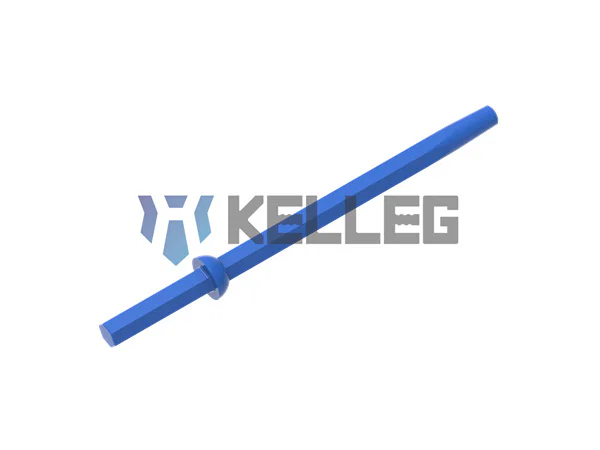
Extending drill rod service life is not about a single improvement—it is the result of consistent control over lubrication, maintenance, drilling parameters, system matching, and storage practices. When these factors are well managed, rod failures can be significantly reduced even in harsh drilling conditions.
Proper Lubrication (Correct Lubrication Practice) #
Lubrication directly affects thread life, heat control, and wear resistance.
Best practices:
- Apply dedicated thread grease regularly to all connections
- Ensure sufficient shank lubrication reaches impact zones
- Avoid dry drilling or “dry firing” conditions
- Check lubrication system performance frequently
Proper lubrication helps prevent galling, overheating, and premature thread failure.
Regular Inspection #
Early detection is key to avoiding catastrophic failure.
Inspection focus areas:
- Thread wear and deformation
- Cracks near collar or shank areas
- Carbide condition (for integral rods)
- Straightness and bending signs
Small defects should be addressed early—delayed replacement often leads to full rod failure.
Use Matched Tools #
Drill rods perform best when all components are properly matched.
Key principles:
- Do not mix different manufacturers’ threads or components
- Ensure correct matching of rod, bit, coupling, and shank adapter
- Use compatible thread types (R, T, or others, depending on system)
Mismatched systems increase stress concentration and accelerate wear.
Control Drilling Parameters (Optimize Operation Settings) #
Incorrect parameters are one of the fastest ways to reduce rod service life.
Critical controls:
- Feed pressure (avoid overloading or underfeeding)
- Rotation speed (match rock hardness and bit condition)
- Percussion pressure (avoid excessive impact energy)
- Flushing pressure (ensure efficient cutting removal)
Balanced parameters reduce vibration, heat buildup, and fatigue stress.
Storage Environment Management (Proper Handling & Storage) #
Improper storage often causes hidden corrosion and surface damage before rods even enter service.
Best practices:
- Store rods on dedicated racks (never directly on the ground)
- Keep dry and ventilated storage conditions
- Apply anti-rust protection if long-term storage is required
- Avoid impact, bending, or stacking deformation
Good storage habits protect both internal and external rod integrity.
Selection Tips to Avoid Failures #
Many drill rod failures are not caused during operation, but actually begin at the selection stage. Choosing the right rod based on geological conditions and drilling requirements is one of the most effective ways to prevent premature failure and reduce total drilling cost.
Select Material Based on Rock Hardness #
Rock hardness and abrasiveness directly determine the stress level applied to drill rods.
Selection guidelines:
- Soft rock: Standard steel grades are usually sufficient
- Medium-hard rock: Requires improved wear resistance and toughness balance
- Hard / highly abrasive rock: High-strength alloy steel with enhanced heat treatment is recommended
Incorrect material selection often leads to rapid wear, cracking, or fatigue failure.
Select Structure Based on Working Conditions #
Different drilling environments require different rod structures to ensure stability and efficiency.
Key considerations:
- Use integral rods for shallow, low-demand drilling
- Use tapered rods for light-duty and hand-held applications
- Use MF rods for high efficiency and reduced coupling needs
- Use extension rods for deep-hole drilling
- Use shank rods for high-impact energy transfer
Structural mismatch often leads to connection failure, misalignment, or energy loss.
Select Length Based on Drilling Depth #
Rod length affects stability, alignment, and overall drilling accuracy.
Selection principles:
- Short rods: better control and stability in shallow drilling
- Medium length: balanced performance for general applications
- Long rods: suitable for deep drilling but require higher alignment precision
Overly long rods in shallow or unstable conditions increase the risk of bending and deviation failure.
Choose a Reliable Supplier (Material & Heat Treatment Quality) #
Even with correct design selection, poor manufacturing quality will still lead to failure.
What to evaluate:
- Steel material consistency and grade certification
- Heat treatment process control (hardness + toughness balance)
- Thread machining accuracy and tolerance control
- Carbide quality (for integrated systems)
- Quality inspection and testing standards
Reliable suppliers ensure not only performance consistency but also longer service life and predictable failure behavior.
Conclusion #
Drill rod failures are rarely caused by a single issue. In most real drilling conditions, they are the result of a combined effect of geology, operation, equipment condition, and tool quality. When these factors interact negatively, even high-quality drill rods can experience premature wear or breakage.
However, field experience shows that a large proportion of failures are actually preventable.
By combining correct usage, smart selection, and consistent maintenance, operators can significantly extend service life, improve drilling efficiency, and reduce overall project cost.