- Introduction
- Key Factors That Influence Drilling Method Selection
- Drilling Methods Overview
- Drilling Method Selection by Rock Type
- Drilling Method Selection Matrix
- Common Mistakes in Drilling Method Selection
- Engineering Optimization Tips
- Future Trends in Drilling Method Selection
- Conclusion
Introduction #
Drilling method selection is not universal because every drilling project operates under different geological conditions, performance requirements, and cost constraints. In modern mining, tunneling, and construction projects, the efficiency of drilling is not determined only by the equipment itself, but more importantly by how well the drilling method matches the rock formation.
Rock formation is the most critical factor affecting drilling performance. Different geological conditions directly influence:
- Penetration rate (ROP) – how fast the rock drilling tools can break the rock
- Tool service life – how long drill bits, rods, and DTH hammers can last under impact and abrasion
- Hole straightness – especially important in deep drilling and blasting holes
- Project cost – including fuel consumption, air compression demand, and tool replacement frequency
In real field operations, a common mistake is selecting a drilling method based only on equipment availability or operator habit, rather than geological conditions. This often leads to low drilling efficiency, excessive tool wear, hole deviation, and significantly higher operational costs.
As a result, the correct drilling method selection must always start from one fundamental question:
“What type of rock formation are we drilling into?”
Different rock types require different energy transfer mechanisms. Soft formations are best drilled with rotational cutting type, while hard and abrasive rocks require high-impact percussion systems such as DTH or Top Hammer drilling. In complex geological conditions, hybrid or casing-supported drilling methods may be necessary to maintain stability and performance.
Therefore, understanding the relationship between rock formation and drilling technology is the foundation of efficient and cost-effective drilling design.
Key Factors That Influence Drilling Method Selection #
Selecting the correct drilling method requires a systematic evaluation of geological and operational conditions. In practical engineering applications, drilling performance is not determined by a single parameter, but by the combined influence of rock strength, structure, abrasiveness, groundwater conditions, and project objectives.
Understanding these factors helps engineers and contractors choose the most efficient drilling type, reduce tool consumption, and improve overall project productivity.
Rock Hardness (UCS – Uniaxial Compressive Strength) #
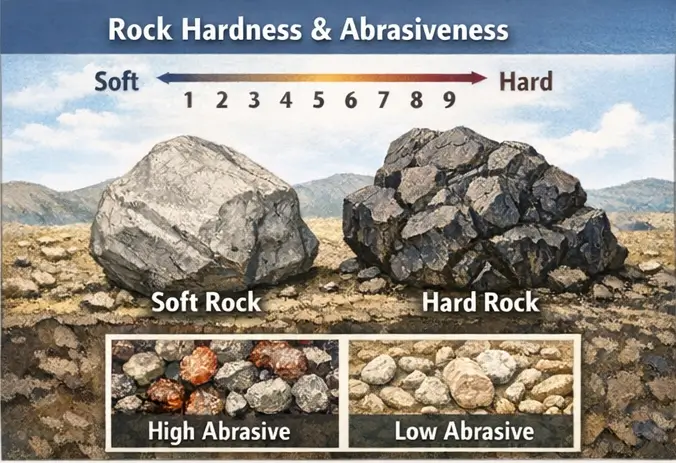
Rock hardness, commonly measured by Uniaxial Compressive Strength (UCS), is one of the most important parameters in drilling method selection. It directly determines the type of energy required to break the rock.
- Soft rock (< 20 MPa)
Typically includes clay, weathered soil, and soft sandstone. These formations can be drilled efficiently using rotary cutting methods without the need for high-impact percussion. - Medium rock (20–80 MPa)
Includes limestone and medium-strength sandstone. These formations often require a combination of rotation and impact energy, making Top Hammer drilling highly effective. - Hard rock (80–150 MPa)
Includes granite, basalt, and dense sandstone. These rocks require high-impact energy delivery, where Down-the-Hole (DTH) drilling becomes the preferred solution. - Extremely hard rock (> 150 MPa)
Found in fresh granite and highly consolidated igneous formations. High-pressure DTH drilling tools with optimized button bits are typically required to maintain penetration efficiency.
Rock hardness is the primary decision factor that defines whether drilling relies on cutting, percussion, or high-pressure impact systems.
Rock Structure #
Rock structure describes how the rock mass is formed and how it behaves under mechanical stress. Even rocks with similar hardness can perform very differently depending on their structural condition.
- Massive rock
Homogeneous and stable formations with consistent drilling resistance. These conditions are ideal for standard percussion or rotary-percussion types. - Fractured/jointed rock
Contains cracks, joints, and discontinuities. These formations often cause hole instability and require controlled energy application, often favoring DTH drilling with better hole straightness. - Layered sedimentary rock
Alternating layers of different strength can cause uneven penetration rates and bit deviation. Drilling method must adapt to varying resistance. - Highly weathered formations
Weak and unstable materials that may collapse easily. These conditions often require casing-supported drilling or rotary types to maintain hole integrity.
Rock Abrasiveness #
Abrasiveness determines how quickly drilling tools wear during operation. It is strongly influenced by mineral composition, especially quartz content.
- Quartz-rich rocks (high wear)
Such as granite and quartz sandstone. These formations cause rapid wear on drill bits and require high-quality carbide inserts (e.g., YG13C–YG15 grades). - Limestone (low–medium abrasion)
Relatively softer and less abrasive, allowing longer tool service life and higher drilling efficiency. - Granite/basalt (high abrasion)
Extremely abrasive and hard, requiring optimized bit design, flushing hole, and durable drilling materials.
Abrasiveness directly impacts tool cost, maintenance frequency, and overall drilling economy.
Water Conditions #
Groundwater conditions significantly affect drilling stability and method selection, especially in deep holes or unstable formations.
- Dry rock
Most drilling methods perform efficiently under dry conditions with stable cuttings removal. - Water-bearing formations
Require controlled flushing systems (air or mud) to prevent hole collapse and maintain cuttings transport. - Muddy/unstable formations
Highly challenging conditions where borehole walls are prone to collapse. Casing systems or rotary mud drilling methods are typically required.
Water conditions are often underestimated but can completely change the drilling method selection in real field operations.
Drilling Objective #
The final selection factor is the engineering purpose of the drilling operation. Different applications require different levels of precision, depth, and productivity.
- Blasthole drilling (mining & quarrying)
Focuses on high penetration rate and productivity. DTH and Top Hammer are most commonly used. - Tunneling
Requires accuracy, controlled blasting, and adaptability to complex geology. Top Hammer and DTH drilling tools are widely applied. - Anchor bolting (slope & underground support)
Requires precision drilling in confined spaces. Lightweight Top Hammer drilling tools or self-drilling anchor bolts are preferred. - Foundation drilling (construction & infrastructure)
Focuses on borehole stability and depth accuracy. Rotary or casing drilling tools are commonly used.
Together, these five key factors form the foundation of drilling method selection. In practical engineering, the optimal solution is always a balance between geological conditions, equipment capability, and project requirements.
Drilling Methods Overview #
Understanding the main drilling methods is essential for selecting the right drilling method based on rock formation conditions. Each drilling method uses a different energy transfer principle, which directly affects penetration rate, hole quality, and operational efficiency.
In engineering practice, there is no “universal best method”—each method is designed for specific geological conditions and project requirements.
Top Hammer Drilling #
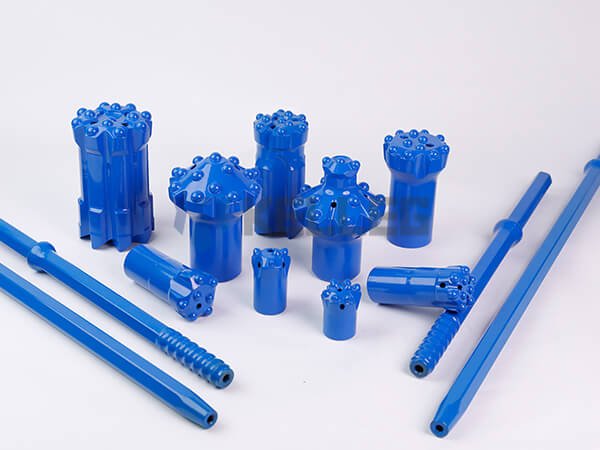
Top Hammer drilling is a percussion-based drilling method where the impact energy is generated from a hammer located on the surface and transmitted through the drill rod to drill bit.
This method combines percussion + rotation, allowing efficient rock breakage in medium to medium-hard formations.
Key Characteristics: #
- Impact energy delivered from surface-mounted equipment
- Energy transmitted through drill rods to the bit
- High frequency impact combined with rotation
Best Suited For: #
- Medium to medium-hard rock formations (e.g., limestone, sandstone)
- Short to medium-depth drilling
- Tunneling and small-to-medium diameter blastholes
Advantages: #
- High drilling speed in suitable rock conditions
- Flexible and widely used equipment
- Lower initial equipment cost compared to DTH drilling tools
Limitations: #
- Energy loss increases with depth (drill rod transmission loss)
- Less efficient in very hard or highly abrasive rock
- Hole deviation may increase in deep drilling
Down-the-Hole (DTH) Drilling #
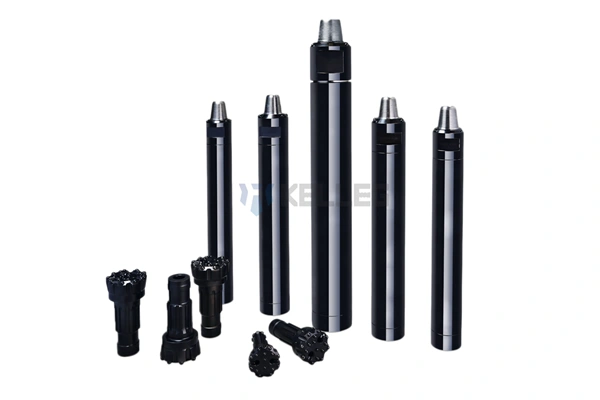
Down-the-Hole (DTH) drilling places the hammer directly behind the drill bit at the bottom of the hole. This design allows impact energy to be delivered directly to the rock surface with minimal energy loss.
It is one of the most efficient methods for hard rock drilling applications.
Key Characteristics: #
- DTH hammer operates directly at the bottom of the borehole
- Compressed air powers the DTH hammer and flushes cuttings
- Direct energy transfer to rock
Best Suited For: #
- Hard and extremely hard rock formations (e.g., granite, basalt)
- Deep blasthole drilling
- Mining, quarrying, and large-diameter drilling
Advantages: #
- High penetration rate in hard rock
- Excellent hole straightness, even in deep drilling
- Lower energy loss compared to Top Hammer drilling tools
Limitations: #
- Higher air compressor requirement
- Slower in soft formations
- Higher equipment cost and complexity
Rotary Drilling #
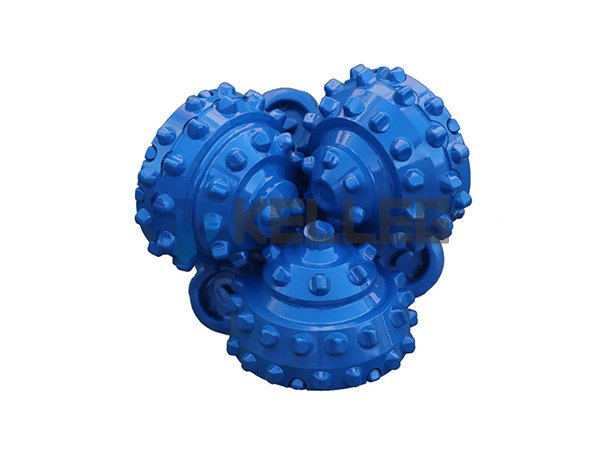
Rotary drilling is a cutting-based method where the rock is broken primarily through continuous rotation and downward pressure rather than percussion.
This method is most effective in soft to medium formations where cutting efficiency is higher than impact breaking.
Key Characteristics: #
- Continuous rotation of drill bit
- Rock removal through cutting and shearing
- Often uses mud or air flushing holes
Best Suited For: #
- Soft rock formations (clay, soil, weathered rock)
- Overburden drilling
- Foundation and civil engineering projects
Advantages: #
- High efficiency in soft ground conditions
- Stable borehole walls in suitable formations
- Lower vibration compared to percussion drilling
Limitations: #
- Ineffective in hard rock formations
- Lower penetration rate in consolidated rock
- Requires proper flushing hole for cuttings removal
Rotary Percussion / Hybrid Methods #
Rotary percussion drilling combines rotation and impact energy, integrating elements of both rotary and percussion drilling. In some configurations, it may also be combined with casing advancement or air/mud circulation systems.
This hybrid approach is designed for complex geological conditions where a single drilling method is not sufficient.
Key Characteristics: #
- Combination of rotation and impact energy
- Adaptable to changing geological conditions
- Often integrated with casing systems or dual-wall drilling
Best Suited For: #
- Mixed or unstable formations
- Fractured rock zones
- Overburden-to-bedrock transition layers
- Complex tunneling or foundation conditions
Advantages: #
- High adaptability in variable geology
- Improved borehole stability
- Reduced risk of drilling failure in complex formations
Limitations: #
- Higher complexity
- Requires experienced operators
- Equipment cost is generally higher
Together, these four drilling methods form the foundation of modern rock excavation technology. The correct selection depends on matching the energy transfer mechanism with the geological conditions encountered in the field.
Drilling Method Selection by Rock Type #
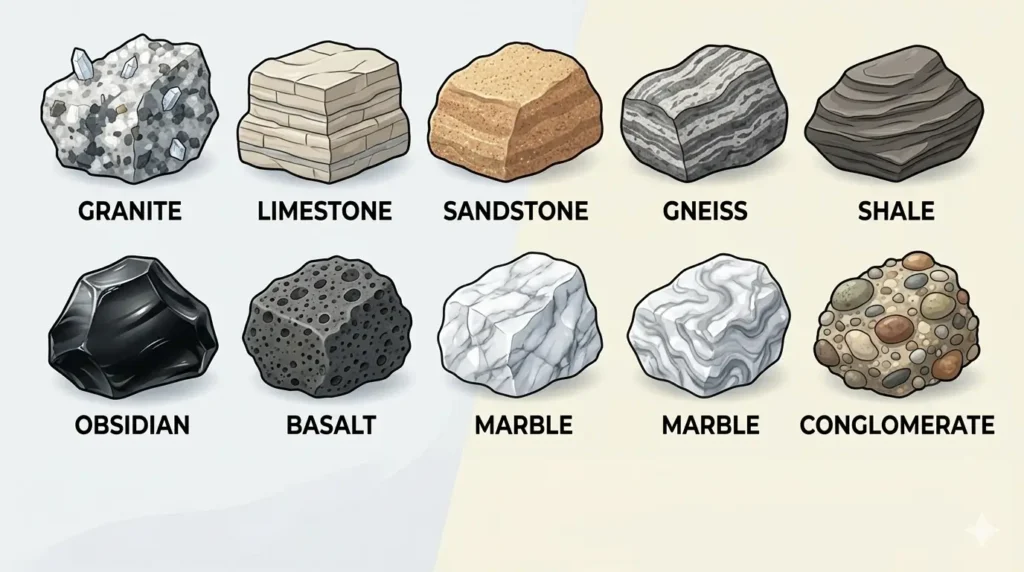
Drilling method selection is fundamentally determined by geological conditions. Each rock type responds differently to cutting, percussion, and rotary energy. Therefore, matching the correct drilling method to the formation is essential for maximizing penetration rate (ROP), reducing tool wear, and ensuring borehole stability.
Soft Rock Formations (0–20 MPa) #
Typical Rocks: #
- Clay
- Shale
- Soft sandstone
- Weathered soil / overburden
Recommended Methods: #
- Rotary drilling (primary choice)
- Rotary auger drilling
- Casing drilling (for unstable ground conditions)
Why These Methods Work: #
Soft rock formations have low resistance to mechanical breakage. In these conditions, rock can be efficiently removed through cutting and rotation alone, without requiring percussion energy. Applying impact drilling in soft ground is unnecessary and often counterproductive.
Limitations of Incorrect Method Selection: #
- Percussion drilling may cause hole wall to collapse
- Excessive vibration leads to overbreaking of formation
- Reduced efficiency and increased drilling cost
In soft formations, stability and cuttings removal efficiency are more important than impact power.
Medium Hard Rock (20–80 MPa) #
Typical Rocks: #
- Limestone
- Medium sandstone
- Dolomite
Recommended Methods: #
- Top Hammer drilling (most common choice)
- Small-diameter DTH drilling (selective use)
- Rotary percussion drilling (in mixed conditions)
Why These Methods Work: #
Medium hard rock requires a balance between impact energy and rotational cutting. Top Hammer drilling tools are highly effective because they combine high-frequency percussion with rotation, making them suitable for moderate resistance formations.
Key Engineering Considerations: #
- Button bit selection significantly affects penetration rate
- Air pressure and flushing efficiency directly influence performance
- Incorrect bit design leads to rapid wear or reduced drilling speed
This rock category is highly sensitive to equipment optimization and drilling parameters.
Hard Rock (80–150 MPa) #
Typical Rocks: #
- Granite
- Basalt
- Dense quartz sandstone
Recommended Methods: #
- DTH drilling (primary and most efficient method)
- Top Hammer drilling (secondary, shallow applications only)
Why DTH Drilling Dominates: #
In hard rock formations, energy loss in the drill rod becomes a critical limitation. DTH drilling solves this problem by placing the hammer directly at the bottom of the hole, ensuring direct energy transfer to the rock surface.
Key Advantages: #
- Higher penetration rate in hard formations
- Excellent hole straightness in deep drilling
- Reduced energy loss compared to top hammer drilling tools
- Improved bit service life in abrasive rock conditions
For most mining and quarry applications, DTH drilling is the standard solution in this hardness range.
Extremely Hard & Abrasive Rock (>150 MPa) #
Typical Rocks: #
- Fresh granite
- Massive basalt
- Quartz-rich veins
Recommended Methods: #
- High-pressure DTH drilling (18–35 bar)
- Premium carbide button bits (YG13C–YG15 grade)
- Optimized flushing holes design
Engineering Challenges: #
Extremely hard and abrasive formations create simultaneous challenges of high resistance + severe tool wear. Standard drilling methods often fail due to bit damage or insufficient penetration efficiency.
Critical Engineering Considerations: #
- Bit wear becomes the limiting factor of drilling performance
- Flushing efficiency is essential to prevent overheating
- Heat buildup must be controlled to avoid premature tool failure
In this category, tool quality and air system performance become more important than drilling speed.
Fractured / Jointed Rock #
Formation Characteristics: #
- Highly unstable rock structure
- Sudden collapse risk during drilling
- Uneven and variable hardness distribution
Recommended Methods: #
- DTH drilling with casing systems
- Top Hammer drilling (for shallow or controlled applications)
- Dual-wall or casing systems
Why These Methods Are Required: #
In fractured rock, the primary challenge is not hardness but hole stability. Without proper support, boreholes can collapse or become blocked during drilling.
Engineering Principle: #
In these conditions, borehole stability is more important than penetration rate.
Controlled drilling methods with casing support significantly reduce drilling failure risk.
Water-Bearing / Unstable Formations #
Common Problems: #
- Borehole wall collapse
- Difficulty in cuttings removal
- Air loss in DTH drilling due to high permeability
Recommended Methods: #
- Casing system drilling (most stable solution)
- Rotary drilling with mud circulation
- Controlled flushing systems, depending on depth and soil condition
Engineering Focus: #
In water-bearing formations, drilling success depends on stabilization and circulation control rather than speed.
Key Objective: #
- Maintain borehole integrity
- Ensure efficient cuttings transport
- Prevent fluid loss and collapse zones
Proper method selection in these conditions directly determines whether drilling can be completed successfully or not.
Drilling Method Selection Matrix #
To simplify drilling method selection in real engineering applications, the following matrix provides a practical comparison between rock types, hardness levels, and the most suitable drilling methods.
This table is widely used in mining, tunneling, and foundation engineering projects to quickly identify the most efficient drilling method based on geological conditions.
Drilling Method Selection by Rock Type #
| Rock Type | Hardness Level | Best Drilling Method | Secondary Option |
|---|---|---|---|
| Soft soil | Low | Rotary drilling | Casing system |
| Limestone | Medium | Top Hammer drilling | Small-diameter DTH drilling |
| Sandstone | Medium-hard | Top Hammer drilling | DTH drilling |
| Granite | Hard | DTH drilling | Top Hammer drilling |
| Basalt | Very hard | DTH drilling | — |
| Fractured rock | Variable | DTH drilling + casing system | Top Hammer drilling |
| Water-bearing ground | Unstable | Casing system | Rotary mud drilling |
This selection matrix is not only a classification table but also reflects the fundamental relationship between rock mechanics and drilling energy transfer methods.
Each drilling method corresponds to a different energy mechanism:
- Rotary drilling → Cutting and shear force
- Top Hammer drilling → Surface percussion + rotation
- DTH drilling → Direct impact energy at the rock face
- Casing systems → Borehole stabilization + controlled advancement
The correct selection ensures that the energy delivery method matches the resistance characteristics of the rock formation.
How to Use This Matrix in Real Projects #
In actual field applications, engineers should not rely solely on rock type. Instead, selection should also consider:
- Borehole depth
- Required diameter
- Groundwater conditions
- Hole stability requirements
- Equipment availability
For example:
- In hard and deep rock, DTH drilling provides the best balance of penetration rate and hole straightness
- In unstable or water-bearing formations, casing systems are more important than drilling speed
- In medium rock, Top Hammer remains the most cost-efficient solution
Key Engineering Insight #
There is no single “best drilling method” for all conditions. The optimal choice is always a balance between:
- Geological formation characteristics
- Energy transfer efficiency
- Tool wear rate
- Project cost and productivity
This is why drilling method selection must always be based on rock formation analysis rather than equipment preference.
Common Mistakes in Drilling Method Selection #
In real engineering practice, many drilling inefficiencies and cost overruns are not caused by equipment limitations, but by incorrect drilling method selection. Choosing the wrong method for the geological conditions can significantly reduce penetration rate (ROP), increase tool wear, and even lead to drilling failure.
Below are the most common mistakes observed in mining, tunneling, and foundation drilling projects.
Choosing Top Hammer Drilling for Deep Hard Rock Drilling #
One of the most frequent mistakes is using Top Hammer drilling for deep holes in hard rock formations.
Why it happens: #
- Equipment availability
- Lower initial cost perception
- Lack of understanding of energy loss in drill rod
Why it is a problem: #
In deep drilling, energy transmission through drill rods causes significant energy loss, reducing impact efficiency at the bit.
Engineering consequence: #
- Low penetration rate (ROP)
- Increased rod wear and deviation
- Poor hole straightness at depth
In hard and deep formations, DTH drilling is significantly more efficient.
Using DTH Drilling in Very Soft Soil #
DTH drilling are often incorrectly used in soft formations such as clay or weathered soil.
Why it happens: #
- Misapplication of “high-performance” equipment
- Lack of geological analysis
Why it is inefficient: #
Soft soil does not require impact energy. Instead, DTH drilling waste compressed air energy without improving cutting efficiency.
Engineering consequence: #
- Extremely low cost efficiency
- Excessive energy consumption
- No improvement in penetration rate
Rotary drilling is the correct and cost-effective solution for soft formations.
Ignoring Rock Abrasiveness When Selecting Bits #
Rock abrasiveness is often overlooked during drilling method selection, especially in quartz-rich formations.
Why it matters: #
Abrasiveness directly affects button wear, bit lifespan, and drilling cost.
Engineering consequence: #
- Rapid bit failure
- Increased downtime for bit replacement
- Higher operational cost per meter
High-abrasion rocks require premium carbide grades (e.g., YG13C–YG15) and optimized bit design.
Not Considering Air Compressor Capacity #
In DTH drilling, air compressor performance is a critical factor that is often underestimated.
Why it matters: #
DTH hammers rely entirely on compressed air for both impact energy and cutting removal.
Engineering consequence: #
- Reduced hammer efficiency
- Poor cuttings evacuation
- Risk of stuck drilling tools in deep holes
Proper matching of air pressure (e.g., 18–35 bar drilling tools for hard rock) is essential for stable performance.
Overlooking Hole Stability Issues #
Another major mistake is focusing only on penetration rate while ignoring borehole stability.
Why it matters: #
Unstable formations can collapse during drilling, regardless of rock hardness.
Engineering consequence: #
- Hole collapse and re-drilling
- Lost drilling tools
- Severe project delays
In fractured or water-bearing formations, casing systems are essential to maintain borehole integrity.
Most drilling problems are not caused by poor equipment but by the selection of incorrect methods and a poor understanding of geological conditions.
The optimal drilling performance always depends on:
- Correct rock analysis
- Proper method matching
- Equipment-method compatibility
Engineering Optimization Tips #
Optimizing drilling performance is not only about selecting the correct drilling method, but also about properly matching drilling consumables and operating parameters. Even with the right drilling method, improper configuration of bits, air pressure, or drill rods can significantly reduce efficiency and increase operational cost.
The following optimization strategies are widely applied in mining, tunneling, and foundation drilling projects.
Match Bit Type to Rock Formation #
Drill bit design directly affects penetration rate (ROP), tool service life, and overall drilling stability. Different rock formations require different button geometries to achieve optimal energy transfer and fracture efficiency.
- Spherical buttons → Hard rock formations
Spherical buttons provide high wear resistance and concentrated impact strength, making them ideal for granite, basalt, and other high-strength rocks. - Ballistic buttons → Medium rock formations
Ballistic designs offer faster penetration in medium-hard rocks such as limestone and sandstone, balancing speed and durability. - Conical buttons → Soft rock formations
Conical buttons provide aggressive cutting action and higher penetration efficiency in softer formations with low resistance.
Correct bit selection ensures maximum energy utilization and reduces premature bit failure.
Adjust Air Pressure (DTH Drilling) #
In Down-the-Hole (DTH) drilling, compressed air is not only the energy source for the DTH hammer but also the medium for cuttings removal. Therefore, air pressure control is a critical performance factor.
- Low air pressure → Shallow drilling applications
Suitable for shorter boreholes and medium formations where energy demand is lower. - High air pressure → Deep hard rock drilling
Required for granite, basalt, and other hard rock formations to maintain consistent hammer impact energy and efficient cuttings evacuation.
Incorrect air pressure settings can lead to reduced penetration rate, poor hole cleaning, and increased tool wear.
Select Proper Drill Rod #
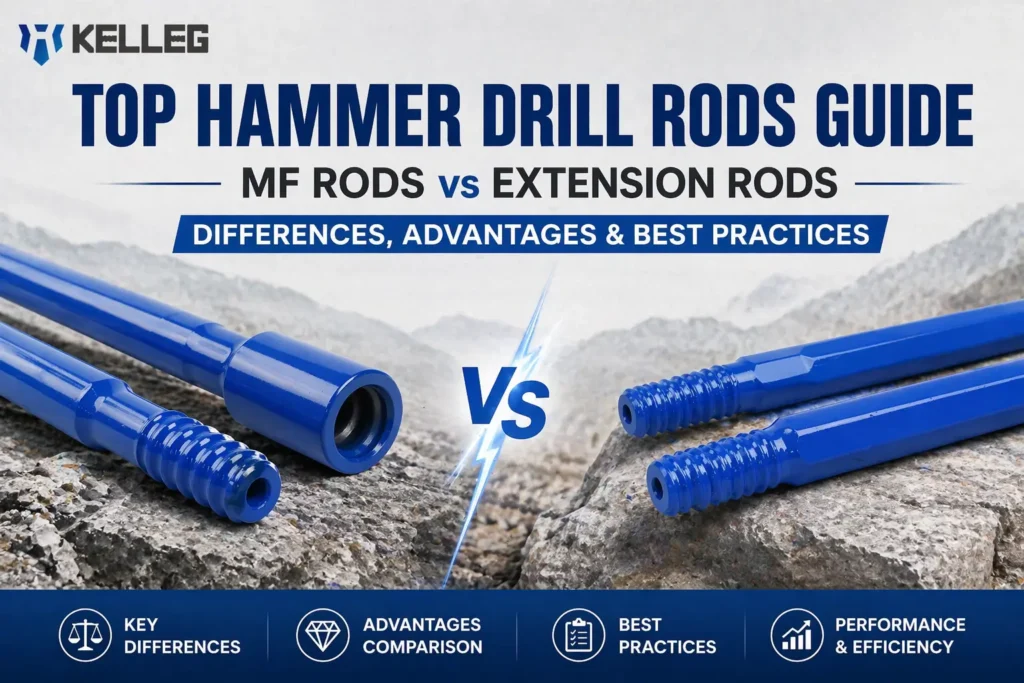
Drill rods play a key role in transmitting energy and maintaining drilling stability, especially in Top Hammer where energy is transferred from the surface.
- MF Rods (Male–Female connection) → Precision drilling
MF rods provide better energy transmission stability and are commonly used in drilling applications where accuracy is critical. - Extension Rods → Flexibility
Extension rods are suitable for variable depth drilling and allow flexible assembly for different project requirements.
Proper drill rod selection improves energy efficiency, reduces deviation, and extends the overall lifespan of the drilling tools.
Key Engineering Insight #
Drilling optimization is a system-level process. Maximum efficiency is achieved only when bit design, air pressure, and drill rod configuration are all properly matched to rock formation conditions.
In practical applications, even small mismatches in system configuration can significantly affect penetration rate, tool life, and total project cost.
Future Trends in Drilling Method Selection #
The drilling industry is rapidly evolving toward higher levels of automation, intelligence, and sustainability. Future drilling method selection will no longer rely solely on manual geological interpretation, but increasingly on real-time data analysis, AI-driven decision systems, and automated equipment control.
These innovations aim to improve drilling efficiency, reduce operational costs, and minimize environmental impact.
Smart Drilling Systems (Real-Time Rock Detection) #
Smart drilling systems integrate sensors, telemetry, and real-time geological feedback to identify rock conditions during drilling operations.
Key capabilities: #
- Real-time detection of rock hardness and formation changes
- Continuous monitoring of penetration rate (ROP) and vibration signals
- Adaptive adjustment of drilling parameters during operation
This allows operators to dynamically adjust drilling strategies instead of relying only on pre-drilling geological surveys.
Automated Method Switching Rigs #
Future drilling rigs are expected to feature automated switching between drilling methods based on geological conditions.
How it works: #
- System detects formation changes in real time
- Automatically switches between rotary, Top Hammer, or DTH modes
- Optimizes energy transfer without manual intervention
Engineering impact: #
- Reduced human error
- Improved drilling continuity in complex formations
- Higher efficiency in mixed geology zones
This technology is especially valuable in tunneling and deep mining applications where rock conditions change frequently.
AI-Based Penetration Optimization #
Artificial intelligence is increasingly being used to optimize drilling performance by analyzing large datasets from previous drilling operations.
AI functions include: #
- Predicting optimal drilling parameters (pressure, rotation speed, impact frequency)
- Estimating penetration rate (ROP) before drilling begins
- Recommending best drilling method based on historical data
Engineering benefit: #
- Improved decision accuracy in method selection
- Reduced trial-and-error in field operations
- Higher overall drilling productivity
AI-driven optimization is expected to become a standard feature in advanced drilling systems.
Sustainable Drilling Practices (Waste Reduction & Efficiency) #
Sustainability is becoming a core requirement in modern mining and construction operations. Future drilling method selection will increasingly consider environmental impact alongside technical performance.
Key sustainability practices: #
- Reduction of tool waste through optimized bit selection
- Lower energy consumption via efficient air and hydraulic systems
- Extended tool life through improved material technology
- Reduced drilling waste and improved cuttings management
Industry trend: #
Companies are shifting toward “efficient drilling with minimal environmental footprint”, especially in large-scale mining and infrastructure projects.
Key Insight #
The future of drilling method selection will be defined by the integration of intelligent systems, automation, and sustainability principles. Instead of manually choosing a drilling method based on experience alone, engineers will rely on data-driven and AI-supported decision systems.
The evolution is moving from:
experience-based selection → data-driven intelligent selection
Conclusion #
Rock formation is the most decisive factor in drilling method selection, as it directly determines how energy is transferred to the rock and how efficiently the drilling method performs in field conditions.
There is no single drilling method that can perform optimally across all geological environments. Each method—whether rotary drilling, Top Hammer drilling, or Down-the-Hole (DTH) drilling—is designed for specific rock hardness levels, structural conditions, and operational requirements.
A scientifically based drilling method selection ensures that the drilling system is properly matched with the geological formation, rather than relying on equipment availability or operator preference.
In practical engineering applications, correct selection significantly improves:
- Drilling efficiency – higher penetration rate (ROP) and smoother operation
- Cost control – reduced fuel consumption, air usage, and replacement frequency
- Tool service life – optimized wear rate for drill bits, drill rods, and DTH hammers
- Project safety – improved borehole stability and reduced operational risks
Ultimately, effective drilling performance depends on one key principle:
Matching the right drilling method with the right rock formation is the foundation of safe, efficient, and cost-effective drilling operations.