- Introduction
- What Are Threaded Button Bits?
- Why Threaded Button Bits Are Widely Used in Mining, Quarrying & Tunneling
- Threaded Button Bit Face Designs
- How to Choose the Best Threaded Button Bits
- Best Threaded Button Bits for Mining
- Best Threaded Button Bits for Quarrying
- Best Threaded Button Bits for Tunneling
- How to Choose a Reliable Threaded Button Bit Supplier
- Conclusion
Introduction #
Threaded button bits are essential rock drilling tools used in top hammer drilling tools for mining, quarrying, tunneling, and construction applications. Designed with threaded connections that securely attach to drill rods, these bits transfer high-impact energy from the rock drill directly into the rock surface, enabling fast and efficient penetration in a wide range of geological conditions.
In modern drilling operations, threaded button bits play a critical role in achieving stable drilling performance, accurate hole alignment, and reliable productivity. They are widely used in underground mining, bench drilling, tunnel excavation, road construction, foundation engineering, and aggregate production, where drilling efficiency and tool durability directly affect project timelines and operating costs.
Choosing the right threaded button bit is extremely important because it influences several key drilling factors, including:
- Drilling penetration speed
- Tool service life
- Energy consumption
- Hole straightness and drilling accuracy
- Overall drilling cost per meter
A properly matched button bit can significantly improve productivity while reducing downtime, premature wear, and unnecessary equipment stress.
Different rock formations require different button bit configurations. Hard and abrasive rock conditions may demand stronger carbide buttons and wear-resistant face designs, while softer formations often require designs optimized for faster penetration rates. In addition, factors such as thread type, carbide button shape, skirt body structure, and flushing hole configuration all have a major impact on drilling efficiency, energy transfer, debris removal, and bit longevity. Selecting the correct combination helps operators maximize drilling performance under specific working conditions.
What Are Threaded Button Bits? #

Threaded button bits are one of the most commonly used rock drilling tools in top hammer drilling applications. They are specially designed to connect with threaded drill rods and efficiently transfer impact energy from the rock drill into the rock surface. Widely used in mining, quarrying, tunneling, and construction projects, threaded button bits are valued for their high drilling efficiency, durability, and adaptability to different rock formations.
These drill bits are available in various thread types, face designs, and carbide configurations to meet different drilling requirements, including hard rock drilling, underground development, bench drilling, and tunnel excavation.
Definition of Threaded Button Bits #
Threaded button bits are rock drill bits equipped with threaded connections that allow them to be securely attached to drill rods or extension rods in top hammer drilling tools. The threaded design ensures stable energy transfer and reliable drilling performance, especially in demanding rock conditions.
Unlike tapered bits, threaded button bits are commonly used for deeper holes, larger drilling diameters, and higher-powered drilling equipment. Their robust connection structure makes them suitable for modern hydraulic drilling rigs.
These bits are considered replaceable drilling consumables because they experience continuous wear during drilling operations and must be replaced or re-sharpened periodically to maintain optimal performance.
Key characteristics of threaded button bits include:
- Secure threaded connection with drill rods
- High impact resistance for percussive drilling
- Replaceable and regrindable design
- Suitable for both surface and underground drilling operations
- Available in multiple thread standards such as R25, R32, T38, T45, and T51
How Threaded Button Bits Work #
Threaded button bits work by combining high-frequency impact energy with rotational force to break and penetrate rock formations efficiently.
In a top hammer drilling, the rock drill generates powerful percussive energy that travels through the drill rod and reaches the button bit. The carbide buttons on the bit face repeatedly strike the rock surface while the drill rod rotates continuously. This combination of impact and rotation creates fractures in the rock and gradually crushes the formation into small rock chips.
The drilling process mainly involves three key actions:
Percussive Energy Transmission #
The rock drill produces high-impact shock waves that are transferred through the drill rods directly to the button bit. Efficient energy transmission is essential for achieving fast penetration and minimizing energy loss.
Rotation and Impact Crushing #
During drilling, the bit rotates while simultaneously delivering repeated impacts to the rock surface. The rotating action ensures that the carbide buttons strike new positions continuously, improving drilling efficiency and reducing uneven wear.
Rock Fragmentation and Flushing #
As the carbide buttons crush and fracture the rock, compressed air or water passes through the flushing holes to remove rock cuttings from the hole bottom. Effective flushing helps prevent regrinding, reduces heat buildup, and improves drilling speed.
Main Components of a Threaded Button Bit #
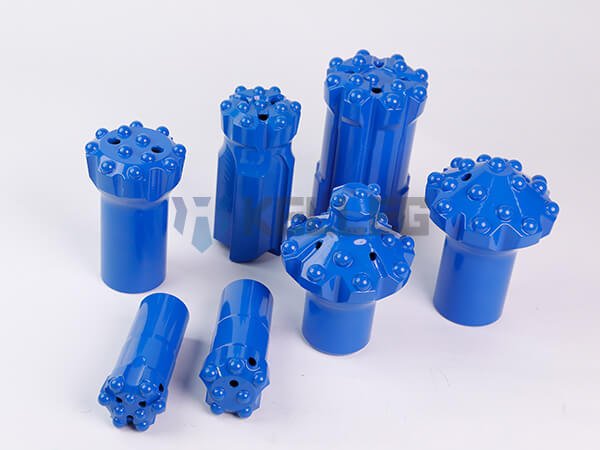
A threaded button bit consists of several important components that work together to ensure efficient drilling performance and long service life.
Carbide Buttons #
Carbide buttons are the cutting elements of the drill bit and the primary contact points with the rock surface. Made from high-strength tungsten carbide, these buttons provide excellent wear resistance and impact toughness.
Different button shapes are designed for different drilling conditions:
- Spherical buttons for hard and abrasive rock
- Ballistic buttons for faster penetration in softer formations
- Semi-ballistic buttons for balanced performance
The quality and arrangement of carbide buttons directly affect drilling speed, durability, and hole quality.
Skirt Body #
The skirt body is the steel structure that supports the carbide buttons and absorbs drilling stresses during operation. It protects the bit from excessive wear and helps maintain drilling stability.
Different skirt designs are available for various drilling applications, including:
- Standard skirt
- Retrac skirt for fractured rock
- Heavy-duty skirt for abrasive formations
A properly designed skirt body improves bit durability and reduces the risk of body cracking or premature failure.
Thread Connection #
The threaded connection allows the bit to securely connect with drill rods or extension rods. Different thread types are used depending on drilling equipment, hole diameter, and drilling depth requirements.
Common thread standards include:
- R25
- R28
- R32
- T38
- T45
- T51
- GT60
A reliable thread connection ensures efficient energy transfer and stable drilling performance.
Flushing Holes #
Flushing holes are designed to deliver compressed air or water through the bit during drilling. Their main function is to remove rock debris from the bottom of the hole and cool the drilling components.
Proper flushing helps:
- Improve penetration rate
- Reduce bit overheating
- Prevent clogging and regrinding
- Extend tool service life
The flushing hole layout may vary depending on the bit design and drilling application.
Face Design #
The face design determines how the bit contacts the rock and influences drilling stability, penetration speed, and hole straightness.
Common face designs include:
- Flat face for hard and abrasive rock
- Drop center face for better hole straightness
- Concave face for balanced drilling performance
- Convex face for faster penetration in softer rock
Selecting the proper face design is critical for optimizing drilling efficiency under different geological conditions.
Why Threaded Button Bits Are Widely Used in Mining, Quarrying & Tunneling #
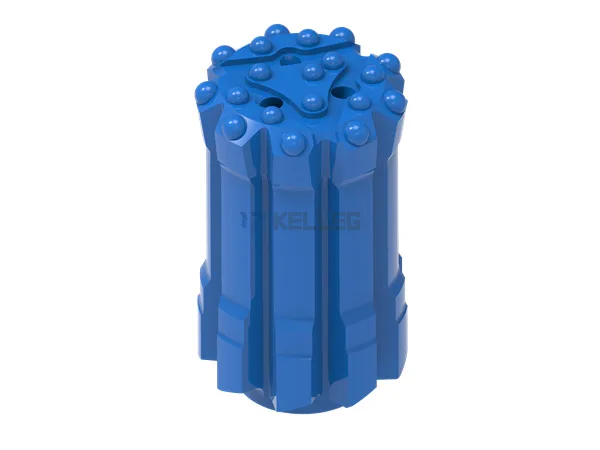
Threaded button bits have become one of the most important consumable tools in modern rock drilling operations. Their ability to deliver efficient energy transfer, high penetration rates, and reliable drilling performance makes them the preferred choice for demanding applications such as mining, quarrying, tunneling, and heavy construction.
Compared with conventional drill bits, threaded button bits are specifically engineered for top hammer drilling, where drilling productivity, hole accuracy, and tool durability are critical to operational success. Their strong threaded connection, wear-resistant carbide buttons, and adaptable face designs allow them to perform efficiently across a wide range of geological conditions.
From underground mine development to tunnel excavation and aggregate production, threaded button bits help contractors and operators improve drilling efficiency while reducing downtime and overall drilling costs.
Advantages of Hard Rock Drilling #
Hard rock drilling environments place extreme stress on drilling tools due to high impact loads, abrasive formations, and continuous operation. Threaded button bits are designed to withstand these demanding conditions while maintaining stable and efficient drilling performance.
High Penetration Rate #
Threaded button bits are designed to maximize impact energy transfer from the rock drill to the rock surface. Combined with optimized carbide button layouts and advanced face designs, they can achieve high penetration rates even in hard and abrasive formations.
Faster penetration helps operators:
- Increase drilling productivity
- Reduce drilling cycle time
- Improve project efficiency
- Lower operational costs per drilled meter
This is particularly important in mining and quarrying operations where drilling speed directly affects production output.
Better Energy Transfer #
The threaded connection between the drill rod and button bit provides a secure and stable interface for transferring percussive energy. Efficient energy transmission minimizes power loss and allows more impact force to reach the rock surface.
Benefits of improved energy transfer include:
- Higher drilling efficiency
- Reduced vibration and stress loss
- Lower fuel or energy consumption
- Improved drilling consistency
Modern threaded button bits are specifically engineered to optimize shock wave transmission under high-frequency drilling conditions.
Stable Hole Quality #
Hole straightness and stability are essential in blasting, tunneling, and underground development projects. Poor hole quality can negatively affect blasting results, excavation accuracy, and overall project safety.
Threaded button bits help maintain:
- Better hole alignment
- Reduced hole deviation
- Consistent hole diameter
- Improved drilling accuracy
Specialized face designs, such as drop center and concave faces, further improve guidance and hole stability in fractured or uneven rock formations.
Longer Service Life #
High-quality threaded button bits are manufactured using durable alloy steel and premium tungsten carbide buttons to withstand severe drilling conditions. Proper heat treatment and optimized button geometry help extend bit service life while reducing premature wear and button breakage.
Longer service life offers several operational advantages:
- Reduced tool replacement frequency
- Lower downtime
- Lower drilling consumables costs
- Improved drilling reliability
This makes threaded button bits highly cost-effective for large-scale drilling projects.
Suitability for Different Industries #
Threaded button bits are widely used across multiple industries because they can adapt to different drilling methods, rock formations, and operational requirements.
Mining #

Mining operations require reliable drilling tools capable of handling hard rock conditions, long operating hours, and high production demands. Threaded button bits are extensively used in both surface and underground mining applications.
Underground Mining #
In underground mining, threaded button bits are commonly used for:
- Face drilling
- Production drilling
- Roof support drilling
- Ore body development
Their stable drilling performance and resistance to wear make them ideal for confined underground environments where accuracy and reliability are essential.
Bench Drilling #
Surface mining operations often use threaded button bits for bench drilling in open-pit mines. These applications require high penetration rates and durable drilling tools capable of handling abrasive rock formations.
Benefits include:
- Faster drilling cycles
- Improved blasting efficiency
- Reduced downtime
- Better hole consistency
Drift Development #
Drift and tunnel development require accurate drilling to ensure controlled blasting and smooth excavation progress. Threaded button bits help maintain straight holes and stable drilling performance during underground development operations.
Quarrying #

Quarry drilling operations require efficient and durable drilling tools to maximize aggregate production and maintain consistent drilling performance.
Aggregate Production #
In aggregate quarries, threaded button bits are widely used for production drilling in limestone, granite, basalt, and other rock formations.
Advantages include:
- High drilling productivity
- Reduced wear in abrasive rock
- Consistent blasting results
- Lower cost per drilled meter
Dimension Stone Extraction #
Dimension stone quarrying requires precise drilling to minimize rock damage and improve block quality. Threaded button bits provide controlled drilling performance and accurate hole placement for stone extraction operations.
Tunneling #
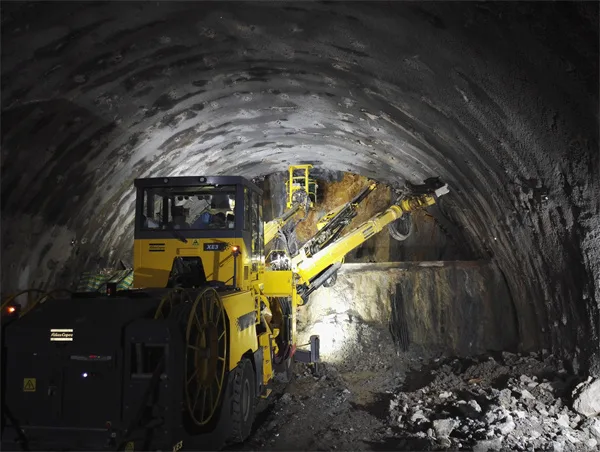
Tunnel excavation projects demand accurate drilling tools capable of handling varying geological conditions and maintaining stable drilling performance.
Drill and Blast Tunneling #
Threaded button bits are essential in drill-and-blast tunnel excavation methods. They are used to create precise blast holes that ensure effective rock fragmentation and controlled tunnel profiles.
Key benefits include:
- Accurate drilling patterns
- Better blasting efficiency
- Reduced overbreak
- Improved excavation quality
Underground Infrastructure #
Large underground infrastructure projects, such as metro systems, utility tunnels, and transportation tunnels, rely on threaded button bits for efficient rock excavation and ground-support drilling.
Hydropower Projects #
Hydropower tunnel construction often involves drilling through hard and abrasive rock formations. Durable threaded button bits help maintain drilling efficiency and reduce downtime in these demanding environments.
Construction #
Threaded button bits are also widely used in civil engineering and construction projects that involve rock excavation and foundation work.
Foundation Drilling #
Construction projects frequently require rock drilling for:
- Pile foundations
- Ground reinforcement
- Structural support installations
Threaded button bits provide reliable drilling performance in reinforced ground and rock formations.
Slope Stabilization #
Slope stabilization projects often involve anchor drilling and rock reinforcement in difficult geological conditions. Button bits with strong wear resistance and stable drilling capability are commonly used for these applications.
Road Projects #
Road construction and infrastructure development frequently require controlled rock blasting and excavation. Threaded button bits help improve drilling productivity and maintain accurate blasting hole placement in highway and railway projects.
Threaded Button Bit Face Designs #
The face design of a threaded button bit plays a major role in drilling performance, hole quality, penetration rate, and service life. Different face profiles are engineered for specific rock conditions and drilling applications, making proper selection essential for achieving efficient and stable rock drilling results.
Factors such as rock hardness, abrasiveness, hole depth, and drilling accuracy requirements all influence which face design performs best in the field. Choosing the wrong face configuration may lead to excessive bit wear, hole deviation, poor flushing, or reduced drilling efficiency.
Below are the most common threaded button bit face designs used in mining, quarrying, tunneling, and construction drilling operations.
Flat Face Button Bits #
Flat face button bits are widely recognized as the best choice for hard, abrasive, and fractured rock formations. Their flat surface design provides maximum contact with the rock, resulting in excellent drilling stability and strong resistance to carbide button breakage.
This design is particularly effective in applications where hole straightness and reduced deviation are critical, such as underground mining and long-hole drilling.
Advantages #
- Excellent performance in hard and abrasive rock
- Strong resistance to wear and impact damage
- Reduced hole deviation
- Improved drilling stability in fractured formations
- Longer service life in demanding conditions
Limitations #
- Slightly lower penetration rate in softer rock
- Higher energy consumption compared to aggressive face designs
Recommended Rock Formations #
- Granite
- Basalt
- Quartzite
- Hard abrasive ore bodies
- Fractured underground rock formations
Drop Center Face Bits #
Drop center face bits feature a recessed center design that improves hole guidance and flushing performance. This structure helps maintain straighter holes, especially in broken or uneven rock formations.
The recessed center also enhances cutting removal by improving airflow or water flushing at the hole bottom, reducing the risk of clogging and regrinding.
Advantages #
- Improved hole straightness
- Better flushing efficiency
- Stable drilling in fractured rock
- Reduced hole wandering
- Effective debris removal
Limitations #
- Slightly slower penetration in extremely hard rock
- Center area may wear faster under abrasive conditions
Recommended Rock Formations #
- Broken rock formations
- Medium-hard rock
- Underground tunnel drilling
- Drift and development drilling
- Applications requiring accurate hole alignment
Concave Face Bits #
Concave face button bits are one of the most commonly used general-purpose designs in top hammer drilling. The inward-curved face improves drilling centering ability and provides balanced performance across a wide range of rock conditions.
This design offers an excellent combination of penetration rate, hole quality, and bit durability, making it highly popular in mining, quarrying, and tunneling operations.
Advantages #
- Good overall drilling stability
- Balanced penetration and service life
- Excellent hole centering capability
- Suitable for various rock formations
- Versatile general-purpose performance
Limitations #
- May not achieve maximum penetration in soft rock
- Not as wear-resistant as flat face designs in highly abrasive formations
Recommended Rock Formations #
- Medium-hard rock
- Mixed geological conditions
- Limestone
- Dolomite
- General quarry and tunneling applications
Convex Face Bits #
Convex face button bits are designed to maximize penetration speed in softer and less abrasive rock formations. The outward-curved face concentrates impact energy into a smaller contact area, allowing faster rock breaking and increased drilling productivity.
These bits are often used where high drilling speed is prioritized over maximum durability.
Advantages #
- Faster penetration rates
- Efficient energy concentration
- Increased drilling productivity in soft rock
- Lower drilling resistance
Limitations #
- Reduced stability in hard rock
- Higher risk of hole deviation
- Faster wear in abrasive formations
- Less suitable for fractured ground
Recommended Rock Formations #
- Soft rock
- Medium-soft formations
- Limestone
- Sandstone
- Non-abrasive quarry formations
Recommended Face Design for Different Rock Formations #
Selecting the correct face design according to rock conditions can significantly improve drilling efficiency and reduce operating costs.
| Rock Formation | Recommended Face Design | Main Benefit |
|---|---|---|
| Hard abrasive rock | Flat Face | Maximum durability and stability |
| Fractured rock | Drop Center Face | Better hole straightness |
| Medium-hard mixed rock | Concave Face | Balanced overall performance |
| Soft non-abrasive rock | Convex Face | Faster penetration rate |
| Underground tunneling | Drop Center / Concave | Improved hole accuracy |
| Quarry bench drilling | Concave / Convex | Productivity and drilling speed |
Comparison of Threaded Button Bit Face Designs #
| Face Design | Best Rock Type | Penetration Rate | Hole Straightness | Wear Resistance | Main Advantage |
|---|---|---|---|---|---|
| Flat Face | Hard & abrasive rock | Medium | Excellent | Excellent | Stability and durability |
| Drop Center | Fractured & medium-hard rock | Medium | Excellent | Good | Better flushing and guidance |
| Concave Face | General-purpose formations | Good | Good | Good | Balanced performance |
| Convex Face | Soft rock | Excellent | Moderate | Moderate | Faster drilling speed |
Selecting the proper threaded button bit face design is essential for optimizing drilling performance, reducing downtime, and extending tool service life. Understanding how each design interacts with specific rock conditions helps drilling contractors and mining operators achieve higher productivity and lower drilling costs.
How to Choose the Best Threaded Button Bits #
Choosing the best threaded button bit is essential for maximizing drilling efficiency, reducing operating costs, and extending tool service life. Different drilling projects require different bit configurations depending on rock conditions, drilling depth, hole diameter, and equipment specifications.
A properly selected threaded button bit can improve penetration rate, reduce downtime, minimize energy consumption, and maintain better hole quality. On the other hand, using the wrong bit design may lead to excessive wear, poor drilling performance, carbide breakage, or unstable drilling results.
Below are the key factors to consider when selecting threaded button bits for mining, quarrying, tunneling, and construction applications.
Consider Rock Hardness #
Rock hardness is one of the most important factors when choosing a threaded button bit. Different geological formations require different carbide button shapes, face designs, and skirt body structures to achieve the best drilling performance.
Soft Rock #
Soft rock formations usually allow faster penetration rates and lower drilling resistance. In these conditions, operators often prioritize drilling speed and productivity.
Recommended features for soft rock:
- Convex face design
- Ballistic carbide buttons
- Aggressive cutting structure
- Larger flushing holes for faster debris removal
Typical soft rock formations include:
- Limestone
- Sandstone
- Shale
- Soft sedimentary rock
Medium-Hard Rock #
Medium-hard formations require a balanced combination of penetration speed, durability, and drilling stability.
Recommended features for medium-hard rock:
- Concave face design
- Semi-ballistic carbide buttons
- Balanced button distribution
- Standard skirt body
Typical applications include:
- General quarry drilling
- Tunnel development
- Construction blasting
Hard Abrasive Rock #
Hard, abrasive rock formations impose high-impact stress and severe wear on drilling tools. In these environments, durability and wear resistance become the primary concerns.
Recommended features for hard abrasive rock:
- Flat face design
- Spherical carbide buttons
- Heavy-duty skirt body
Typical hard rock formations include:
- Granite
- Basalt
- Quartzite
- Hard ore bodies
Selecting a bit specifically designed for abrasive conditions helps reduce button breakage, extend service life, and improve drilling reliability.
Match Hole Diameter Requirements #
Hole diameter requirements directly affect the selection of thread type, bit size, flushing design, and drilling configuration.
Small-Hole Drilling #
Small-hole drilling applications are commonly used in:
- Underground mining
- Secondary blasting
- Light construction work
- Roof bolting
Typical characteristics:
- Smaller thread sizes, such as R25 or R28
- Lightweight drilling equipment
- Improved maneuverability in confined spaces
Smaller button bits provide better flexibility and easier handling for short-hole applications.
Production Drilling #
Production drilling requires efficient drilling performance and consistent hole quality to maximize blasting productivity.
Typical requirements include:
- Medium to large hole diameters
- High penetration rate
- Durable carbide protection
- Stable hole alignment
Common thread types:
- R32
- T38
- T45
These configurations are widely used in quarrying, bench drilling, and tunnel excavation.
Long-Hole Drilling #
Long-hole drilling places greater stress on the drill rod and requires excellent hole straightness and energy transfer efficiency.
Recommended features:
- Larger thread connections
- High-strength skirt body
- Stable face design
- Improved flushing capability
Common thread types for long-hole drilling:
- T45
- T51
- GT60
Proper bit selection helps minimize hole deviation and maintain drilling accuracy at greater depths.
Select Proper Thread Type #
Choosing the correct thread type is critical for ensuring compatibility with drilling equipment and achieving efficient energy transfer.
Drill Rod Compatibility #
The button bit thread must match the drill rod thread exactly to ensure:
- Secure connection
- Efficient shock wave transmission
- Reduced thread wear
- Stable drilling performance
Common thread standards include:
- R25
- R28
- R32
- T38
- T45
- T51
- GT60
Using incompatible thread types may result in poor energy transfer and premature equipment damage.
Drill Rig Power #
More powerful drilling rigs generate higher impact energy and torque, which require stronger thread connections and more durable bit structures.
General recommendations:
- Smaller rigs → R25 / R28 / R32
- Medium rigs → T38 / T45
- Heavy-duty rigs → T51 / GT60
Matching the thread size with drill rig power helps maintain stable drilling efficiency and reduce connection failures.
Drilling Depth #
Deeper drilling applications require stronger and more stable thread types to handle increased stress and vibration.
For deep-hole drilling:
- Larger thread types are preferred
- Higher rigidity improves hole straightness
- Better energy transfer reduces drilling loss
Proper thread selection is especially important in underground mining and long-hole production drilling.
Evaluate Penetration Rate vs Service Life #
One of the most important considerations when selecting threaded button bits is balancing drilling speed with tool durability.
Faster Drilling vs Lower Wear #
Aggressive bit designs can improve penetration rates but may increase wear under abrasive conditions. Conversely, highly wear-resistant bits may drill more slowly but offer longer service life.
Examples:
- Ballistic buttons → faster penetration but faster wear
- Spherical buttons → slower penetration but longer durability
The ideal balance depends on:
- Rock conditions
- Production targets
- Equipment capability
- Operating budget
Total Drilling Cost Consideration #
The cheapest bit is not always the most economical option. Operators should evaluate total drilling cost rather than focusing only on initial purchase price.
Important cost factors include:
- Cost per drilled meter
- Bit lifespan
- Downtime for replacement
- Fuel or energy consumption
- Drilling productivity
High-quality threaded button bits often provide lower long-term operating costs through improved efficiency and reduced maintenance.
Different drilling applications require different threaded button bit designs to achieve the best balance between penetration rate, durability, hole quality, and operating cost. Rock conditions, drilling methods, equipment power, and project requirements all influence which type of button bit performs most efficiently in the field.
Selecting application-specific threaded button bits helps operators improve drilling productivity, reduce downtime, extend tool life, and maintain stable drilling performance under challenging working conditions.
Below are the recommended threaded button bit features for mining, quarrying, and tunneling applications.
Best Threaded Button Bits for Mining #
Mining operations often involve hard and abrasive rock formations, long operating hours, and demanding drilling environments. In underground and surface mining, drilling tools must provide reliable performance, strong wear resistance, and stable hole quality to support efficient blasting and ore extraction.
The best threaded button bits for mining are typically designed with reinforced structures, durable carbide buttons, and stable face configurations capable of withstanding high-impact drilling conditions.
Key Features for Mining Applications #
High Wear Resistance #
Mining environments frequently involve abrasive rock types such as granite, basalt, quartzite, and hard ore bodies. Button bits used in these conditions require premium tungsten carbide buttons and high-strength alloy steel bodies to resist excessive wear and impact damage.
Recommended features include:
- Spherical carbide buttons
- Flat face or concave face designs
- Heavy-duty skirt body
- Reinforced gauge buttons
High wear resistance helps reduce:
- Carbide breakage
- Premature bit failure
- Tool replacement frequency
- Overall drilling consumable costs
Stable Drilling Performance #
Stable drilling is critical in underground mining operations where hole accuracy directly affects blasting efficiency and tunnel development quality.
Threaded button bits designed for mining should provide:
- Smooth energy transfer
- Reduced vibration
- Consistent penetration rate
- Reliable hole alignment
Concave and flat face designs are commonly preferred for maintaining drilling stability in fractured or variable rock formations.
Reduced Hole Deviation #
Hole deviation can negatively impact blasting accuracy, ore recovery, and drilling efficiency. In long-hole production drilling and underground development, maintaining straight holes is especially important.
Recommended designs for reduced deviation include:
- Flat face bits
- Drop center face bits
- Balanced carbide button layouts
These designs help improve:
- Hole straightness
- Blasting precision
- Fragmentation quality
- Drilling accuracy at greater depths
Recommended Mining Applications #
Threaded button bits are widely used in:
- Underground mining
- Drift development
- Long-hole drilling
- Bench drilling
- Production blasting
- Ore body development
Common thread types:
- R32
- T38
- T45
- T51
Best Threaded Button Bits for Quarrying #
Quarry drilling operations focus heavily on productivity, penetration speed, and cost efficiency. In aggregate and stone production, drilling performance directly influences blasting results and overall material output.
The best threaded button bits for quarrying are typically designed to maximize drilling speed while maintaining acceptable wear resistance and hole quality.
Key Features for Quarrying Applications #
Faster Penetration Rate #
High drilling productivity is essential in quarry operations where large numbers of blast holes are drilled daily.
Recommended features include:
- Convex or concave face designs
- Ballistic or semi-ballistic buttons
- Optimized flushing systems
- Efficient cutting structures
Faster penetration provides:
- Higher production efficiency
- Reduced drilling time
- Lower fuel and energy consumption
- Increased equipment utilization
Large Hole Diameter Capability #
Quarry blasting often requires larger hole diameters to improve rock fragmentation and blasting efficiency. Larger threaded button bits provide stronger rock-breaking capability and improved productivity for bench drilling applications.
Common large-diameter drilling applications include:
- Aggregate production
- Open-pit quarrying
- Limestone extraction
- Granite quarry drilling
Typical thread types:
- T38
- T45
- T51
- GT60
Recommended Quarry Applications #
Threaded button bits are commonly used for:
- Bench drilling
- Production blasting
- Aggregate quarrying
- Limestone drilling
- Granite quarry operations
- Dimension stone extraction
Best Threaded Button Bits for Tunneling #
Tunnel drilling applications require high drilling precision, stable hole quality, and reliable performance under complex geological conditions. Tunnel excavation often involves confined spaces, fractured ground, and demanding drilling angles, making bit stability and hole consistency extremely important.
The best threaded button bits for tunneling are designed to improve drilling control, reduce jamming risk, and maintain accurate blast hole positioning.
Key Features for Tunneling Applications #
Anti-Jamming Performance #
Tunnel drilling frequently encounters fractured rock, broken ground, and unstable formations that can increase the risk of bit sticking or jamming.
Button bits with strong anti-jamming capability typically feature:
- Drop center face designs
- Efficient flushing hole layouts
- Smooth debris evacuation channels
These designs help:
- Improve cutting removal
- Reduce blockage risk
- Prevent stuck drilling tools
- Maintain a continuous drilling operation
Efficient flushing is especially important in underground tunneling environments where poor debris removal can quickly reduce drilling performance.
Consistent Hole Quality #
Accurate and consistent blast holes are essential for achieving controlled tunnel excavation and minimizing overbreak.
Threaded button bits used in tunneling should provide:
- Excellent hole straightness
- Stable drilling guidance
- Consistent hole diameter
- Reduced vibration during drilling
Stable hole quality improves:
- Blasting efficiency
- Tunnel profile accuracy
- Rock fragmentation control
- Excavation safety
Recommended Tunneling Applications #
Threaded button bits are widely used in:
- Drill-and-blast tunneling
- Underground infrastructure projects
- Metro tunnel construction
- Hydropower tunnels
- Railway tunnels
- Road tunnel excavation
Commonly recommended thread types:
- R32
- T38
- T45
Preferred face designs:
- Drop center face
- Concave face
Recommended Threaded Button Bits by Application #
| Application | Recommended Features | Preferred Face Design | Typical Thread Types |
|---|---|---|---|
| Underground Mining | High wear resistance, stable drilling | Flat Face / Concave Face | R32, T38, T45 |
| Quarrying | Faster penetration, productivity focus | Convex Face / Concave Face | T38, T45, T51 |
| Tunneling | Anti-jamming, hole consistency | Drop Center / Concave Face | R32, T38, T45 |
| Hard Abrasive Rock | Heavy-duty carbide protection | Flat Face | T45, T51 |
| Soft Rock Quarrying | High penetration speed | Convex Face | T38, T45 |
Selecting the right threaded button bit according to the application environment can significantly improve drilling efficiency, reduce operating costs, and extend tool service life across mining, quarrying, and tunneling projects.
How to Choose a Reliable Threaded Button Bit Supplier #
Selecting a reliable threaded button bit supplier is just as important as choosing the right drill bit design. High-quality drilling tools directly influence drilling efficiency, tool lifespan, hole accuracy, and overall operating costs in mining, quarrying, tunneling, and construction projects.
A professional supplier should not only provide durable products but also offer technical expertise, stable production capability, quality control, and customized drilling solutions for different rock formations and working conditions.
When evaluating threaded button bit manufacturers or suppliers, the following factors should be carefully considered.
Material Quality #
The overall durability and performance of threaded button bits largely depend on the quality of the raw materials used in production.
Reliable suppliers typically use:
- High-strength alloy steel
- Wear-resistant steel materials
- Strictly controlled forging materials
- Premium raw material sourcing standards
High-quality steel improves:
- Impact resistance
- Fatigue strength
- Thread durability
- Resistance to cracking and deformation
Poor-quality materials may lead to:
- Premature body failure
- Thread damage
- Reduced service life
- Unstable drilling performance
A trustworthy supplier should have strict material inspection procedures and stable raw material supply systems to ensure consistent product quality.
Carbide Grade #
Carbide buttons are the primary rock-breaking components of threaded button bits, making carbide quality one of the most critical performance factors.
Different drilling applications require different carbide grades depending on:
- Rock hardness
- Abrasiveness
- Impact load
- Drilling speed requirements
A reliable supplier should offer multiple carbide solutions, including:
- Spherical carbide buttons for hard abrasive rock
- Ballistic buttons for faster penetration
- Semi-ballistic buttons for balanced performance
High-quality carbide provides:
- Better wear resistance
- Stronger impact toughness
- Reduced button breakage
- Longer service life
Advanced carbide technology helps lower drilling costs by improving bit durability and reducing downtime.
Heat Treatment Capability #
Heat treatment is a key manufacturing process that directly affects the strength, toughness, and fatigue resistance of threaded button bits.
Professional suppliers use advanced heat treatment processes to optimize:
- Surface hardness
- Core toughness
- Wear resistance
- Structural stability
Proper heat treatment helps button bits withstand:
- High-frequency impact loads
- Extreme drilling vibration
- Abrasive rock conditions
- Long-term drilling stress
Inconsistent or poor heat treatment may result in:
- Cracking
- Excessive wear
- Thread deformation
- Reduced drilling reliability
When selecting a supplier, it is important to evaluate whether they have:
- Controlled heat treatment systems
- Automated temperature monitoring
- Stable manufacturing standards
- Quality inspection procedures
OEM and Customization Support #
Different drilling projects often require customized button bit designs to match specific geological conditions and drilling equipment.
Reliable threaded button bit suppliers should provide OEM and customization services, such as:
- Customized thread types
- Special face designs
- Carbide button configuration optimization
- Logo marking and branding
- Custom flushing hole layouts
Customization support is especially valuable for:
- Mining contractors
- Drilling equipment distributors
- Large infrastructure projects
- Regional geological requirements
An experienced supplier can recommend optimized designs based on:
- Rock conditions
- Hole diameter
- Drill rig specifications
- Drilling depth
- Operational goals
Production Capacity #
Stable production capability is essential for ensuring consistent product supply and timely delivery, especially for large-scale drilling projects.
A reliable supplier should have:
- Modern manufacturing facilities
- Automated production equipment
- Large-scale forging capability
- CNC machining systems
- Quality control laboratories
- Efficient inventory management
Strong production capacity helps ensure:
- Consistent product quality
- Faster delivery times
- Stable supply for long-term projects
- Better response to urgent orders
For mining and tunneling projects with continuous drilling operations, supply stability is extremely important to avoid costly downtime.
Global Project Experience #
Suppliers with international project experience are often better equipped to understand different drilling challenges and application requirements.
Experienced global suppliers typically have knowledge in:
- Underground mining operations
- Quarry production drilling
- Tunnel excavation projects
- Hydropower construction
- Infrastructure development
They are more familiar with:
- Different geological formations
- Regional drilling standards
- International quality requirements
- Equipment compatibility across markets
A supplier with proven global experience can often provide:
- More reliable product recommendations
- Better application matching
- Field-tested drilling solutions
- Stronger technical confidence
When evaluating suppliers, consider reviewing:
- Export markets
- Project references
- Industry certifications
- Customer case studies
Technical Support #
Professional technical support is an important factor that many buyers overlook when purchasing threaded button bits.
Reliable suppliers should provide technical assistance before, during, and after the sale.
Technical support may include:
- Bit selection recommendations
- Rock formation analysis
- Drilling parameter optimization
- Bit failure analysis
- Regrinding recommendations
- Application troubleshooting
Strong technical support helps customers:
- Improve drilling efficiency
- Reduce consumable costs
- Avoid incorrect bit selection
- Solve field drilling problems faster
Suppliers with experienced engineering teams can provide more practical drilling solutions based on real operating conditions rather than simply selling standard products.
Key Checklist for Choosing a Threaded Button Bit Supplier #
| Evaluation Factor | Why It Matters |
|---|---|
| Material Quality | Determines durability and structural strength |
| Carbide Grade | Affects wear resistance and drilling efficiency |
| Heat Treatment | Improves impact toughness and service life |
| OEM Capability | Supports customized drilling solutions |
| Production Capacity | Ensures stable supply and timely delivery |
| Global Experience | Provides proven field application knowledge |
| Technical Support | Helps optimize drilling performance |
Choosing the right threaded button bit supplier can significantly improve drilling productivity, reduce operating costs, and ensure long-term reliability in mining, quarrying, tunneling, and construction projects. A supplier with strong manufacturing capability, technical expertise, and industry experience can provide far greater value than simply offering the lowest product price.
Conclusion #
Selecting the correct threaded button bit is essential for achieving efficient, reliable, and cost-effective rock drilling performance. The right bit design directly affects drilling penetration rate, hole quality, energy consumption, tool lifespan, and overall operating costs across mining, quarrying, tunneling, and construction projects.
Because drilling conditions vary significantly between different rock formations and applications, there is no single button bit solution suitable for every project. Hard abrasive rock, fractured ground, soft formations, long-hole drilling, and tunnel excavation each require specific combinations of face design, carbide button shape, thread type, and flushing configuration to achieve the best results.
High-quality threaded button bits not only improve drilling speed and productivity but also help reduce downtime, minimize premature wear, and extend service life under demanding working conditions. Investing in properly designed and professionally manufactured button bits can significantly lower cost per drilled meter while improving operational stability and long-term drilling performance.
Whether for underground mining, quarry production, or tunnel development, choosing the right threaded button bit and working with a reliable supplier are key factors in maximizing drilling efficiency and project success.