- Introduction
- Why Rock Hardness and Abrasiveness Matter More Than You Think
- Rock Classification for Fast Bit Selection (Soft → Extremely Abrasive)
- Top Hammer Button Bit Selection Framework
- Quick Decision Checklist
- Quick Selection Guide: Which Button Bit Works Best for Each Rock Type
- Button Bit Selection Comparison Table
- Common Selection Mistakes to Avoid
- Pro Tips to Improve Bit Performance in Different Rock Conditions
- When Should You Switch Bit Type During Drilling?
- Work with the Right Button Bit Supplier
- Conclusion
Introduction #
Choosing the wrong top hammer button bit can quickly lead to low drilling efficiency, premature wear, and increased operational costs. Many conventional guides focus heavily on button shapes, but this approach often feels too technical and impractical for fast decision-making in the field.
In reality, what matters most is how the bit matches the rock hardness and abrasiveness. These two factors directly determine drilling performance and tool lifespan.
This guide takes a more practical approach by classifying rock conditions from soft to extremely abrasive, helping you quickly identify the most suitable button bit setup for each scenario.
With the right selection strategy, you can significantly improve penetration rate (ROP), extend bit service life, and achieve better overall cost control in your drilling operations.
Why Rock Hardness and Abrasiveness Matter More Than You Think #
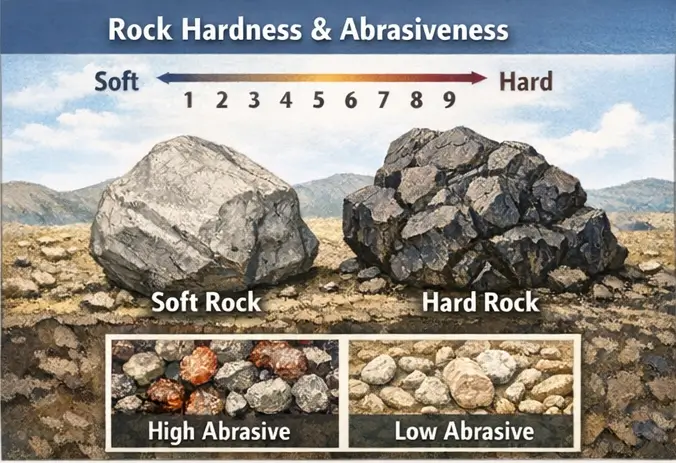
When selecting a top hammer button bit, many operators focus on general rock type or experience. However, two factors have a far greater impact on drilling performance than most people realize: rock hardness and abrasiveness.
- Rock hardness determines how easily the formation can be broken. The harder the rock, the more impact energy is required, and the slower the penetration rate.
- Rock abrasiveness controls how quickly the bit wears. Highly abrasive formations can rapidly grind down carbide buttons and gauge protection, even if the rock is not extremely hard.
In simple terms:
- Hardness affects how fast you can drill (penetration rate)
- Abrasiveness determines how long your bit will last (service life)
Focusing on only one while ignoring the other often leads to poor performance and higher costs. That’s why an effective selection strategy must consider both factors together.
Rock Classification for Fast Bit Selection (Soft → Extremely Abrasive) #
To enable quick field decisions, rock formations can be classified by hardness and abrasiveness, which directly determine the performance requirements for button bits. The table below provides a practical reference for selecting top-hammer drilling applications.
| Rock Type | Hardness Level | Abrasiveness | Typical Examples | Drilling Challenge |
|---|---|---|---|---|
| Soft Rock | Low | Low | Clay, shale | Over-penetration, poor hole control |
| Medium Rock | Medium | Low–Medium | Limestone | Balanced drilling conditions |
| Hard Rock | High | Medium | Granite | Reduced penetration rate |
| Very Hard Rock | Very High | Medium–High | Basalt | High impact stress on bit structure |
| Extremely Abrasive Rock | Medium–High | Very High | Quartzite | Severe wear and short bit life |
This classification provides a clear foundation for selecting the right button bit configuration, helping operators quickly understand what type of drilling challenge they are dealing with before choosing the appropriate solution.
Next, we’ll break down a practical selection framework to help you quickly choose the right top hammer button bit based on rock hardness and abrasiveness.
Top Hammer Button Bit Selection Framework #

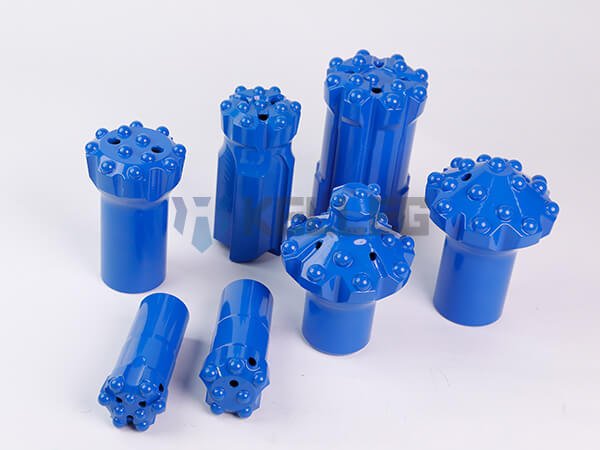
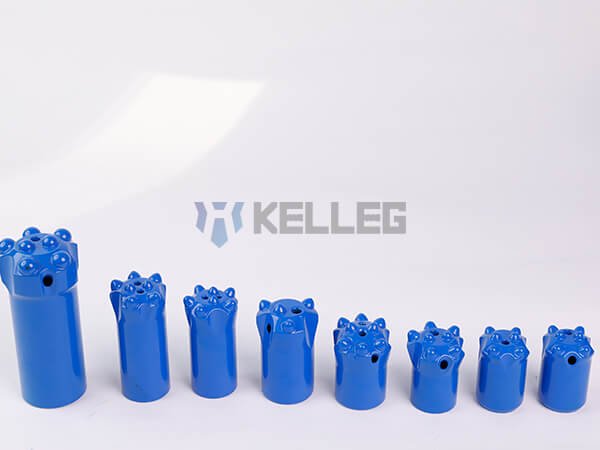
To make fast and reliable decisions in the field, your selection should be based on three core elements working together:
Button Shape #
- Determines penetration behavior and wear resistance
- Should be matched to rock hardness and abrasiveness
For a detailed comparison of different button geometries, see our Button Drill Bits Guide.
Face Design #
- Controls hole stability, flushing efficiency, and energy distribution
- Different face structures perform better in different ground conditions
Bit Type (Standard / Retrac / Reaming) #
- Standard Bit → General drilling in stable formations
- Retrac Bit → Better hole straightness and performance in fractured or broken rock
- Reaming Bit → Used for enlarging holes or maintaining diameter
Quick Decision Checklist #
Use this simple checklist for fast selection:
Step 1: Identify Rock Hardness
- Soft / Medium / Hard / Very Hard
Step 2: Evaluate Abrasiveness
- Low / Medium / High
Step 3: Define Priority
- Soft rock → Focus on penetration
- Hard rock → Focus on impact resistance
- Abrasive rock → Focus on wear resistance
Step 4: Match Configuration
- Select an appropriate button shape
- Choose a suitable face design
- Confirm correct bit type based on hole condition
Quick Selection Guide: Which Button Bit Works Best for Each Rock Type #
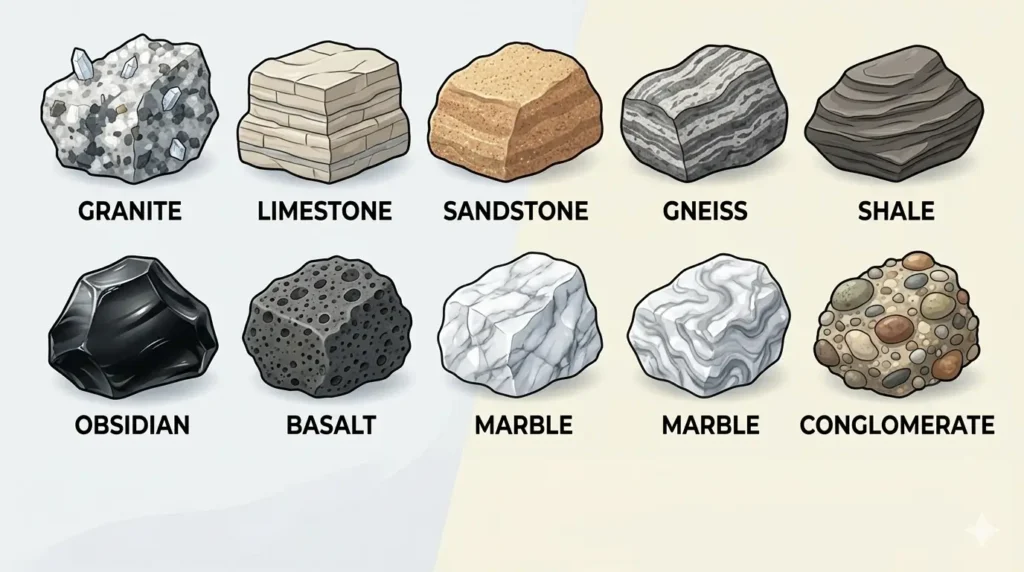
This section provides a direct, field-ready selection guide to help you quickly match rock conditions → optimal top hammer button bit configuration without complex analysis.
Soft Rock (Low Hardness, Low Abrasiveness) #
Selection Focus:
- Aggressive penetration
- Avoid clogging
Recommended Setup:
- Button distribution: Wider spacing
- Flushing design: Strong flushing capacity
Avoid:
- Overly dense button layout (can reduce penetration efficiency)
Medium Rock (Balanced Conditions) #
Selection Focus:
- Balanced penetration and durability
Recommended Setup:
- Moderate button density
- Standard flushing holes
Hard Rock (High Hardness) #
Selection Focus:
- Impact resistance
- Controlled penetration
Recommended Setup:
- Higher button density
- Reinforced gauge area protection
Very Hard Rock (Extreme Impact Conditions) #
Selection Focus:
- Maximum durability
- Crack resistance
Recommended Setup:
- Dense button layout
- Strong carbide support structure
Extremely Abrasive Rock (High Wear Environment) #
Selection Focus:
- Wear resistance is more important than penetration speed
Recommended Setup:
- Extra gauge protection
- High wear-resistant carbide grade
- Optimized flushing for fast cutting removal
Button Bit Selection Comparison Table #
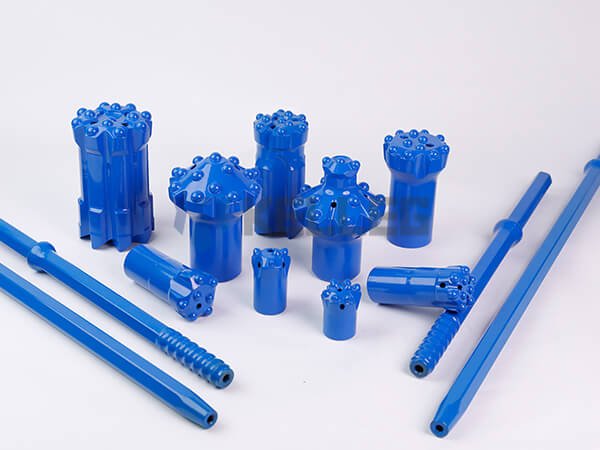
For more precise engineering-level selection, the following table links rock properties (UCS + CAI) with recommended bit configurations:
| Rock Type | Hardness (UCS) | Abrasiveness (CAI) | Rock Characteristics | Recommended Face Design | Recommended Button Shape | Bit Type | Key Selection Focus |
|---|---|---|---|---|---|---|---|
| Granite | Hard (150–300 MPa) | High | Dense, abrasive | Flat Face | Spherical | Retrac button bit | Wear resistance & impact durability |
| Limestone | Medium (50–150 MPa) | Low–Medium | Layered, relatively uniform | Concave / Convex | Ballistic / Parabolic | Standard/Retrac button bit | Faster penetration (ROP) |
| Sandstone | Medium | High | Abrasive, layered | Flat Face | Spherical | Retrac button bit | Anti-wear performance |
| Basalt | Very Hard (>200 MPa) | Medium–High | Tough, dense | Flat Face | Spherical | Retrac button bit | Impact resistance over speed |
| Shale | Soft (<50 MPa) | Low | Fractured, unstable | Concave | Ballistic | Standard button bit | Fast drilling & hole cleaning |
| Quartzite | Very Hard | Very High | Extremely abrasive | Flat Face | Spherical | Retrac button bit | Maximum wear resistance |
| Mixed Formations | Variable | Variable | Interbedded layers | Flat / Slightly Convex | Parabolic / Hybrid | Retrac button bit | Balanced performance |
In real drilling conditions, the best performance comes from matching rock behavior + selecting the right bit configuration combination, rather than relying on a single parameter like hardness alone.
Common Selection Mistakes to Avoid #
Even experienced drillers can face performance issues when button bit selection is based on incomplete rock evaluation. Below are the most common mistakes that lead to reduced efficiency, premature wear, and higher operational costs.
Mistake 1: Only Considering Rock Hardness #
→ Ignoring rock abrasiveness
Many users select a bit based only on how “hard” the rock is, without evaluating how abrasive the formation actually is.
This often results in unexpected gauge wear and shortened bit life, even in moderately hard formations.
Mistake 2: Chasing High Penetration in Highly Abrasive Rock #
→ Leads to rapid bit failure
In abrasive formations, prioritizing penetration rate alone can severely reduce service life.
The bit may drill fast initially, but it will wear out quickly, increasing downtime and replacement costs.
Mistake 3: Using One Bit Type for All Formations #
→ Lower efficiency and higher overall cost
Rock conditions can vary significantly within a single project. Using a “one-size-fits-all” bit approach often leads to:
- Reduced drilling efficiency
- Frequent bit changes
- Unstable performance across different layers
Successful top hammer drilling requires matching the bit to both hardness and abrasiveness, not just relying on general rock type. Avoiding these mistakes is essential for achieving stable performance and controlling total drilling cost.
Pro Tips to Improve Bit Performance in Different Rock Conditions #

Even with the right selection, drilling performance can still be optimized further by adjusting operational parameters to match real rock conditions.
Match impact energy with rock hardness #
Ensure the drill rig energy is properly aligned with formation strength. Too much or too little impact can reduce efficiency and accelerate wear.
Adjust rotation speed in abrasive formations #
In highly abrasive rock, optimized rotation helps reduce localized wear on carbide buttons and improves overall bit life.
Ensure proper air flushing #
Efficient cutting removal prevents re-grinding, reduces heat buildup, and helps maintain stable penetration rates.
Use high-quality carbide buttons #
Carbide grade directly affects wear resistance and impact performance, especially in hard and abrasive formations.
When Should You Switch Bit Type During Drilling? #
Knowing the right moment to change your button bit is critical for maintaining efficiency and avoiding unnecessary downtime.
You should consider switching when:
- ROP (Rate of Penetration) drops significantly
- Uneven button wear is observed
- Hole diameter becomes unstable or inconsistent
👉 These are strong indicators that the current bit configuration is no longer suitable for the changing formation. In such cases, it is recommended to consult your drilling tool supplier for a more optimized solution rather than continuing with reduced performance.
Work with the Right Button Bit Supplier #
Choosing the right supplier is as important as choosing the right bit. A professional partner can significantly improve drilling efficiency and reduce total project cost.
Key capabilities to look for include:
Carbide grade customization #
Ability to match carbide performance with different rock hardness and abrasiveness levels.
Advanced heat treatment capability #
Ensures improved toughness, wear resistance, and overall bit durability.
Field-based technical recommendations #
Practical guidance based on real drilling conditions, not just theoretical specifications.
A reliable supplier helps ensure that your button bit selection is not only correct at the start but continuously optimized throughout the entire drilling operation.
Conclusion #
Selecting the right top hammer button bit is not just about choosing a product—it is about matching the tool to real rock conditions for optimal performance.
In summary:
- Rock hardness determines whether you can drill effectively
- Rock abrasiveness determines how long the bit will last
- Correct selection leads to a balance of higher efficiency and lower overall cost
By evaluating both hardness and abrasiveness together, operators can make faster, more accurate decisions, reduce unnecessary wear, and significantly improve drilling productivity in the field.