- Introduction
- Overview of Heavy-Duty Rock Drilling Tools
- Production Process of Heavy-Duty Rock Drilling Tools
- Raw Material Preparation
- Cutting to Length
- Billet Sorting
- Straightening
- Shot Blasting
- Softening (Forging)
- Annealing
- End Facing and Chamfering
- Machining of Threads
- Semi-Finished Product Inspection
- Carburizing Heat Treatment
- Final Straightening
- Thread Inspection
- Shot Blasting (Second Pass)
- Final Product Inspection
- Surface Anti-Corrosion Treatment
- Product Storage
- Factors Affecting Quality of Heavy-Duty Rock Drilling Tools
- Quality Testing and Standards for Heavy-Duty Rock Drilling Tools
- Common Production Challenges in Heavy-Duty Rock Drilling Tool Manufacturing
- Conclusion
Introduction #
Heavy-duty rock drilling tools are essential tools in industries such as mining, tunneling, quarrying, and large-scale construction. They are designed to withstand extreme impact, abrasion, and high-frequency loads while delivering efficient drilling performance in hard rock and challenging environments.
The quality and reliability of these tools are critical—not only do they directly affect drilling efficiency and operational costs, but they also play a key role in ensuring the safety of workers and the longevity of drilling equipment.
This article aims to provide a comprehensive overview of the production process of heavy-duty rock drilling tools and to examine the key factors that influence their quality, helping manufacturers, engineers, and buyers understand what makes a drilling tool reliable and high-performing.
Overview of Heavy-Duty Rock Drilling Tools #
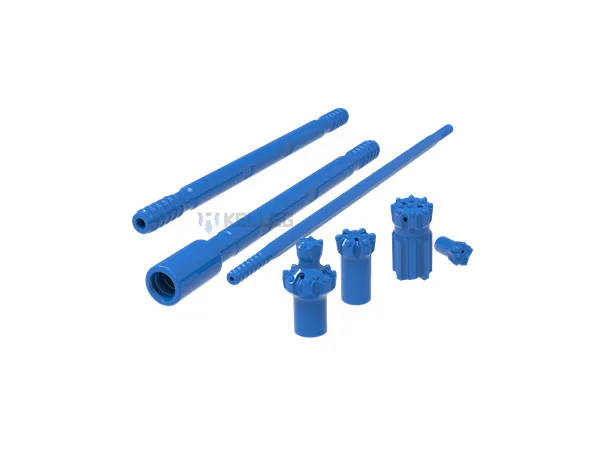
Heavy-duty rock drilling tools are specialized equipment designed for drilling through hard rock and other demanding geological formations. These tools include a range of components such as extension rods, MF rods, and button bits, each tailored to specific drilling requirements and operational conditions.
They are widely used in mining, tunneling, quarrying, and large-scale construction projects, where high penetration rates, durability, and reliability are essential. These tools must perform efficiently under extreme conditions, including high-impact loads, abrasive rock surfaces, and exposure to dust and water.
Manufacturing precision is critical for heavy-duty rock drilling tools. Accurate dimensions, proper thread connections, and precise placement of tungsten carbide inserts ensure optimal energy transfer, reduce wear and tear, and prevent premature failure. High-quality manufacturing directly translates into improved drilling performance, lower operational costs, and enhanced safety on site.
Production Process of Heavy-Duty Rock Drilling Tools #
With the evolving drilling methods, the use of drilling jumbos has increased year by year, leading to a corresponding growth in the demand for heavy-duty rock drilling tools, especially drill rods. To meet this demand, the production of heavy-duty drill rods follows a precise and well-defined process to ensure quality, reliability, and performance.
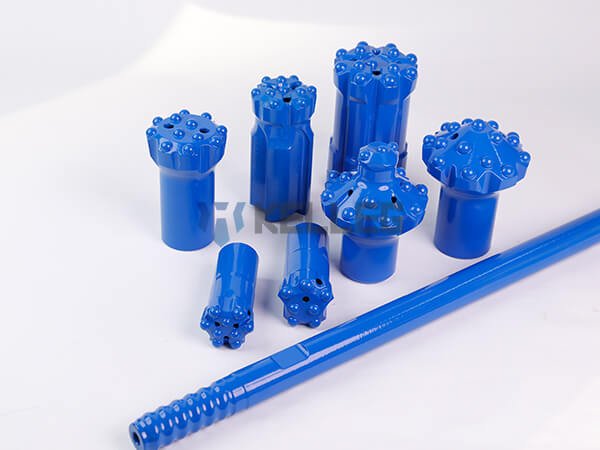
The typical production process includes the following steps:
Raw Material Preparation #
Selecting high-quality steels that meet strength, toughness, and wear-resistance requirements.
Cutting to Length #
Materials are cut to predetermined sizes for further processing.
Billet Sorting #
Raw billets are inspected and sorted according to quality standards to ensure uniformity.
Straightening #
Billets are straightened to correct any deformation and ensure dimensional accuracy.
Shot Blasting #
Surface cleaning removes scale, rust, and impurities to improve subsequent processing and treatment.
Softening (Forging) #
Softening or initial forging prepares the billets for shaping, improving grain structure and toughness.
Annealing #
Heat treatment to relieve internal stresses and enhance material uniformity.
End Facing and Chamfering #
Both ends of the rod are machined to the required dimensions and chamfered for threading and assembly.
Machining of Threads #
Threads are cut on both ends with precise tolerances to ensure proper assembly.
Semi-Finished Product Inspection #
Checks are performed on dimensions, straightness, and thread quality before further treatment.
Carburizing Heat Treatment #
Surface hardening through carburization improves wear resistance and extends service life.
Final Straightening #
Ensures that rods maintain precise straightness after heat treatment.
Thread Inspection #
Verifying thread accuracy and integrity to prevent assembly issues.
Shot Blasting (Second Pass) #
Additional surface cleaning prepares the rods for finishing and coating.
Final Product Inspection #
Comprehensive checks on straightness, dimensions, threads, and hardness ensure quality standards are met.
Surface Anti-Corrosion Treatment #
Coating or treatment to prevent rust and enhance durability.
Product Storage #
Finished products are stored under proper conditions before shipping.
This meticulous production process ensures that heavy-duty drill rods can withstand harsh drilling environments, deliver high performance, and provide long-term reliability in mining, tunneling, and construction applications.
Factors Affecting Quality of Heavy-Duty Rock Drilling Tools #
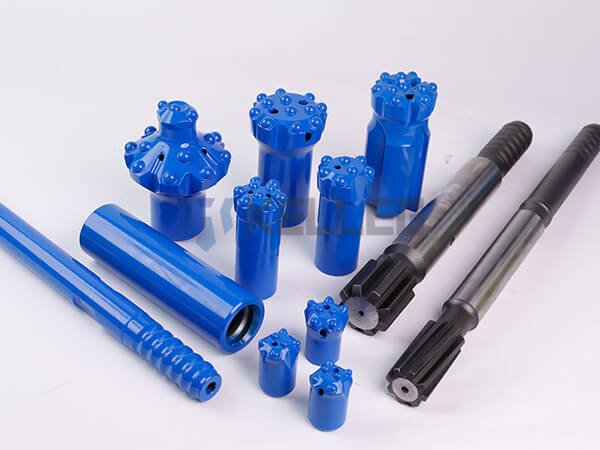
The quality of heavy-duty rock drilling tools depends on multiple factors throughout the production process. Understanding these factors is essential for ensuring reliability, durability, and optimal performance in demanding drilling environments.
Raw Material #
Most rock drill tools are made from high-strength steel. The quality of the raw material has a direct impact on the final product. Defects in the steel—such as decarburization, oxidation, or cracks—can be magnified during carburizing and heat treatment processes. Such defects may compromise the tool’s hardness, toughness, and overall performance, potentially leading to premature failure during drilling operations.
Softening and Forging (Annealing) #
The forging process, often combined with softening and annealing, plays a significant role in the mechanical properties of the drill tool. Proper forging ensures uniform grain structure, improved toughness, and reduced internal stress, laying the foundation for subsequent processing and heat treatment. Poor forging or annealing may introduce weaknesses that affect tool performance and lifespan.
Machining #
Machining is a critical step for defining the dimensions and structural features of the drill rod. The surface quality of the rod directly affects heat treatment results. During machining, residual stresses can develop, potentially causing deformation during heat treatment. Surface defects such as roughness, scratches, or tool marks can lead to stress concentration points, increasing the risk of cracking and early failure during drilling operations. Precision machining and careful surface finishing are therefore essential.
Carburizing and Heat Treatment #
Carburizing and heat treatment are key processes in drill rod production, aiming to increase surface hardness, wear resistance, and fatigue strength while maintaining a tough core. The quality of these processes significantly influences the final tool performance.
Key factors affecting heat treatment quality include:
- Process Design and Operation: Proper temperature, timing, and sequence are crucial for uniform hardening.
- Equipment Performance: Furnace sealing, insulation, temperature uniformity, and atmosphere control directly impact the microstructure.
- Carbon Potential Control: Stable carbon potential during carburization ensures an optimal martensite and residual austenite distribution. Large fluctuations can lead to coarse and uneven microstructures, reducing tool durability.
- Inspection and Quality Control: Accurate monitoring and rigorous testing throughout the heat treatment process are essential to maintain consistent quality.
By carefully controlling these factors—raw material selection, forging, machining, and heat treatment—manufacturers can produce heavy-duty rock drill tools that deliver high reliability, long service life, and superior drilling performance.
Quality Testing and Standards for Heavy-Duty Rock Drilling Tools #

Ensuring the quality of heavy-duty rock drilling tools requires comprehensive testing and adherence to recognized standards. Effective quality testing guarantees reliability, durability, and safety during demanding drilling operations.
Mechanical Testing #
Mechanical tests are conducted to verify the fundamental properties of the drill tools:
- Hardness Testing: Confirms the surface hardness achieved after heat treatment, ensuring wear resistance.
- Tensile Testing: Measures the rod’s ability to withstand pulling forces without failure.
- Impact Testing: Evaluates toughness, resistance to sudden loads, and the tool’s ability to endure high-impact conditions.
Field Performance Testing #
Laboratory tests alone cannot fully represent real-world drilling conditions. Field performance testing involves using the drill tools in actual mining, tunneling, or quarrying operations to evaluate:
- Drilling efficiency and penetration rate.
- Wear patterns and durability under abrasive rock conditions.
- Resistance to fatigue and failure over extended use.
International Standards #
Compliance with international standards ensures that heavy-duty drill tools meet global quality and safety benchmarks. Commonly referenced standards include:
- ISO (International Organization for Standardization): Provides guidelines on dimensions, material properties, and testing procedures.
By combining mechanical testing, field evaluation, and adherence to international standards, manufacturers can deliver heavy-duty rock drilling tools that meet high-performance expectations and ensure long-term reliability in challenging drilling environments.
Common Production Challenges in Heavy-Duty Rock Drilling Tool Manufacturing #
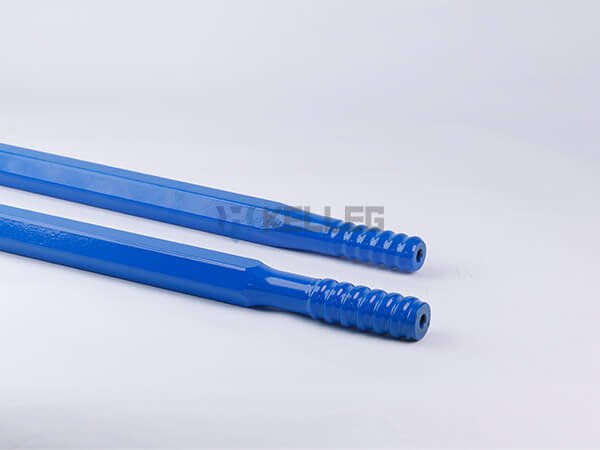
Despite meticulous production processes, manufacturers often face several challenges that can affect the quality and performance of heavy-duty rock drilling tools. Understanding these issues and implementing preventive measures is crucial for delivering reliable products.
Cracks During Heat Treatment #
Heat treatment, particularly carburizing, is critical for achieving the desired surface hardness and core toughness. However, improper temperature control, rapid cooling, or uneven heating can lead to cracks in the drill rod.
Preventive Measures:
- Ensure uniform furnace temperature and controlled heating/cooling rates.
- Use high-quality heat treatment equipment with proper insulation and circulation.
- Implement thorough inspection of rods before and after heat treatment.
Misalignment of Inserts #
Tungsten carbide inserts, such as button bits, must be precisely positioned. Misaligned inserts can cause uneven wear, inefficient energy transfer, and localized stress, reducing the tool’s service life.
Preventive Measures:
- Use precision jigs and fixtures during insert placement.
- Conduct regular inspections to verify alignment and bonding quality.
- Train operators on standardized assembly procedures.
Surface Defects #
Surface defects like scratches, grooves, or roughness can weaken the tool, create stress concentration points, and increase the likelihood of cracking during heat treatment or drilling operations.
Preventive Measures:
- Implement strict machining and finishing quality controls.
- Use shot blasting and polishing to remove minor surface imperfections.
By addressing these common production challenges, manufacturers can significantly improve the reliability, durability, and performance of heavy-duty rock drilling tools, ensuring they meet the demanding conditions of mining, tunneling, and construction projects.
Conclusion #
Heavy-duty rock drilling tools are critical for efficient and reliable operations in mining, tunneling, quarrying, and large-scale construction. Their performance and longevity depend not only on robust design but also on meticulous manufacturing processes, including material selection, forging, machining, heat treatment, and precision assembly.
Quality is influenced by multiple factors—raw material integrity, machining accuracy, heat treatment control, and surface finishing—all of which directly affect the tool’s durability and performance under extreme drilling conditions. Rigorous mechanical testing, field performance evaluation, and adherence to international standards ensure that these tools meet demanding operational requirements.
By understanding and addressing common production challenges, manufacturers can deliver heavy-duty rock drilling tools that offer high reliability, extended service life, and optimal drilling efficiency, ultimately reducing operational costs and enhancing safety on site.