- Introduction
- What Is Drill Rod Material?
- Main Types of Drill Rod Materials
- Key Steel Grades for Drill Rod Manufacturing
- Heat Treatment: The Key to High-Performance Drill Rods
- Drill Rod Material Property Comparison Table
- How to Choose the Best Drill Rod Material for Your Project
- Common Problems Caused by Poor Drill Rod Material
- How Manufacturers Improve Drill Rod Material Quality
- Buying Guide: What to Ask Your Supplier
- Conclusion
Introduction #
Drill rod material is the core factor that determines the strength, toughness, fatigue resistance, and service life of a drill rod. In drilling operations, the material directly affects how efficiently impact energy and torque are transmitted through the drill rod, as well as how well the rod can withstand harsh working conditions without cracking or failure.
The choice of material has a direct impact on drilling performance, influencing energy transfer efficiency, fracture risk, and overall operating cost. Poor material selection can lead to premature wear, thread damage, or even catastrophic rod failure, significantly increasing downtime and maintenance expenses.
Over time, drill rod materials have evolved from basic carbon steels to high-strength alloy steels and micro-alloyed grades, driven by increasing demands for deeper drilling, harder rock formations, and higher drilling efficiency. Modern manufacturing also combines advanced heat treatment processes to further enhance mechanical properties and service reliability.
This article aims to provide a clear understanding of drill rod materials, including common steel types, performance differences, and key selection principles, helping you choose the most suitable material for different drilling applications.
What Is Drill Rod Material? #
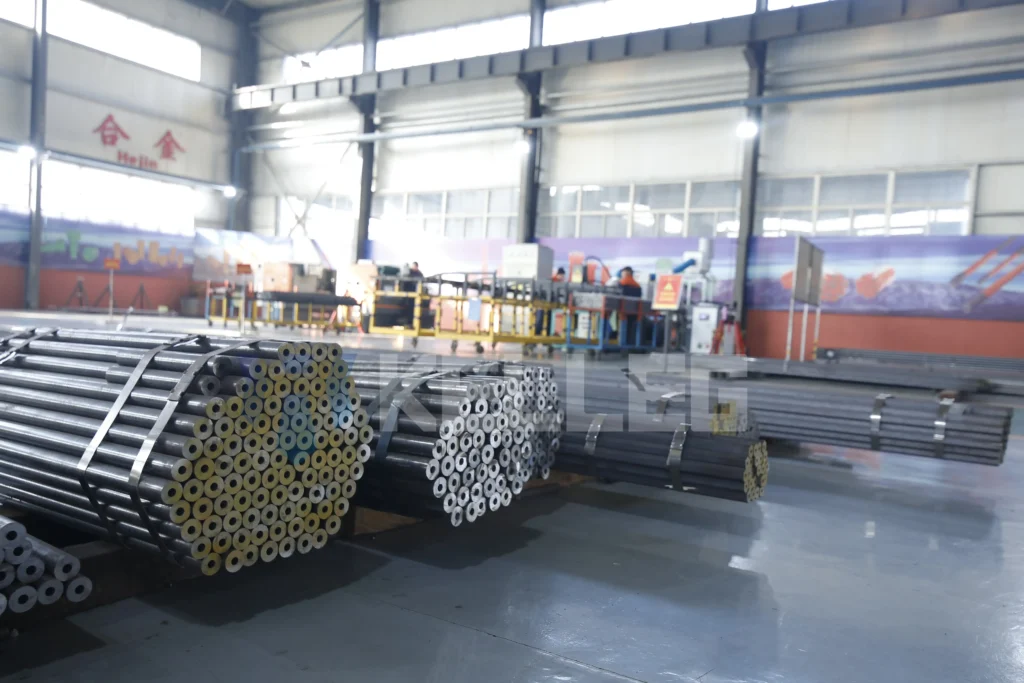
Drill rod material refers to a specially engineered alloy steel used in the manufacturing of drill rods. It is designed with high hardenability, excellent tempering stability, and strong fatigue resistance to ensure reliable performance under extreme drilling conditions.
The primary function of drill rod material is to withstand complex mechanical stresses during drilling operations, including high-frequency impact loads, torsional forces, bending stress, and cyclic fatigue. At the same time, it plays a critical role in transmitting drilling energy efficiently from the drilling rig to the drill bit, while also allowing the circulation of flushing media such as air or water to remove cuttings from the borehole.
A high-quality drill rod material ensures stable energy transfer and structural integrity even in deep-hole or hard rock drilling environments. It must maintain strength while also offering sufficient toughness to prevent brittle failure under repeated impact.
In contrast, poor-quality or improperly selected materials can lead to several serious problems, including:
- Early service failure due to insufficient fatigue resistance
- Crack initiation and propagation under cyclic loading
- Reduced drilling efficiency caused by energy loss along the drill rod
- Thread damage or deformation under high torque conditions
- Increased downtime and higher overall operational costs
Therefore, selecting the right drill rod material is essential for ensuring drilling stability, extending tool life, and maintaining cost-effective performance in demanding mining, tunneling, and construction applications.
Main Types of Drill Rod Materials #
Drill rod materials can be classified from different perspectives, mainly based on manufacturing processes and alloy composition. Each category offers different levels of strength, toughness, and fatigue resistance, making them suitable for different drilling conditions.
Classification by Manufacturing Process #
Seamless steel tube materials #
These are produced through hot-rolling or hot-extrusion processes without welded seams. Seamless structures provide uniform mechanical properties along the entire rod, making them highly reliable under high internal pressure and cyclic loading. They are widely used in high-performance drilling applications due to their consistent strength and reduced risk of weak points.
Forged materials #
Forged drill rod materials are formed under high pressure, which refines the grain structure of the steel and significantly improves toughness and fatigue resistance. Compared with standard rolled materials, forging enhances structural density and impact resistance, making forged rods suitable for heavy-duty mining and deep-hole drilling operations.
Classification by Alloy Type #
Chromium-Molybdenum (Cr-Mo) steel #
Cr-Mo steel is one of the most commonly used alloy systems for drill rods. Chromium improves wear resistance and hardenability, while molybdenum enhances strength at high temperatures and improves fatigue performance. It offers a balanced combination of strength and cost efficiency.
Chromium-Nickel-Molybdenum (Cr-Ni-Mo) steel #
This alloy type provides higher toughness and impact resistance due to the addition of nickel. It is especially suitable for demanding drilling conditions involving high impact energy and variable geological formations.
Low-alloy high-strength steel #
Low-alloy steels are designed to achieve high strength with relatively small amounts of alloying elements. They are widely used in modern drilling tools where both strength and economic efficiency are required.
Common Drill Rod Material Categories #
Carbon steel #
Carbon steel is the most basic material type. It has a lower cost but limited strength and fatigue resistance, making it suitable only for light-duty or shallow drilling applications.
Alloy steel #
Alloy steel is the industry standard for most drilling applications. It offers a good balance between strength, toughness, wear resistance, and cost, making it suitable for mining, tunneling, and quarry drilling.
High-strength micro-alloy steel #
Micro-alloy steels contain small additions of elements such as vanadium, niobium, or titanium. These elements refine grain structure and significantly improve fatigue resistance and overall mechanical performance, making them ideal for deep-hole drilling and high-impact environments.
Key Steel Grades for Drill Rod Manufacturing #
The performance of a drill rod is highly dependent on the selected steel grade and its chemical composition. Different alloy systems are engineered to achieve a balance between strength, toughness, wear resistance, and fatigue life, depending on drilling depth and rock conditions.
Common Alloy Steel Grades #
42CrMo #
42CrMo is one of the most widely used alloy steels in drill rod manufacturing. It offers high strength, good hardenability, and strong fatigue resistance after proper heat treatment. It is suitable for medium to heavy-duty drilling applications such as mining and tunneling.
30CrNiMo / 30NiCrMo series #
This series contains nickel, chromium, and molybdenum, providing a superior combination of toughness and impact resistance. It performs especially well under high-impact and deep-hole drilling conditions where cyclic loading is severe.
35CrMo #
35CrMo is a cost-effective alloy steel with balanced mechanical properties. It provides sufficient strength and toughness for general drilling applications, making it widely used in standard mining and quarry operations.
Why Alloy Composition Matters #
Each alloying element plays a specific role in enhancing drill rod performance:
- Chromium (Cr) → Wear resistance and hardenability
Improves surface hardness and helps the material resist abrasion in harsh rock conditions. - Molybdenum (Mo) → High-temperature strength and fatigue resistance
Enhances stability under repeated impact loads and prevents softening during heat exposure. - Nickel (Ni) → Toughness and impact resistance
Improves the ability of the steel to absorb shock loads without cracking or brittle failure.
Mechanical Properties vs Chemical Composition Mapping #
The relationship between chemical composition and mechanical performance can be summarized as follows:
- Higher Cr content → increased surface hardness → better wear resistance
- Higher Mo content → improved fatigue strength → longer service life in deep drilling
- Higher Ni content → improved toughness → better resistance to impact and fracture
- Balanced alloy ratios → optimized combination of strength + toughness + durability
In practice, drill rod performance is not determined by a single element but by the interaction of the entire alloy system combined with proper heat treatment. This synergy defines the final mechanical properties such as tensile strength, impact toughness, and fatigue life.
Heat Treatment: The Key to High-Performance Drill Rods #
Heat treatment is a critical manufacturing process that determines the final mechanical properties of drill rods, including strength, toughness, hardness, and fatigue resistance. Even when high-quality alloy steel is used, improper heat treatment can significantly reduce performance and lead to premature failure.
Even the best steel grade will fail without proper heat treatment.
Quenching Process #
Quenching is the process of rapidly cooling heated steel to achieve high hardness and strength. In drill rod manufacturing, the steel is heated to a critical temperature and then quickly cooled in oil, water, or polymer solutions.
This process transforms the internal microstructure of the steel, increasing its hardness and load-bearing capacity. However, if not properly controlled, quenching may also introduce internal stress, which must be balanced in later processes.
Tempering Process #
Tempering is performed after quenching to reduce brittleness and improve toughness. The quenched steel is reheated to a lower temperature and then cooled again in a controlled manner.
This step is essential for drill rods because it ensures a balance between hardness and toughness. Without tempering, the rod may be too brittle and prone to cracking under impact loads during drilling operations.
Carburizing (for Surface Hardness) #
Carburizing is a surface hardening process in which carbon is diffused into the outer layer of steel at high temperature. This creates a hard, wear-resistant surface while maintaining a tough and ductile core.
For drill rods, this combination is particularly important because:
- The surface resists abrasion and thread wear
- The core absorbs impact energy and prevents brittle failure
- Overall, the service life is significantly extended in harsh drilling conditions
Heat treatment is not a secondary step but a defining factor in drill rod performance. A well-designed heat treatment process ensures the steel achieves the optimal balance of hardness, toughness, and fatigue resistance required for demanding mining, tunneling, and rock drilling applications.
Drill Rod Material Property Comparison Table #
The performance of different drill rod materials varies significantly in terms of strength, wear resistance, fatigue life, cost, and suitable application scenarios. The table below provides a clear comparison to help understand how each material type performs in real drilling conditions.
| Material Type | Strength | Wear Resistance | Fatigue Life | Cost | Application |
|---|---|---|---|---|---|
| Carbon Steel | Low | Low | Low | Low | Light drilling |
| Alloy Steel | High | Medium | High | Medium | Mining / tunneling |
| Micro-alloy Steel | Very High | High | Very High | High | Deep drilling |
This comparison shows that as material performance improves, cost also increases. In practical applications, the selection should always balance drilling conditions, required service life, and overall project cost efficiency.
How to Choose the Best Drill Rod Material for Your Project #
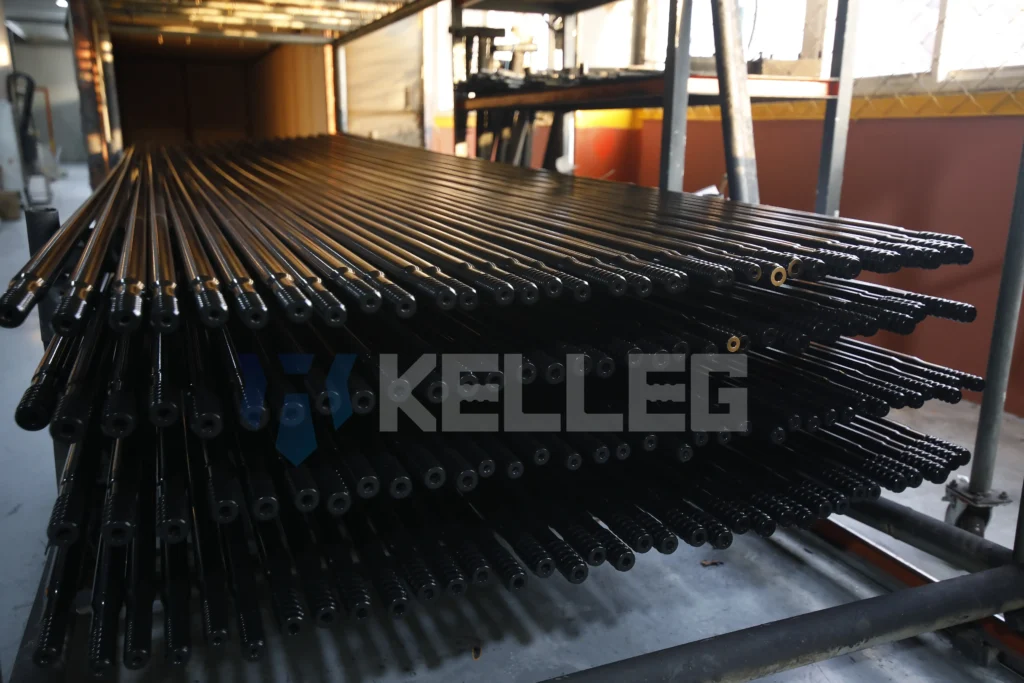
Selecting the right drill rod material is essential for optimizing drilling efficiency, reducing failure risk, and controlling overall project cost. The correct choice should always be based on working conditions, performance requirements, material grade, and quality verification.
Evaluate Working Conditions #
The first step in material selection is to understand the actual drilling environment.
Rock Hardness Conditions #
- Soft rock → standard alloy steel is usually sufficient
- Hard rock → high-strength alloy steel with better wear and impact resistance is required
Drilling Method #
Different drilling methods place different demands on drill rod materials:
- Top hammer drilling → requires high fatigue resistance and impact toughness
- DTH drilling → requires strong wear resistance and stable energy transmission
- Rotary drilling → requires high torsional strength and structural stability
Hole Depth Requirements #
- Shallow holes → standard drill rods with balanced properties
- Deep holes → fatigue-resistant and high-strength materials are essential to prevent failure
Define Key Performance Requirements #
Each project prioritizes different performance characteristics:
- High strength → needed for high load and high torque conditions
- High toughness → critical for impact-heavy drilling environments
- High wear resistance → important in abrasive rock formations
A proper balance of these properties ensures stable and efficient drilling performance.
Match Steel Grade with Heat Treatment Process #
Even the best steel grade cannot perform properly without optimized heat treatment. The combination of material and process determines final performance.
Key considerations include:
- Proper quenching to improve hardness and strength
- Tempering to enhance toughness and reduce brittleness
- Surface hardening (if required) to improve wear resistance
Cost vs Lifespan Balance #
Material selection should not focus only on purchase cost. A lower-cost rod may lead to:
- Shorter service life
- Higher replacement frequency
- Increased downtime costs
In contrast, higher-grade materials often provide better long-term cost efficiency due to extended lifespan and improved reliability.
Verify Quality Documentation #
Reliable suppliers should provide complete quality assurance documentation, including:
- Material certification (steel grade verification)
- Metallographic analysis reports
- Mechanical property test results (strength, hardness, toughness)
- Heat treatment records
These documents ensure that the drill rod material meets engineering and safety requirements before use.
Common Problems Caused by Poor Drill Rod Material #
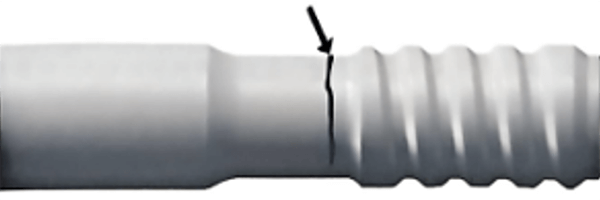
The quality of drill rod material directly determines the reliability and efficiency of drilling operations. When inferior or improperly selected materials are used, a series of performance and safety issues can occur, often leading to unexpected downtime and increased operational costs.
Rod bending #
Insufficient strength or poor heat treatment can cause the drill rod to deform under high axial load or bending stress, especially in deep-hole drilling applications.
Thread failure #
Low-quality material or improper hardness distribution may lead to thread wear, stripping, or cracking under repeated torque loading and coupling/uncoupling operations.
Premature fatigue cracking #
Inadequate fatigue resistance results in crack initiation and propagation under cyclic impact loads, eventually causing sudden rod failure during drilling.
Poor energy transmission #
Substandard material can dampen impact energy transfer from the drilling rig to the drill bit, reducing drilling efficiency and increasing energy loss along the drill rod.
Reduced drilling speed #
Combined effects of deformation, wear, and energy loss directly reduce penetration rate and overall drilling productivity.
Most drilling failures are not equipment-related, but material-related.
This highlights the importance of selecting high-quality, properly heat-treated drill rod materials to ensure stable performance, longer service life, and cost-effective drilling operations in demanding geological conditions.
How Manufacturers Improve Drill Rod Material Quality #
High-performance drill rod materials are not only determined by steel grade selection, but also by advanced manufacturing processes. Leading manufacturers use a combination of metallurgical control, precision forming, machining technology, and heat treatment to ensure consistent quality and long service life.
Vacuum Degassing Steelmaking #
Vacuum degassing is an advanced steel refining process used to remove harmful gases such as hydrogen, oxygen, and nitrogen from molten steel. These gases can form internal defects like porosity and inclusions, which significantly reduce fatigue resistance.
By improving steel cleanliness and internal density, vacuum degassing helps produce drill rod materials with:
- Higher structural integrity
- Improved fatigue life
- Reduced risk of internal cracking
Precision Forging #
Precision forging refines the grain structure of steel under high pressure, improving both strength and toughness. Compared with conventional rolling processes, forging creates a more uniform and dense microstructure.
Key benefits include:
- Enhanced impact resistance
- Better fatigue performance under cyclic loading
- Improved overall mechanical stability
This process is especially important for drill rods used in deep drilling and high-impact mining applications.
CNC Thread Machining #
Threads are one of the most critical stress concentration areas in a drill rod. CNC machining ensures high dimensional accuracy and consistent thread geometry.
Benefits of CNC thread machining include:
- Precise thread engagement and fit
- Reduced stress concentration points
- Improved connection stability under high torque
- Lower risk of thread wear and failure
This directly improves the reliability of drill rod.
Heat Treatment #
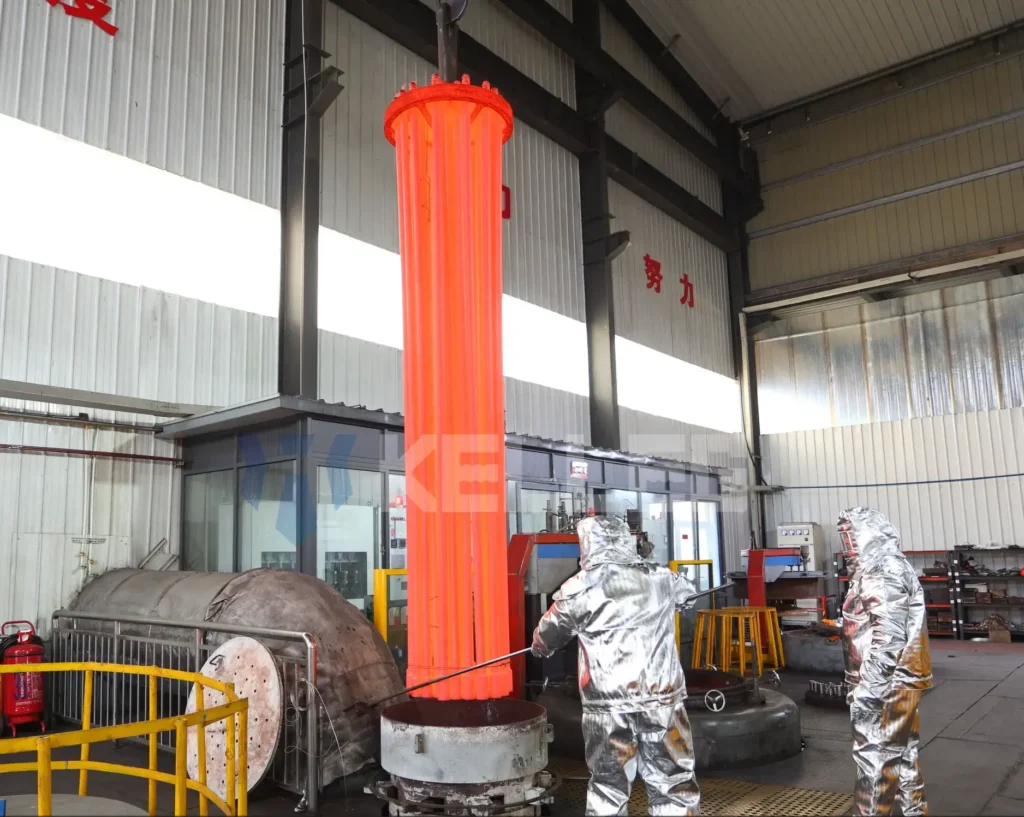
Heat treatment is the final and most critical step in defining the mechanical properties of drill rod material. Through controlled processes such as quenching and tempering, manufacturers can achieve an optimal balance between hardness and toughness.
Proper heat treatment ensures:
- High strength for load-bearing capacity
- Adequate toughness to resist impact fracture
- Improved fatigue resistance for long service life
- Stable performance under harsh drilling conditions
Without precise control of heat treatment, even high-grade steel cannot achieve its intended performance in real drilling environments.
Buying Guide: What to Ask Your Supplier #
Choosing a reliable drill rod supplier involves more than comparing prices. The quality of the material, manufacturing process, and quality control system directly affect the performance and lifespan of the drill rods. Before placing an order, ask your supplier the following key questions to ensure you are purchasing products that meet your project requirements.
What steel grade is used? #
Ask the supplier to specify the exact steel grade used for manufacturing the drill rods, such as 42CrMo, 35CrMo, or 30CrNiMo. A reputable manufacturer should also explain why the selected material is suitable for your drilling application and provide material certificates upon request.
What is the heat treatment process? #
The supplier should clearly describe the heat treatment procedures used, including quenching, tempering, and any additional surface-hardening processes, such as carburizing. Proper heat treatment is essential for achieving the required balance of strength, toughness, and fatigue resistance.
What is the hardness range? #
Hardness is an important indicator of wear resistance and mechanical performance. Ask for the hardness specifications of both the rod body and threaded sections, as well as the testing method used (such as HRC or HB). Consistent hardness indicates stable manufacturing quality.
What fatigue testing standards are followed? #
Since drill rods operate under continuous impact and cyclic loading, fatigue resistance is critical. Ask whether the products have undergone fatigue testing and request supporting test reports or compliance with recognized industry standards. Reliable suppliers should be able to provide documented mechanical testing results.
Can the drill rods match different thread types? #
Verify whether the drill rods are compatible with the thread types used by your drilling equipment. Common thread types include R25, R28, R32, R38, T38, T45, T51, GT60, and other industry-standard connections. Proper thread compatibility ensures efficient energy transfer, secure connections, and easy integration with existing drilling tools.
Additional Questions Worth Asking #
Besides the five key questions above, experienced buyers often ask:
- What quality certifications do you provide (e.g., ISO 9001 or material certificates)?
- Can you provide metallographic analysis and mechanical property reports?
- What quality inspection procedures are performed before shipment?
- Do you offer customized drill rod materials or dimensions for specific projects?
- What warranty or technical support is available after delivery?
By asking these questions, you can evaluate not only the quality of the drill rod itself but also the supplier’s manufacturing capability, quality control system, and technical expertise. Selecting a supplier that provides transparent documentation and comprehensive technical support is often just as important as selecting the right drill rod material.
Conclusion #
Drill rod material is the foundation of drilling performance. It determines the maximum potential strength, toughness, wear resistance, and fatigue life that a drill rod can achieve. However, material alone is not enough. Proper heat treatment is what unlocks these mechanical properties, ensuring the drill rod performs reliably under repeated impact, high torque, and harsh geological conditions.
Ultimately, the best drill rod material depends on the specific application. Factors such as rock hardness, drilling method, hole depth, and operating environment should all be considered when selecting the most suitable steel grade and manufacturing process. A well-matched drill rod not only improves drilling efficiency but also reduces downtime, maintenance costs, and total cost of ownership.
Choosing the right drill rod material is critical for drilling efficiency and cost control. A reliable supplier can help you match the correct material to your geological conditions and drilling method, ensuring maximum productivity, longer tool life, and consistent drilling performance.