- Introduction
- What Are Tungsten Carbide Buttons?
- Key Performance Indicators of Tungsten Carbide Buttons
- Factors That Affect Tungsten Carbide Button Performance
- Common Failure Modes of Tungsten Carbide Buttons
- How to Improve Tungsten Carbide Button Performance
- Applications of Tungsten Carbide Buttons in Rock Drilling Tools
- How to Select High-Quality Tungsten Carbide Buttons
- Conclusion
Introduction #
In modern rock drilling operations, tungsten carbide buttons play a critical role in determining the overall performance of rock drilling tools. These hard metal inserts are mounted on the face of drill bits and are responsible for directly breaking and crushing rock formations during drilling.
Tungsten carbide buttons are widely used in a variety of drilling applications, including mining, quarrying, and tunneling projects. Because they are the primary contact point between the drill bit and the rock, their material properties and structural design have a significant impact on drilling efficiency and tool reliability.
The performance of tungsten carbide buttons can directly influence several key operational factors, such as:
- Drilling penetration rate
- Drill bit service life
- Rock fragmentation efficiency
- Overall drilling cost and productivity
In challenging rock conditions, the difference in carbide button quality can determine whether a drill bit performs efficiently for long periods or fails prematurely.
This raises several important questions for drilling engineers and equipment buyers:
- What factors determine the performance of tungsten carbide buttons?
- How do material composition and button design influence drilling efficiency?
- Why do some drill bits last significantly longer than others in the same rock conditions?
Understanding the performance characteristics of tungsten carbide buttons helps drilling professionals select the right tools and optimize drilling performance in mining, construction, and infrastructure projects.
What Are Tungsten Carbide Buttons? #

Tungsten carbide buttons are extremely hard and wear-resistant inserts used in a wide range of industrial drilling and cutting tools. In rock drilling applications, these buttons are mounted on the face of drill bits and act as the primary contact point between the drilling tool and the rock formation.
Often referred to simply as “carbide buttons”, these components are designed to withstand severe mechanical stress, high impact forces, and abrasive rock conditions. Because of their exceptional durability, tungsten carbide buttons are widely used in rock drilling tools, mining equipment, construction machinery, and oil and gas drilling systems.
Compared with conventional steel components, tungsten carbide buttons offer significantly higher hardness and abrasion resistance. This allows rock drilling tools equipped with carbide buttons to maintain effective rock-breaking performance over long operating periods, even in highly abrasive formations.
In modern drilling systems such as top hammer drilling and down-the-hole (DTH) drilling, tungsten carbide buttons play a critical role in determining drilling efficiency, penetration rate, and tool service life.
Composition of Tungsten Carbide Buttons #
Tungsten carbide buttons are manufactured from a composite material consisting primarily of tungsten carbide (WC) particles bonded together by a metallic binder, most commonly cobalt (Co). This material structure combines the extreme hardness of ceramic carbide with the toughness provided by the metal binder.
The production process typically involves powder metallurgy technology. Tungsten powder and carbon are reacted at high temperature through a process known as carburization to form tungsten carbide. The carbide powder is then mixed with cobalt binder, pressed into the desired shape, and sintered to create a dense and durable carbide insert.
Most tungsten carbide buttons contain carefully controlled tungsten carbide grains embedded in 6% to 25% cobalt binder. The cobalt acts as a cementing phase that holds the carbide particles together, allowing the material to absorb impact energy during drilling operations.
The proportion of cobalt binder directly influences the mechanical properties of the carbide button:
- Lower cobalt content generally results in higher hardness and improved wear resistance, making it suitable for abrasive rock formations.
- Higher cobalt content increases toughness and impact resistance, which helps prevent cracking or breakage under heavy drilling loads.
By adjusting the carbide grain size and cobalt percentage, manufacturers can produce different carbide grades tailored for specific drilling conditions.
Typical Composition Range of Tungsten Carbide Buttons #
| Constituent | Composition by Weight (%) |
|---|---|
| Tungsten (W) | 72.0 – 97.5% |
| Carbon (C) | 0.6 – 6.0% |
| Cobalt (Co) Binder | 3.0 – 25% |
This wide range of possible compositions allows carbide manufacturers to optimize button performance for various drilling environments, from highly abrasive hard rock formations to impact-intensive drilling applications.
Why Tungsten Carbide Is Ideal for Rock Drilling Tools #

The unique microstructure of tungsten carbide provides a combination of properties that are difficult to achieve with conventional materials:
- Extremely high hardness for efficient rock fragmentation
- Excellent wear resistance in abrasive formations
- High compressive strength to withstand drilling pressure
- Strong impact resistance when combined with a cobalt binder
Because of these advantages, tungsten carbide buttons have become the standard cutting elements in modern rock drilling tools, widely used in mining, quarrying, tunneling, and infrastructure construction projects.
Key Performance Indicators of Tungsten Carbide Buttons #
The performance of tungsten carbide buttons in rock drilling tools is determined by several key material and mechanical properties. These properties influence how effectively the buttons can withstand repeated impacts, resist wear, and maintain drilling efficiency in different rock conditions.
Understanding these indicators helps engineers evaluate the quality of carbide inserts and select the most suitable drilling tools for specific applications.
Hardness #
Hardness is one of the most important properties of tungsten carbide buttons. It determines the ability of the insert to resist deformation and abrasion when contacting hard rock surfaces.
Higher hardness generally improves the rock-breaking capability of the drill bit and allows the carbide buttons to maintain their cutting edges for longer periods. However, excessive hardness without sufficient toughness may increase the risk of brittle fracture under high-impact drilling conditions.
Therefore, an optimal balance between hardness and toughness is essential for stable drilling performance.
Toughness #
Toughness refers to the ability of tungsten carbide buttons to absorb energy without cracking or breaking during drilling operations.
In percussion drilling methods such as top hammer or DTH drilling, carbide buttons are exposed to continuous high-frequency impacts. If the toughness of the material is insufficient, the buttons may experience chipping, cracking, or catastrophic failure.
Improving toughness helps carbide buttons withstand repeated impact loads and maintain structural integrity over long drilling cycles.
Wear Resistance #
Wear resistance determines how well tungsten carbide buttons can maintain their shape and size during prolonged drilling operations.
In highly abrasive rock formations, carbide buttons gradually wear down due to constant friction and rock fragmentation. High wear resistance ensures that the buttons retain their cutting geometry, which helps maintain consistent drilling speed and reduces the frequency of drill bit replacement.
Impact Resistance #
Impact resistance is particularly important for rock drilling tools used in percussion drilling systems. During operation, each impact from the rock drill generates a powerful force that is transmitted through the drill bit to the carbide buttons.
High impact resistance allows the buttons to withstand these repeated forces without cracking or breaking. This property is closely related to both the material composition and the manufacturing quality of the carbide inserts.
Thermal Stability #
During high-speed drilling operations, friction between the drill bit and the rock generates heat. Tungsten carbide buttons must maintain their mechanical properties under elevated temperatures.
Good thermal stability prevents softening or structural degradation of the carbide material, ensuring consistent drilling performance even in demanding drilling environments.
Summary of Key Performance Indicators #
| Property | Role in Drilling Performance |
|---|---|
| Hardness | Improves rock-breaking capability and abrasion resistance |
| Toughness | Prevents cracking and brittle fracture under impact loads |
| Wear Resistance | Extends drill bit service life in abrasive formations |
| Impact Resistance | Allows buttons to withstand repeated hammer impacts |
| Thermal Stability | Maintains performance under high drilling temperatures |
Factors That Affect Tungsten Carbide Button Performance #
The performance of tungsten carbide buttons in rock drilling tools is influenced by several key factors, including material composition, carbide grain structure, button geometry, arrangement on the drill bit, and manufacturing technology.
These factors determine how well the carbide buttons can withstand impact loads, resist abrasive wear, and maintain stable drilling performance under different rock conditions.
Understanding these variables helps drilling professionals select the most suitable drill bits and optimize drilling efficiency in mining, quarrying, and construction projects.
Material Composition #
The material composition of tungsten carbide buttons plays a fundamental role in determining their mechanical properties. Most carbide buttons are composed of tungsten carbide (WC) particles bonded with a cobalt (Co) binder.
The ratio between tungsten carbide and cobalt directly affects hardness and toughness.
- Higher tungsten carbide content generally increases hardness and wear resistance, making the buttons suitable for highly abrasive rock formations.
- Higher cobalt content improves toughness and impact resistance, helping the buttons withstand repeated percussion loads during drilling.
Selecting the appropriate composition is essential because different rock formations require different combinations of hardness and toughness.
Grain Size of Tungsten Carbide #
The grain size of tungsten carbide particles significantly influences the mechanical performance of carbide buttons.
- Fine-grain carbide structures typically provide higher hardness and improved wear resistance.
- Coarse-grain carbide structures offer better toughness and resistance to impact damage.
By controlling carbide grain size during the manufacturing process, producers can tailor carbide grades for specific drilling conditions, such as highly abrasive formations or heavy impact drilling environments.
Button Shape and Design #


The shape of tungsten carbide buttons affects how energy is transferred from the drill bit to the rock surface. Different button geometries are designed for specific rock conditions and drilling requirements.
Common button types include:
- Spherical buttons – provide excellent strength and wear resistance, ideal for hard and abrasive rock formations.
- Ballistic buttons – offer faster penetration rates and are suitable for medium-hard rock conditions.
- Conical buttons – designed for aggressive cutting and faster drilling speeds.
- Parabolic buttons – provide a balance between penetration efficiency and durability.
The choice of button shape can significantly influence drilling speed, bit stability, and tool lifespan.
Common Button Shapes and Applications
| Button Shape | Best Application |
|---|---|
| Spherical | Hard and abrasive rock formations |
| Ballistic | Medium-hard rock with higher penetration requirements |
| Conical | Conditions requiring faster penetration |
| Parabolic | Balanced performance across mixed rock formations |
Button Arrangement on the Drill Bit Face #
The arrangement and distribution of carbide buttons on the drill bit face also affect drilling performance.
Proper button placement ensures:
- Efficient rock fragmentation
- Balanced energy distribution
- Improved hole straightness and drilling stability
If the buttons are poorly arranged, drilling efficiency may decrease, and uneven wear can occur, which may shorten the service life of the drill bit.
Engineers typically design button layouts based on drilling diameter, rock hardness, and drilling method (top hammer drilling or DTH drilling).
Manufacturing Technology #
The manufacturing process of tungsten carbide buttons plays a crucial role in ensuring material consistency and structural reliability.
High-quality carbide buttons are typically produced using powder metallurgy technology, which includes several key stages:
- Powder preparation and mixing
- Pressing and forming
- High-temperature sintering
- Precision grinding and finishing
Advanced manufacturing techniques help achieve a dense and uniform microstructure, which reduces internal defects and improves mechanical performance.
Well-controlled production processes can significantly enhance:
- Material density
- Impact resistance
- Wear resistance
- Overall tool service life
As a result, carbide buttons produced with advanced manufacturing technology tend to deliver more consistent performance in demanding drilling applications.
Common Failure Modes of Tungsten Carbide Buttons #
Although tungsten carbide buttons are designed for extreme durability, they are still subject to wear and various types of failure during drilling operations. These failures usually occur due to a combination of high-impact loads, abrasive rock contact, thermal stress, and improper installation.
Understanding the common failure modes of tungsten carbide buttons helps drilling engineers identify performance issues, improve drilling practices, and select more suitable carbide grades for specific rock conditions.
Below are the most common types of tungsten carbide button failures observed in rock drilling tools.
Abrasive Wear #
Abrasive wear is one of the most common and natural forms of failure for tungsten carbide buttons. In many cases, wear occurs gradually without immediate fracture.
During drilling, continuous collision and friction between the carbide button and the rock surface cause progressive material loss. Hard mineral particles in the rock first plow into the relatively softer cobalt binder phase of the carbide structure. As the binder material is worn away, the tungsten carbide (WC) grains lose support and begin to break or detach from the surface.
Under repeated impact from the rock drill, the worn surface area increases and the relative motion between the button and the rock intensifies, which further accelerates wear. Over time, excessive wear reduces the effective cutting geometry of the button and lowers drilling efficiency.
Thermal Fatigue #
Thermal fatigue occurs when carbide buttons are repeatedly exposed to high temperatures followed by rapid cooling during drilling operations.
When drilling at high impact frequency and high rotational speed, the friction between the carbide button and the rock can raise the surface temperature of the button to approximately 700°C. When cooling media such as water suddenly cool the heated surface, rapid temperature changes create large thermal stresses within the carbide material.
Because cemented carbide has relatively low thermal conductivity, these stresses concentrate near the surface. Over time, repeated heating and cooling cycles can initiate microcracks. Once a crack forms in one direction to release part of the stress, additional cracks may form perpendicular to it until the internal stress field is reduced.
Thermal fatigue cracks are usually shallow but can gradually propagate with continued drilling.
Flaking (Surface Spalling) #
Flaking refers to the progressive chipping or detachment of small fragments from the surface of the carbide button. This damage can range from microscopic chipping to large pieces breaking away from the button surface.
Large-scale flaking can significantly shorten the service life of drill bits because it alters the shape and load distribution of the carbide buttons.
Flaking is often related to the material properties of the carbide, particularly the balance between hardness and toughness. Carbide grades with very high hardness but insufficient toughness are more prone to large-scale flaking. In tougher carbide grades, flaking tends to appear as small contact fatigue chips similar to those observed in bearing surfaces.
The size and severity of flaking are influenced by several factors:
- Carbide composition
- WC grain size
- Binder phase distribution
However, flaking is generally not strongly dependent on the rock type being drilled.
Internal Cracks #
Internal cracking is a common cause of early failure in carbide buttons. These fractures originate from microscopic cracks within the carbide material itself, often formed during manufacturing or installation.
During drilling operations, these internal defects act as stress concentration points. Under repeated impact loads from the rock drill, the cracks propagate and eventually cause the carbide button to fracture.
Because this type of failure originates inside the material, it often occurs in the early stages of drill bit operation and is therefore sometimes referred to as early-stage button failure.
Fracture of the Non-Exposed Button Section #
In some cases, a fracture occurs in the non-exposed portion of the carbide button, which is the part embedded inside the drill bit body.
This type of fracture typically produces a relatively smooth fracture surface that is nearly perpendicular to the button axis. The fracture may extend from the upper region of the embedded section down to the bottom of the button hole.
Common causes include:
- Improper button fixing process
- Out-of-round button holes
- Poor interference fit between the button and the bit body
- Excessive tensile stress concentrated at a specific point
If cracks already exist within the carbide button cylinder, these stresses can easily trigger a fracture in the embedded section.
Shear Fracture #
Shear fracture is relatively difficult to detect because the drill bit may continue operating even after the fracture occurs.
In this failure mode, the fracture surface appears irregular and often occurs at an angle relative to the axis of the carbide button. Areas with sharp edges or geometric stress concentration are particularly susceptible to shear failure.
Shear fractures can significantly reduce the service life of drill bits because the damaged button may continue to operate in a compromised condition before the failure becomes visually noticeable.
Careful inspection of the fracture surface is usually required to confirm this failure mode.
Surface Cracks #
Surface cracking occurs on the exposed working surface of the carbide button and often develops in areas where compressive stress is highest during rock breaking.
These cracks are difficult to identify at an early stage because the initiation point is usually very small. In many cases, surface cracking may be mistaken for normal wear.
The formation of surface cracks is influenced by several factors, including:
- Drill bit head design
- Button placement on the bit face
- Drilling parameters and impact energy
- Rock structure and hardness
Over time, these cracks may propagate and eventually lead to chipping or partial fracture of the carbide button.
How to Improve Tungsten Carbide Button Performance #
The performance and service life of tungsten carbide buttons depend not only on material quality but also on proper tool selection, drilling parameters, and maintenance practices. By optimizing these factors, drilling operators can significantly improve drilling efficiency, reduce tool wear, and extend the lifespan of rock drilling tools.
Below are several practical strategies commonly used in mining, quarrying, and construction drilling operations to improve tungsten carbide button performance.
Choose the Right Button Type for Rock Conditions #
Selecting the appropriate carbide button shape and grade for the specific rock formation is one of the most effective ways to improve drilling performance.
Different button geometries are designed to handle different drilling conditions:
- Spherical buttons provide excellent durability and are suitable for hard and abrasive rock formations.
- Ballistic buttons offer higher penetration rates and are commonly used in medium-hard rock conditions.
- Conical or parabolic buttons balance drilling speed and wear resistance in mixed formations.
Matching the button type to the rock hardness, abrasiveness, and drilling method helps ensure efficient energy transfer and reduces the risk of premature button failure.
Optimize Drilling Parameters #
Proper drilling parameters play a crucial role in protecting carbide buttons from excessive stress and abnormal wear.
Key parameters that should be carefully controlled include:
Rotation Speed #
Excessively high rotation speed can increase friction between the carbide buttons and the rock, leading to accelerated wear and higher operating temperatures. Maintaining an appropriate rotation speed helps stabilize drilling performance.
Impact Energy and Pressure #
Impact pressure from the rock drill directly affects how force is transmitted to the carbide buttons. If the impact force is too high, it may cause button cracking or flaking. Proper adjustment ensures efficient rock breaking while minimizing stress on the carbide inserts.
Balanced drilling parameters help maintain stable contact between the drill bit and the rock, which improves both penetration efficiency and tool service life.
Use High-Quality Drill Bits and Carbide Materials #
The quality of tungsten carbide buttons and the manufacturing precision of the drill bit significantly influence overall performance.
High-quality drill bits typically feature:
- Optimized carbide grades for specific drilling environments
- Uniform carbide grain structure
- Strong bonding between the button and the drill bit body
- Precise button placement and geometry
Working with reliable manufacturers ensures that carbide buttons meet strict quality standards, which helps reduce the risk of premature failure and improves drilling reliability.
Perform Regular Tool Inspection #
Routine inspection of rock drilling tools helps detect early signs of button wear, cracking, or damage before severe failure occurs.
Common maintenance practices include:
- Checking button wear and shape deformation
- Inspecting for cracks or flaking on button surfaces
- Monitoring drill bit alignment and button exposure
- Replacing worn drill bits before excessive damage occurs
Regular inspection not only extends the life of tungsten carbide buttons but also helps maintain consistent drilling performance and hole quality.
Key Takeaway #
Improving tungsten carbide button performance requires a combination of proper tool selection, optimized drilling parameters, high-quality materials, and regular inspection. When these factors are carefully managed, drilling operations can achieve higher penetration rates, longer tool life, and lower overall drilling costs.
Applications of Tungsten Carbide Buttons in Rock Drilling Tools #
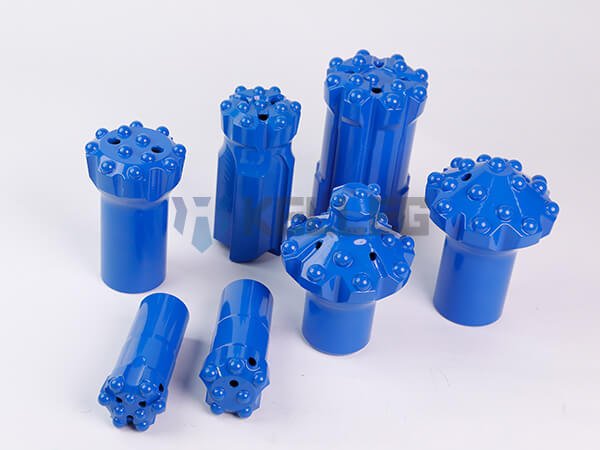
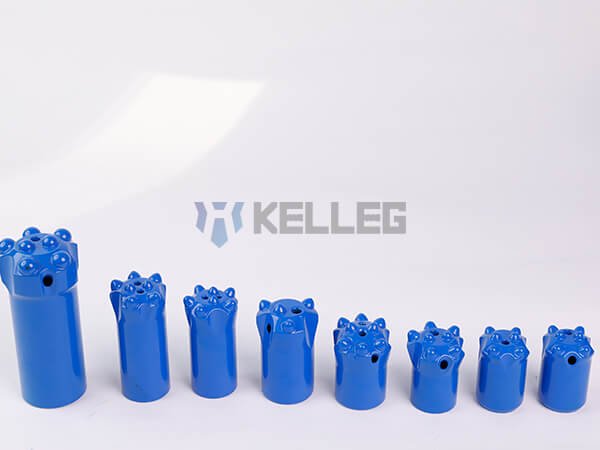
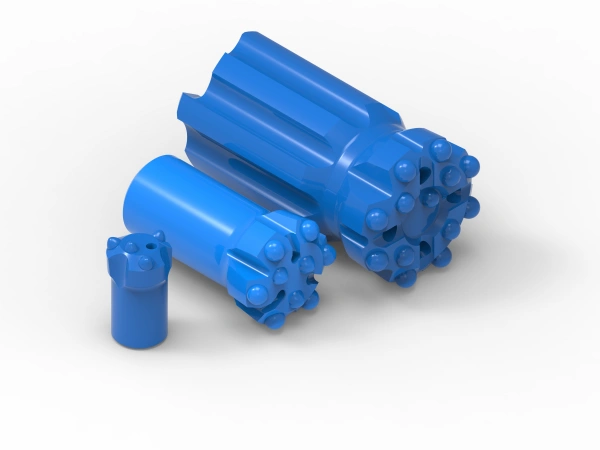
Tungsten carbide buttons are widely used in industries that require tools capable of operating under extreme wear, impact, and abrasive conditions. Thanks to their exceptional hardness and durability, these carbide inserts are essential components in many drilling, cutting, and excavation tools.
In rock drilling applications, tungsten carbide buttons serve as the primary cutting elements that directly interact with the rock surface. Their ability to withstand repeated impacts and abrasive contact makes them indispensable in industries such as construction, mining, and oil and gas exploration.
Major Industry Applications #
| Industry | Common Applications |
|---|---|
| Construction | Road planing tools, piling equipment, tunneling tools, and button bits used for infrastructure development and foundation drilling |
| Mining | Drill bits for mining exploration, crushing tools, grinding components, excavating teeth, and wear-resistant inserts for heavy mining equipment |
| Oil and Gas | DTH drilling tools, wireline equipment, logging instruments, and wear-resistant components used in high-pressure subsurface environments |
Rock Drilling Applications #

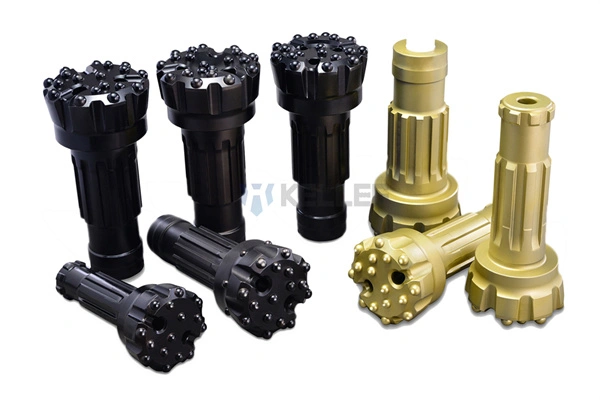

In the rock drilling industry, tungsten carbide buttons are primarily used in the following tools:
- Top hammer drill bits
- DTH (Down-the-Hole) drill bits
- PDC bits
- Cutting picks
These tools rely on carbide buttons to deliver high-impact energy to the rock surface, enabling efficient rock fragmentation and faster penetration rates.
Why Tungsten Carbide Buttons Are Ideal for These Applications #
The widespread use of tungsten carbide buttons across multiple industries is mainly due to their unique performance advantages:
- Exceptional hardness and wear resistance
- High compressive strength
- Excellent impact resistance
- Long service life in abrasive environments
Because of these properties, tungsten carbide buttons have become a standard wear-resistant component in modern rock drilling tools, helping improve drilling efficiency and reduce operational costs in demanding industrial applications.
How to Select High-Quality Tungsten Carbide Buttons #
Selecting high-quality tungsten carbide buttons is essential for ensuring reliable drilling performance and long service life of rock drilling tools. Because carbide buttons are the primary components responsible for rock breaking, their quality directly affects drilling efficiency, tool durability, and overall operating costs.
When evaluating tungsten carbide buttons for rock drilling tools, engineers and procurement professionals should consider several key factors.
Material Grade and Composition #
The carbide grade is one of the most important indicators of carbide button quality. Different grades are designed for different drilling conditions and rock formations.
High-quality tungsten carbide buttons typically feature:
- Carefully controlled tungsten carbide (WC) grain size
- Optimized cobalt binder content
- Uniform microstructure for consistent mechanical properties
For example:
- Lower cobalt content usually provides higher hardness and better wear resistance for abrasive rock formations.
- Higher cobalt content improves toughness and impact resistance for heavy percussion drilling environments.
Selecting the correct carbide grade ensures that the buttons can balance hardness, toughness, and durability during drilling operations.
Button Shape and Design #
The geometry of the carbide button plays a significant role in drilling efficiency and wear behavior.
Common button shapes include:
- Spherical buttons – ideal for hard and abrasive rock conditions due to their superior strength and wear resistance.
- Ballistic buttons – designed to deliver higher penetration rates in medium-hard rock formations.
- Conical or parabolic buttons – used when both drilling speed and durability are required.
A well-designed button shape improves energy transfer, drilling stability, and rock fragmentation efficiency.
Manufacturing Quality #
The manufacturing process has a major influence on the performance and reliability of tungsten carbide buttons.
High-quality carbide buttons are produced using advanced powder metallurgy technology, which ensures:
- High material density
- Minimal internal defects
- Consistent grain distribution
- Precise button dimensions
Strict quality control during pressing, sintering, and finishing processes helps prevent defects such as internal cracks or structural weaknesses that may lead to premature failure.
Supplier Reliability and Technical Support #
Choosing a reliable supplier is another important factor when selecting tungsten carbide buttons. Experienced manufacturers typically provide:
- Stable material quality and consistent carbide grades
- Advanced manufacturing capabilities
- Technical guidance for tool selection and drilling conditions
- Proven performance in mining and construction applications
Working with an established supplier can significantly reduce operational risks and ensure consistent drilling performance.
Additional Factors to Consider #
When sourcing tungsten carbide buttons for rock drilling tools, it is also helpful to evaluate the following aspects:
- Quality certifications to verify manufacturing standards
- Material testing reports, such as hardness and microstructure analysis
- Field performance data from real drilling applications
These indicators help confirm whether the carbide buttons can perform reliably under demanding drilling conditions.
Key Takeaway #
High-quality tungsten carbide buttons combine optimized material composition, precise button design, advanced manufacturing technology, and reliable supplier support. Careful evaluation of these factors helps ensure longer tool life, improved drilling efficiency, and reduced overall drilling costs.
Conclusion #
Tungsten carbide buttons are critical components in modern rock drilling tools. Their performance directly determines drilling efficiency, tool durability, and overall operating costs in demanding environments such as mining, quarrying, construction, and oil and gas exploration.
The performance of carbide buttons depends on several key factors, including material composition, carbide grain structure, button design, manufacturing quality, and drilling conditions. Understanding these factors helps drilling engineers and equipment buyers select the most suitable carbide buttons for specific rock formations and operational requirements.
In addition, recognizing common failure modes—such as abrasive wear, thermal fatigue, flaking, and cracking—can help operators improve drilling practices and extend the service life of drill bits.
For drilling contractors and mining companies, selecting high-quality tungsten carbide buttons and reliable rock drilling tools is essential for achieving stable performance and long-term operational efficiency. Working with experienced manufacturers that provide optimized carbide grades and precision manufacturing can significantly improve drilling productivity and reduce maintenance costs.
As drilling technologies continue to evolve, advanced carbide materials and improved button designs will play an increasingly important role in enhancing the performance and reliability of rock drilling tools across a wide range of industrial applications.