- Introduction
- What is the best type of drill bit for hard rock?
- Which rock drill bit works best for granite or basalt?
- How do I choose the right button shape for hard rock?
- Why does my drill bit wear out too quickly in hard rock?
- How can I increase drilling speed in hard rock?
- What is the most cost-effective drill bit for hard rock?
- When should I use DTH bit instead of top hammer drill bit?
- How important is flushing in hard rock drilling?
- What are the signs that I am using the wrong drill bit?
- Should I choose a standard or customized drill bit?
- Conclusion
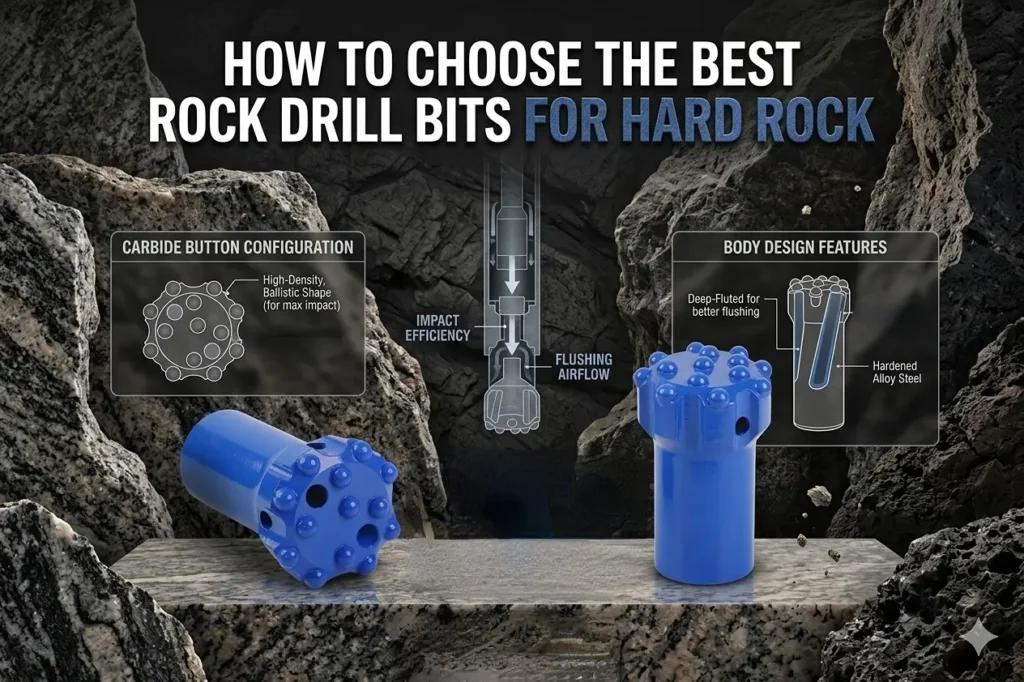
Introduction #
Choosing the right rock drill bit for hard rock drilling can be challenging, especially when dealing with formations like granite, basalt, or quartzite. Different drilling methods, rock conditions, and performance expectations all influence the final decision.
This FAQ guide answers the most common questions from engineers, contractors, and buyers. It focuses on practical selection tips, performance optimization, and cost control—helping you quickly identify the best drill bit solution for your specific application.
What is the best type of drill bit for hard rock? #
There is no single “best” drill bit for all hard rock conditions.
- For shallow drilling → Top hammer bits
- For deep and straight holes → DTH drill bits
- For highly abrasive rock → Button bits with durable carbide
The best choice depends on drilling depth, rock hardness, and required hole accuracy.
Which rock drill bit works best for granite or basalt? #
Granite and basalt are typically hard and abrasive.
- Spherical button bits are the most reliable option
- Flat or concave face designs improve stability
- High-grade carbide is essential for durability
These configurations help reduce wear and prevent premature failure.
How do I choose the right button shape for hard rock? #
Button shape directly affects drilling speed and lifespan.
- Spherical → best for durability and hard rock
- Ballistic → faster penetration but lower durability
- Parabolic → good balance for abrasive conditions
For most hard rock applications, durability should be prioritized over speed.
Why does my drill bit wear out too quickly in hard rock? #
Rapid wear is usually caused by operational or selection issues:
- High abrasiveness (quartz content)
- Poor flushing is causing regrinding
- Excessive rotation speed
- Incorrect carbide grade
Optimizing drilling parameters and bit design can significantly extend lifespan.
How can I increase drilling speed in hard rock? #
To improve penetration rate:
- Match impact energy with rock hardness
- Reduce RPM in very hard formations
- Ensure efficient cutting removal
- Maintain stable feed pressure
Efficiency gains often come from system optimization, not just the bit itself.
What is the most cost-effective drill bit for hard rock? #
The most economical choice is based on cost per meter drilled, not unit price.
- Longer-lasting bits reduce replacement frequency
- Stable performance minimizes downtime
- Faster drilling improves productivity
A higher upfront cost can result in lower overall project cost.
When should I use DTH bit instead of top hammer drill bit? #
- Use Top hammer bit for shallow and flexible drilling
- Use DTH bit for deep, straight, and high-precision holes
In hard rock, DTH bit is often preferred for deeper applications due to better energy efficiency.
How important is flushing in hard rock drilling? #
Flushing is critical for both performance and tool life.
- Removes cuttings from the hole bottom
- Prevents regrinding and overheating
- Improves penetration efficiency. Poor flushing can drastically reduce both speed and bit lifespan.
What are the signs that I am using the wrong drill bit? #
Common indicators include:
- Low penetration rate
- Uneven or excessive wear
- Frequent button breakage
- Hole deviation
These issues usually indicate a mismatch between the bit design and rock conditions.
Should I choose a standard or customized drill bit? #
- Standard bits work for general conditions
- Customized bits perform better in specific or extreme environments
For challenging hard rock projects, customization often delivers better efficiency and lower long-term cost.
Conclusion #
Selecting the right rock drill bit for hard rock is not about choosing a single product—it’s about finding the best match between rock conditions, drilling method, and performance goals.
By understanding key factors such as button shape, drilling parameters, and cost efficiency, you can significantly improve productivity while reducing operational risks.
For more details, please read How to Choose the Best Rock Drill Bits for Hard Rock.