Introduction #
In top hammer drilling tools, the drill rod plays a critical role in transmitting impact energy, torque, and rotation from the drilling rig to the drill bit. As one of the core components in the drilling tools, its performance directly determines drilling efficiency, penetration rate, and overall operational cost.
Among various types of drill rods, extension rods and MF (Male-Female) rods are the two most commonly used solutions in top hammer drilling applications. They are typically distinguished by the internal and external thread configuration of the rod ends, which affects how they connect, extend, and perform under different drilling conditions.
This naturally raises an important question for operators and project engineers:
MF rods vs extension rods — Which one is the better choice for your drilling application?
The decision is not always straightforward. In real drilling conditions, users often face practical challenges such as energy loss during transmission, thread wear caused by repeated connections, and increased operational costs due to frequent rod replacement or maintenance. These issues make the selection of the right drill rod a key factor in improving productivity and reducing total drilling cost.
What Are MF Rods? #
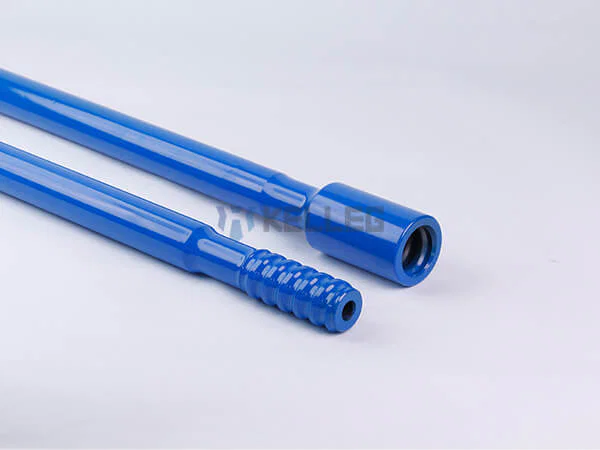
MF rods (Male-Female rods) are widely used drill rods in top-hammer drilling, designed to improve connection efficiency and energy transmission.
Structure & Design #
An MF rod features a male (external) thread at one end and a female (internal) thread at the other. This integrated connection design eliminates the need for separate coupling sleeves, allowing rods to be directly connected.
Typical Specifications #
- Thread types: R32 / T38 / T45 / T51 MF rods
- Length range: 610 mm – 6400 mm
- Compatible with most top hammer drilling rigs and standard thread types
Key Advantages #
- Higher energy transmission efficiency: Fewer connection interfaces reduce energy loss during impact transfer
- Stronger connection stability: Direct rod-to-rod contact improves rigidity and alignment
- Lower vibration: Helps maintain smoother drilling and reduces deviation
- Faster handling: Quicker installation and dismantling, improving overall productivity
Limitations #
- Length constraints per rod: Less flexible
- Higher initial cost: Manufacturing complexity and integrated design increase unit price
Typical Applications #
MF rods are particularly suitable for:
- Long-hole drilling where straightness and stability are critical
- High-precision drilling operations
- Projects requiring minimal hole deviation and consistent performance
What Are Extension Rods? #
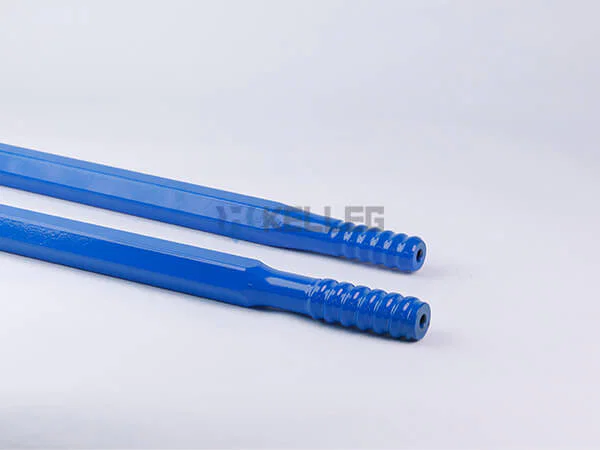
Extension rods are one of the most commonly used drill rods in top hammer drilling, known for their flexibility and adaptability in a wide range of drilling applications.
Structure & Design #
An extension rod is a drill rod with external (male) threads on both ends. Unlike MF rods, extension rods require coupling sleeves to connect multiple rods. This structure allows operators to extend the drilling string to the required length by adding more rods as needed.
Typical Specifications #
- Thread types: R32 / T38 / T45 / T51
- Length range: 915 mm – 6095 mm
Structural Features #
- Connection Method: Multiple rods are connected using coupling sleeves
- Unlimited extension capability: Rod length can be adjusted freely based on drilling depth
- Flexible configuration: Suitable for varying drilling conditions and project requirements
Key Advantages #
- High flexibility in length: Easily adapt to different hole depths
- Lower initial cost: Individual rods are typically less expensive than MF rods
- Convenient on-site assembly: Easy to transport, replace, and extend during operation
Limitations #
- Higher energy loss: Additional connections reduce impact energy transfer efficiency
- Increased vibration and wear: More joints can lead to instability during drilling
- Connection point risks: Couplings are more prone to thread wear and potential failure
Typical Applications #
Extension rods are widely used in:
- Step drilling operations
- Anchor bolt drilling
- Oil and gas-related drilling
- Long-hole drilling projects
- Small-diameter hole drilling
MF Rods vs Extension Rods: Key Differences #
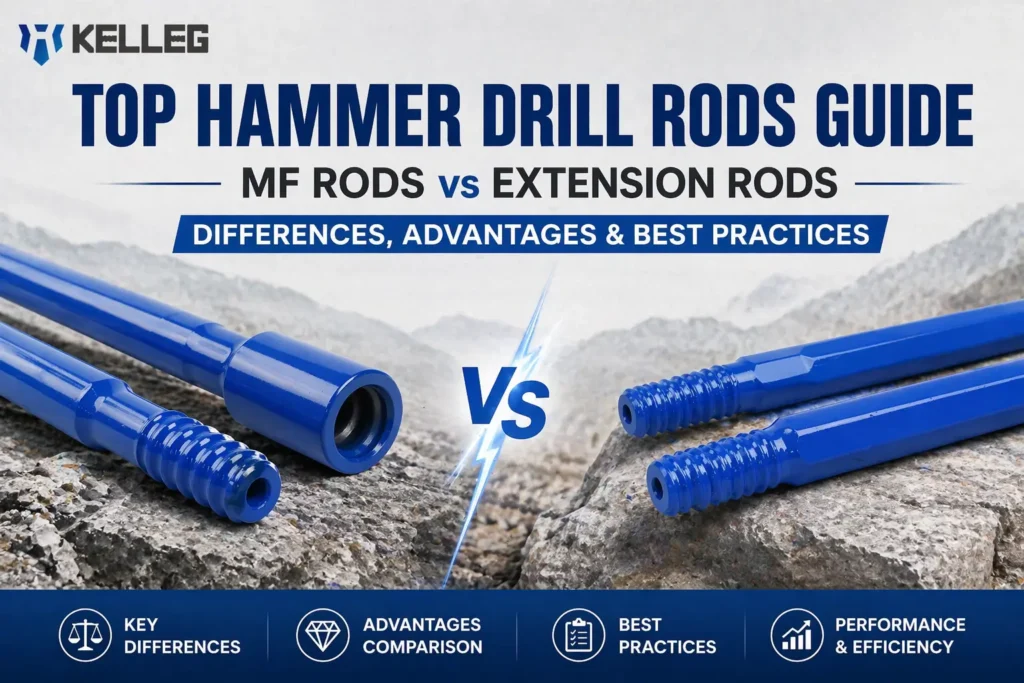
To make a clear and practical selection, the comparison below is based on real-world drilling performance. This table helps engineers and operators quickly identify which rod type fits their specific application.
| Parameter | MF Rods | Extension Rods |
|---|---|---|
| Structure | male (external) thread on one end and a female (internal) thread on the other end | external (male) threads on both ends |
| Energy Transmission Efficiency | Higher (minimal energy loss) | Medium (energy loss at each connection) |
| Connection Strength & Vibration | Excellent (no extra joints) | Moderate (couplings may loosen, more vibration) |
| Length Flexibility | Medium (fixed rod lengths) | Maximum (can be extended freely) |
| Installation / Removal Speed | Faster | Slightly slower |
| Initial Cost | Higher | Lower |
| Long-Term Cost | Lower | Higher (couplings wear out faster) |
| Typical Thread Types | T38 / T45 / T51 | R32 / T38 / T45 / T51 |
How to Choose Between MF Rods and Extension Rods #
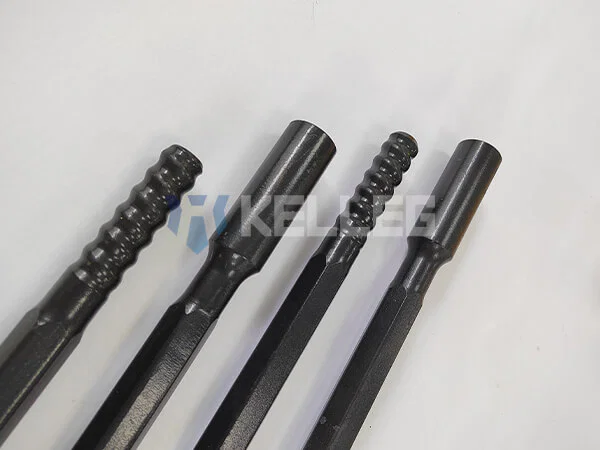
Choosing the right drill rod is not just a product decision—it directly impacts drilling efficiency, tool life, and total project cost. Below is a practical decision workflow + field-proven checklist to help you make the right choice.
Drill Rig Power (Impact Energy & Torque) #
- High-power rigs → Prefer MF rods (better energy transfer, less loss across connections)
- Low to medium power rigs → Extension rods are sufficient
Why it matters: More connections = more energy loss. MF rods preserve impact energy better.
Target Hole Depth #
- <20–30 m → Extension rods (flexible & cost-effective)
- 15–40 m or deeper → MF rods (more stable, less deviation)
Rock Conditions #
- Hard & abrasive rock → MF rods (higher rigidity, reduced vibration, longer thread life)
- Soft to medium rock → Extension rods (cost-efficient, performance sufficient)
Budget & Maintenance Capability #
- Limited upfront budget → Extension rods
- Focus on long-term cost / low downtime → MF rods
Hidden cost tip: Coupling sleeves wear faster than rods.
5-Step Quick Selection Checklist #
Use this checklist for fast decision-making:
- Is your drilling depth over 30 meters? → Choose MF rods
- Is your rock hard or highly abrasive? → Choose MF rods
- Do you want to minimize energy loss and vibration? → Choose MF rods
- Do you need a flexible rod length on-site? → Choose Extension rods
- Is your budget limited upfront? → Choose Extension rods
Compatibility Matters: Avoid Costly Mismatches #
Correct thread matching across the drilling system is critical. Always ensure compatibility between:
- Shank Adapters
- Threaded Drill Bits
- Coupling Sleeves (for extension rods)
- Drill Rods (MF or Extension)
Key rule:
Thread types must match exactly (e.g., T38 with T38, T45 with T45).
Mismatch can lead to:
- Thread damage
- Energy loss
- Connection failure
- Increased downtime
Common Mistakes & How to Avoid Them #
Choosing based only on price
→ Leads to higher long-term costs due to wear and downtime
Ignoring drilling depth
→ Using extension rods in deep holes increases energy loss significantly
Mixing incompatible thread systems
→ Causes rapid thread failure
Overlooking coupling sleeve quality
→ Low-quality couplings wear faster than rods
Not considering rock abrasiveness
→ Leads to premature wear and unstable drilling
Field Testing & Validation Recommendations #
Before large-scale deployment, it’s highly recommended to run a trial test and monitor key performance indicators:
- Energy transmission efficiency → Observe impact performance and penetration consistency
- Penetration rate (ROP) → Compare drilling speed under the same conditions
- Thread wear condition → Inspect after drilling cycles (especially connections/couplings)
- Vibration stability → Check hole straightness and deviation
Pro tip:
Run MF rods vs extension rods side-by-side in the same formation to get the most reliable comparison.
Conclusion #
In most top hammer drilling applications, MF rods offer clear advantages in energy transmission efficiency, drilling stability, and long-term cost control, making them the preferred choice for demanding conditions and deeper holes.
On the other hand, extension rods remain a practical solution where flexibility in rod length is required, especially in variable-depth or cost-sensitive projects.
Ultimately, there is no universal “better” option—the right choice depends on your specific drilling conditions, equipment, and operational priorities. By selecting the appropriate drill rod, you can significantly improve drilling performance, reduce wear-related issues, and achieve better overall project efficiency.