- Introduction
- Understanding Threaded Rock Drill Bits
- R Thread: Sizes, Geometry, Advantages & Limitations
- T Thread (Trapezoidal Thread): Sizes, Geometry, Advantages & Limitations
- How to Choose the Right Threaded Rock Drill Bit
- Common Problems and How to Avoid Them in Threaded Rock Drill Bits
- How to Choose a Reliable Supplier for Threaded Rock Drill Bits
- Conclusion
Introduction #
Threaded rock drill bits are essential tools in modern rock drilling operations, especially for top-hammer drilling. These drill bits are connected to drill rods through threaded joints, allowing flexible assembly and efficient energy transfer during drilling. This design makes them ideal for a wide range of applications, from surface quarrying to underground mining and tunneling.
Among all thread standards, R threads (R22, R25, R28, R32, R38) and T threads (T38, T45, T51) are the most commonly used in top-hammer threaded rock drill bits.
When the drilling diameter increases and operations involve medium- to deep-hole drilling—whether in underground mines or open-pit environments—threaded drilling tools become the preferred choice. They offer better adaptability, stronger connections, and improved drilling stability.
However, selecting the wrong threaded rock drill bit for your specific rock conditions can lead to serious issues, including rapid wear, low penetration rates, frequent bit failure, and increased overall drilling costs. Factors such as rock hardness, abrasiveness, drilling parameters, and thread compatibility all play a critical role in performance.
In this guide, we will walk you through everything you need to know about threaded rock drill bits—from types and thread standards to expert selection tips—so you can improve drilling efficiency and avoid costly mistakes.
Understanding Threaded Rock Drill Bits #
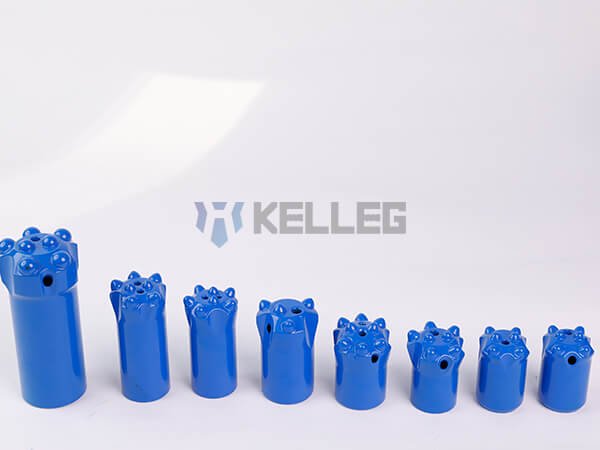
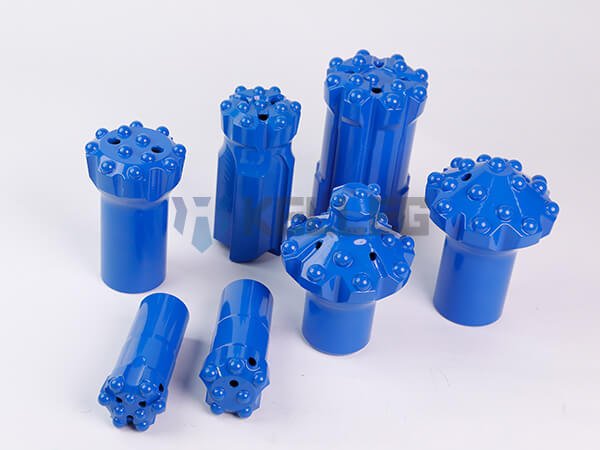

Threaded rock drill bits are essential components of top-hammer drilling tools, designed to efficiently break rock formations through a combination of impact and rotation. They are widely used in mining, quarrying, tunneling, and construction drilling operations due to their durability, flexibility, and high drilling efficiency.
What Are Threaded Rock Drill Bits? #
Threaded rock drill bits are rock drilling tools connected to drill rods via standardized threaded connections, such as R thread or T thread. Unlike integral drill steel, threaded bits are replaceable wear parts, making them more cost-effective and adaptable to different drilling conditions.
Key characteristics:
- Replaceable drilling consumable
- Suitable for a wide range of hole diameters and rock formations
- Designed for high-energy impact drilling environments
Working Principle: How Threaded Drill Bits Transfer Energy #
The performance of threaded rock drill bits depends on the efficient transfer of impact energy and rotational force from the drilling rig to the rock surface.
- Impact Energy Transfer: The rock drill’s piston generates high-frequency percussive blows. These impacts are transmitted through the drill rod to the bit face, where carbide buttons fracture the rock.
- Rotational Movement: The drilling rig applies torque, rotating the bit continuously to ensure uniform hole formation and efficient cuttings removal.
- Role of Threaded Connection: The threaded connection is not only a mechanical but also a critical energy transmission interface. It ensures:
- Stable torque transmission
- Reduced energy loss during drilling
- Secure coupling under high-impact conditions
In simple terms:
The quality of the threaded connection directly affects drilling efficiency, stability, and service life.
Main Components of Threaded Rock Drill Bits #
A typical threaded rock drill bit consists of three key structural parts:
Skirt Body (Bit Body) #
The skirt body is the main structural foundation of the drill bit, manufactured from high-strength alloy steel and heat-treated for maximum durability. It provides:
- Structural support under high impact loads
- Resistance to fatigue and deformation
- Long service life in harsh drilling conditions
Carbide Buttons #
Carbide buttons are the primary rock-breaking elements embedded on the bit face. They are made of tungsten carbide and come in different shapes, such as spherical, ballistic, and conical.
Their performance directly influences:
- Penetration rate (ROP)
- Wear resistance
- Resistance to breakage in hard rock
Flushing Holes #
Flushing holes are designed to deliver air or water through the bit face during drilling. Their functions include:
- Removing drilled cuttings from the bottom of the hole
- Preventing re-grinding of rock debris
- Cooling the bit to reduce wear and overheating
R Thread vs T Thread: Similarities and Key Differences #
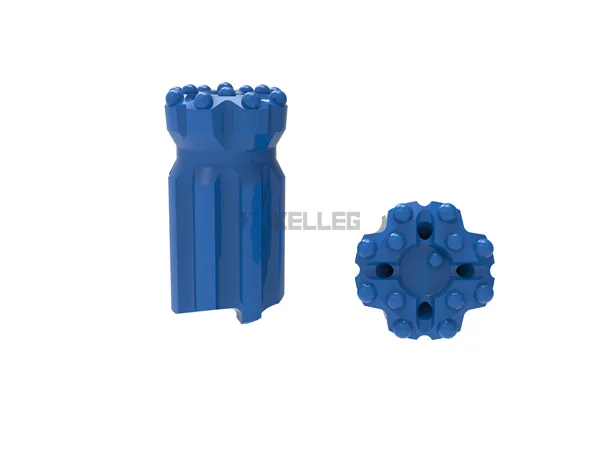
Similarities #
Both R-thread and T-thread systems are widely used in top hammer drilling applications and serve the same fundamental purpose:
- Connecting drill rods and drill bits securely
- Transmitting impact and rotational energy
- Supporting efficient rock breaking in mining and construction drilling
Key Differences #
| Feature | R Thread | T Thread |
|---|---|---|
| Thread Type | Rope thread | Trapezoidal thread |
| Common Sizes | R25, R28, R32, R38 | T38, T45, T51 |
| Diameter | 32mm-127mm | 60mm-152mm |
| Typical Applications | Drifting and Tunneling, Bench Drilling, Tube Drilling | Bench Drilling, Tube Drilling |
Choosing the correct thread type is critical for maximizing drilling efficiency, reducing tool wear, and improving overall project cost-effectiveness.
R Thread: Sizes, Geometry, Advantages & Limitations #
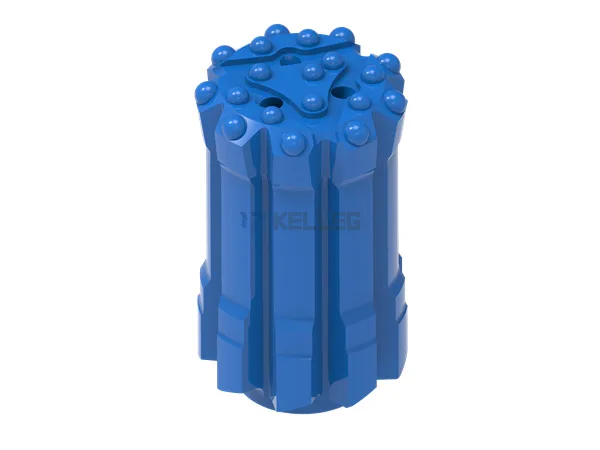
R Thread (Rope Thread) is one of the most widely used threaded types in top hammer rock drilling tools, especially for light to medium-duty drilling applications. It is commonly found in mining, quarrying, and construction drilling, where flexibility and cost efficiency are important.
Typical R Thread Sizes #
R thread comes in several standard sizes, designed to match different drilling requirements and rod diameters:
R25 Thread Button Bits #
- R25 Button Bits, Normal Skirt
- Diameter: 38-51mm
R28 Thread Button Bits #
- R28 Button Bits, Normal Skirt
- Diameter: 38-51mm
R32 Thread Button Bits #
- R32 Button Bits, Normal Skirt
- Diameter: 41-76mm
R38 Thread Button Bits #
- R38 Button Bits, Normal Skirt
- Diameter: 64-89mm
Among them, R32 is the most popular and widely used specification.
Geometrical Characteristics of R Thread #
R thread features a “rope-style” thread profile**, which is designed for ease of assembly and stable energy transmission.
Key geometric characteristics include:
- Thread profile (rope-shaped design): Reduces stress concentration and improves fatigue resistance.
- Shallower thread depth compared to T thread: Allows faster coupling and easier disassembly.
- Smaller contact surface area: Designed for moderate torque and impact loads.
- Compact structure: Suitable for smaller rod diameters and lighter drilling rigs.
Overall, R thread geometry prioritizes flexibility, ease of use, and medium-load performance.
Advantages of R Thread #
R thread remains widely used due to its practical benefits in many drilling environments:
- Easy to assemble and disassemble. Faster rod handling improves overall drilling efficiency.
- Good compatibility with light to medium drilling rigs. Ideal for smaller or less powerful top hammer systems.
- Flexible application range. Suitable for shallow holes, medium rock conditions, and general-purpose drilling.
- Widely available globally (especially R32). Strong standardization ensures easy sourcing and replacement.
Limitations of R Thread #
Despite its popularity, R-thread also has limitations in high-demand drilling environments:
- Reduced resistance in very hard or highly abrasive rock. Faster wear under extreme conditions.
- Limited suitability for high-power drilling rigs. May not fully utilize high-impact energy systems.
- Not recommended for very deep or large-diameter holes. Stability decreases as drilling depth and load increase.
R thread, especially R32, is the most commonly used threaded type for general-purpose top hammer drilling. It offers a strong balance between efficiency, cost, and versatility, but it is best suited for medium-duty drilling conditions rather than extreme deep-hole applications.
T Thread (Trapezoidal Thread): Sizes, Geometry, Advantages & Limitations #
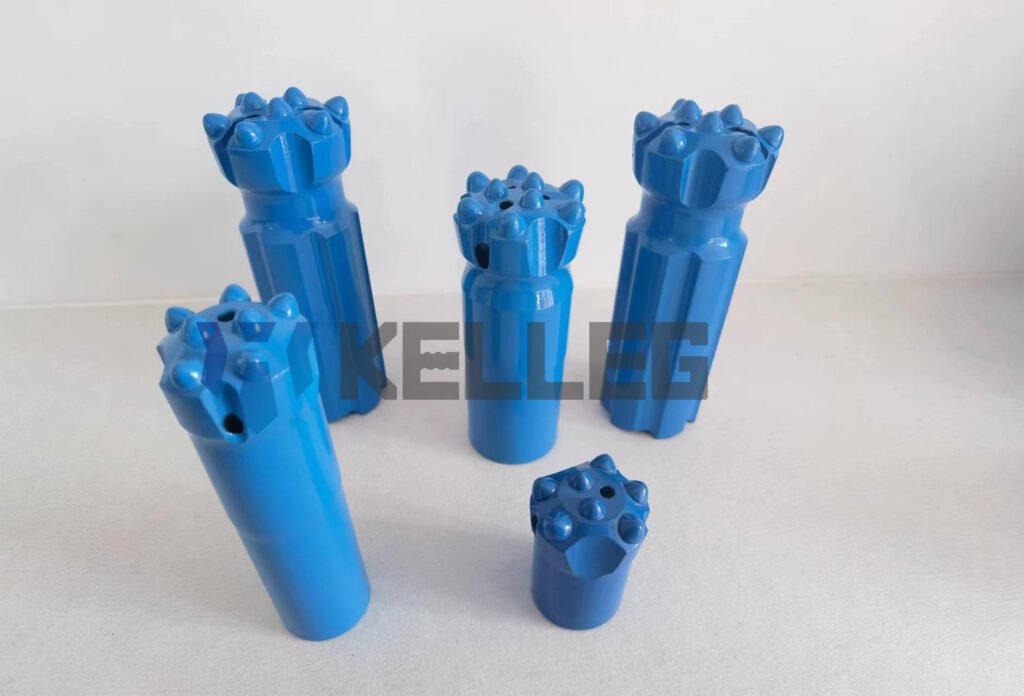
T Thread (Trapezoidal Thread), the basic dimensions and button profile of T-threads, mainly referring to the corporate standards of each company, but the dimensions and button profile of each company are almost the same. Therefore, the drill bits have high interchangeability in the industry. Compared with R-thread, T-thread is designed for higher torque transmission and stronger impact resistance.
Typical T Thread Sizes #
T-thread is commonly used in high-performance drilling systems with larger bit diameters and stronger rigs. The most widely used specifications include:
T38 Thread Button Bits
- T38 Button Bits, Normal Skirt
- Typical bit diameter: 64–89 mm
T45 Thread Button Bits
- T45 Button Bits, Normal Skirt
- Typical bit diameter: 76–127 mm
T51 Thread Button Bits
- T51 Button Bits, Normal Skirt
- Typical bit diameter: 89–127 mm
As thread size increases (T38 → T45 → T51), load capacity, torque resistance, and hole diameter range also increase.
Geometrical Characteristics of T Thread #
T-thread features a trapezoidal thread profile, engineered for strength and stability under high stress conditions.
Key geometric characteristics include:
- Trapezoidal thread shape with flat load-bearing surfaces. Provides better torque transmission and reduced stress concentration.
- Deeper and stronger thread engagement. Increases connection stability under high-impact drilling.
- Larger contact surface area compared to R-thread. Improves load distribution and reduces thread wear.
In essence, T-thread geometry is optimized for strength, stability, and heavy-duty performance.
Advantages of T Thread #
T-thread types offer significant benefits in demanding drilling environments:
- High load-bearing capacity. Suitable for high-impact and high-torque drilling rigs.
- Excellent performance in hard rock conditions. Better resistance to wear and mechanical stress.
- Improved connection stability. Reduces risk of thread failure in drilling.
- Longer service life under heavy-duty use. More durable in high-frequency impact environments.
Limitations of T-Thread #
Although T-thread is stronger, it also has certain trade-offs:
- Higher cost compared to R thread types. More material and machining precision are required.
- Not ideal for lightweight or portable rigs.
- Less suitable for small hole drilling.
T-thread is the preferred choice for high-performance and heavy-duty top hammer drilling applications, especially in medium-to-large hole drilling. Among them, T45 is the most widely used standard.
How to Choose the Right Threaded Rock Drill Bit #
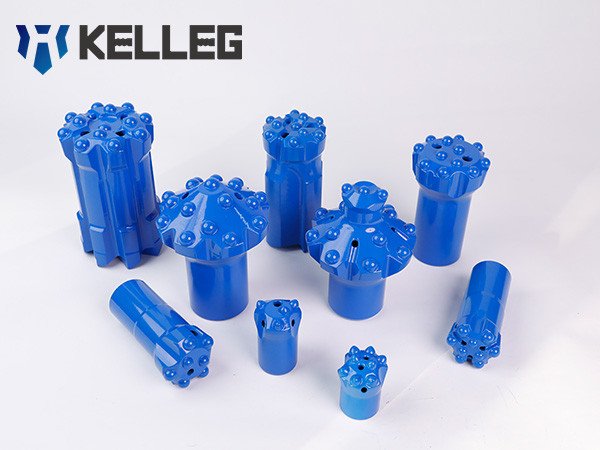
Selecting the correct threaded rock drill bit is critical for maximizing drilling efficiency, reducing tool wear, and lowering overall project cost. The right choice depends on rock conditions, drilling system parameters, and equipment compatibility.
Based on Rock Hardness #
Rock hardness directly determines the required bit design, carbide grade, and impact resistance.
Soft Rock #
- Requires a higher penetration rate
- Use faster-cutting bit designs
- Focus on drilling speed over extreme wear resistance
Medium Hard Rock #
- Balanced conditions
- Standard button bit configurations (spherical or ballistic buttons)
- Most general mining and tunneling applications fall here
Hard Rock #
- Requires stronger carbide buttons and a reinforced bit body
- Prefer spherical buttons for durability and impact resistance
Very Hard Rock #
- Extremely high wear and impact loads
- Emphasis on strength and service life rather than speed
Based on Rock Abrasiveness #
Abrasiveness determines how quickly the bit wears during drilling.
Low Abrasiveness Rock #
- Slower wear rate
- Standard carbide grade is sufficient
- Focus on penetration efficiency
High Abrasiveness Rock #
- Rapid tool wear is common
- Requires higher-grade tungsten carbide
- Stronger bit body and optimized flushing are essential
Even moderately hard rock can cause severe wear if it is highly abrasive.
Based on Drilling Method (Top Hammer Parameters) #
Threaded rock drill bits must match the performance characteristics of the top hammer drilling rigs:
Key parameters include:
- Impact energy
- Rotation speed (RPM)
- Feed force
- Air or water flushing capacity
Based on Cost Efficiency (Initial Cost vs Service Life) #
Cost selection should not only consider purchase price but also total drilling cost:
Lower initial cost #
- Suitable for short-term or light-duty projects
- Lower investment but shorter service life in harsh conditions
Higher durability #
- Higher upfront cost
- Longer lifespan and fewer bit changes
- Lower cost per meter in demanding conditions
Best practice: evaluate cost per drilled meter, not unit price.
Thread Compatibility Considerations (Critical) #
Proper matching of drilling system components is essential to avoid failure or thread damage.
Ensure compatibility between:
- Rock Drill bit (thread type: R or T)
- Drill rod (thread type: R or T)
- Coupling sleeve
- Shank adapter
Common risk: Mismatched threads can cause slippage, thread stripping, or connection failure
Always verify:
- Thread type consistency (R-to-R or T-to-T only)
- Correct size matching (e.g., R32 with R32 drilling tools)
Practical Decision-Making Process #
A practical selection logic used in field applications:
- Drilling rig power (impact energy & torque capacity)
- Required hole diameter and depth
- Expected torque and stress level on the connection
- Select appropriate thread type (R Thread vs T Thread)
Common Problems and How to Avoid Them in Threaded Rock Drill Bits #
Even high-quality threaded rock drill bits can experience performance issues if operating conditions, drilling parameters, or maintenance practices are not properly controlled. Below are the most common problems, their root causes, and practical solutions.
Bit Wears Too Fast #
Problem:
The drill bit shows rapid wear on the face, skirt body, or carbide buttons, significantly reducing service life.
Main Causes:
- High rock abrasiveness without using a wear-resistant carbide grade
- Incorrect button type selection (e.g., using ballistic buttons in hard rock)
- Excessive rotation speed or improper feed pressure
- Poor flushing efficiency, causing re-grinding of cuttings
Solutions:
- Select higher-grade tungsten carbide for abrasive formations
- Match button type to rock conditions (spherical for hard rock)
- Optimize drilling parameters (reduce RPM, adjust feed force)
- Improve flushing system (air or water pressure adjustment)
Buttons Fall Off (Button Loss) #
Problem:
Carbide buttons detach from the bit body during operation, leading to sudden performance failure.
Main Causes:
- Excessive impact energy beyond design limits
- Poor brazing or manufacturing quality
- Severe vibration due to a mismatched thread system or a loose connection
- Drilling in fractured rock with unstable impact loading
Solutions:
- Use appropriate thread type (R or T) based on rig power
- Ensure correct drilling parameter settings (avoid overloading impact energy)
- Choose reliable heat treatment and brazing quality from supplier
- Inspect and tighten threaded connections regularly
Hole Deviation (Drilling Accuracy Loss) #
Problem:
The drilled hole deviates from the intended direction or alignment.
Main Causes:
- Worn or uneven button layout on bit face
- Incorrect face design selection for rock conditions
- Unstable feed pressure or misaligned drilling setup
- Loosely threaded connections are causing vibration
Solutions:
- Replace worn bits promptly to maintain face symmetry
- Select correct face type (e.g., drop center for straight holes)
- Ensure proper rig alignment before drilling
- Maintain tight and stable threaded connections
Low Drilling Speed (Poor Penetration Rate) #
Problem:
Penetration rate is significantly lower than expected, reducing overall productivity.
Main Causes:
- Incorrect bit selection for rock hardness
- Excessive wear of carbide buttons
- Inadequate flushing leading to re-crushing of cuttings
- Mismatch between drill rig power and bit type
Solutions:
- Match bit design to rock hardness and abrasiveness
- Replace worn bits in time
- Improve air/water flushing efficiency
- Ensure proper matching between rig power and thread system (R vs T)
Most threaded rock drill bit problems are not caused by a single factor, but by a mismatch between rock conditions, drilling parameters, and tool selection. By optimizing bit type, thread system, and operating conditions, drilling efficiency can be significantly improved while reducing tool failure and overall cost per meter.
How to Choose a Reliable Supplier for Threaded Rock Drill Bits #
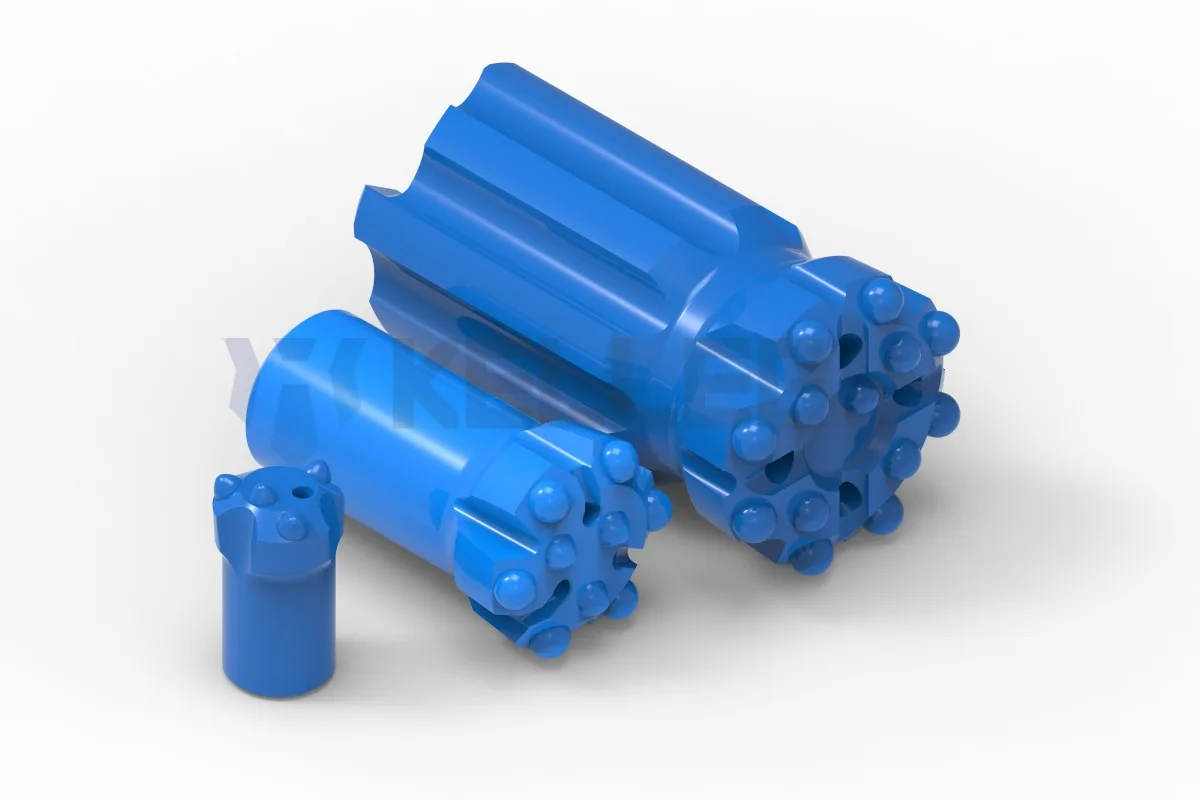
Choosing a reliable supplier is just as important as selecting the right threaded rock drill bit. A high-quality supplier ensures consistent performance, longer tool life, and lower overall drilling costs by controlling every stage of production—from raw materials to final inspection.
Material Quality (Steel Body + Tungsten Carbide) #
Material quality is the foundation of drilling performance.
Steel Body Material #
High-strength alloy steel is essential for resisting impact fatigue and deformation under high-frequency drilling conditions.
Tungsten Carbide Buttons #
The performance of carbide buttons directly affects penetration rate and wear resistance. High-quality carbide ensures:
- Better hardness-to-toughness balance
- Improved resistance to cracking and chipping
- Longer service life in hard and abrasive rock
Reliable suppliers always use stable, traceable raw material sources.
Heat Treatment Capability #
Heat treatment determines the mechanical strength and fatigue resistance of the drill bit body.
Key indicators of a strong supplier:
- Controlled carburizing and hardening processes
- Stable hardness across the bit body (not over-hardened or brittle)
- Improved resistance to impact and cyclic loading
Poor heat treatment often leads to premature cracking or button loss.
CNC Machining Precision #
High-precision CNC machining ensures correct geometry and consistent performance.
Why it matters:
- Accurate thread profiles (R or T thread)
- Proper button positioning for optimal rock breaking
- Improved flushing hole alignment for efficient debris removal
- Reduced vibration during drilling
Even small machining errors can significantly reduce drilling efficiency and tool life.
Compatibility with Major Brands #
A professional supplier should ensure full compatibility with globally recognized drilling tools.
This includes:
- R thread types (R25, R32, R38)
- T thread types (T38, T45, T51)
- Compatibility with major top hammer rigs and drill rod systems
Compatibility ensures flexibility in replacement and global usability.
OEM & Customization Capability #
A reliable manufacturer should offer flexible production options:
- OEM branding support
- Customized bit design (face type, button layout, flushing holes)
- Special solutions for different rock formations
- Tailored thread and diameter combinations
This is especially important for distributors and engineering contractors with specific project needs.
Delivery Time & Production Stability #
In mining and construction projects, downtime is costly.
A strong supplier should provide:
- Stable production capacity
- Short and predictable lead times
- Consistent batch-to-batch quality
- Reliable global shipping support
Technical Support & Application Guidance #
Beyond manufacturing, technical support is a key differentiator.
A professional supplier should offer:
- Drill bit selection guidance based on rock conditions
- Troubleshooting support for field problems
- Drilling parameter recommendations (RPM, feed pressure, flushing)
- Long-term application optimization advice
A reliable threaded rock drill bit supplier is not just a product provider, but a technical partner. The best suppliers combine high-quality materials, advanced manufacturing processes, strict quality control, and strong application support to help customers achieve higher drilling efficiency and lower total cost per meter.
Conclusion #
Threaded rock drill bits play a critical role in the performance, efficiency, and overall cost of top hammer drilling operations. A correct understanding of bit types, thread types, and application conditions is essential for achieving stable and productive drilling results.
To summarize the key takeaways:
- Proper selection leads to higher efficiency and lower drilling costs. Choosing the right threaded rock drill bit directly improves penetration rate, extends tool life, and reduces downtime and consumable consumption.
- Different rock formations require matched drilling parameters and bit designs. Soft, medium, hard, and highly abrasive rock conditions demand different carbide grades, button shapes, and thread types (R or T) to ensure optimal performance.
- Choosing a reliable supplier is a critical decision, not just a purchasing choice. A qualified supplier ensures consistent material quality, precise manufacturing, stable heat treatment, and professional technical support—helping you achieve better drilling results in real applications.
Ultimately, the performance of threaded rock drill bits depends on a system-level match between rock conditions, drilling equipment, and product quality. When these factors are properly aligned, operators can achieve faster drilling speed, longer service life, and significantly lower total project costs.